
When a brand-name drug loses its patent, a generic version can hit the market - and suddenly, the price drops by 70% or more. That’s not just a coincidence. It’s the result of a system designed to save billions every year. The FDA doesn’t just approve drugs; it unlocks massive cost savings for patients, insurers, and the entire U.S. healthcare system. But how much do those savings actually add up to each year? And why do some years show $7 billion in savings while others dip below $1 billion?
How the FDA Measures Generic Drug Savings
The FDA doesn’t track total spending on all generics. Instead, it focuses on one specific thing: the savings generated in the first 12 months after a new generic drug is approved. This method isolates the impact of each new market entry. When a generic version of a brand-name drug like Lipitor or Humira hits shelves, the FDA compares the price of the brand before approval to the price of the generic after launch - and calculates how much money was saved based on how many pills were sold.
This isn’t just theoretical. In 2019, the FDA recorded $7.1 billion in savings from just 17 new generic approvals. That year, a handful of high-demand drugs lost patent protection all at once. One of them, the cholesterol drug Crestor, alone saved consumers over $1.5 billion in its first year as a generic. These numbers aren’t averages - they’re real dollar amounts pulled from pharmacy sales data.
But here’s the catch: not every year is like 2019. In 2020, savings dropped to just $1.1 billion. Why? Because no blockbuster drugs lost their patents that year. The system isn’t steady - it’s lumpy. Savings spike when big drugs go generic. They flatline when they don’t. That’s why looking at a single year can be misleading. You need to see the pattern over time.
Year-by-Year Breakdown: FDA Data (2018-2022)
Here’s what the numbers actually look like for new generic approvals:
- 2018: $2.7 billion in savings from first-time generic approvals
- 2019: $7.1 billion - the highest single-year total in over a decade
- 2020: $1.1 billion - a sharp drop due to few patent expirations
- 2021: $1.37 billion - modest recovery, led by five major drugs
- 2022: $5.2 billion - a major rebound, driven by approvals in large therapeutic markets
These figures come from the FDA’s Office of Generic Drugs. The 2022 surge wasn’t random. It included generics for drugs used to treat diabetes, heart disease, and autoimmune conditions - all with millions of users. One approval alone, for a generic version of the rheumatoid arthritis drug Enbrel, saved an estimated $1.2 billion in its first year.
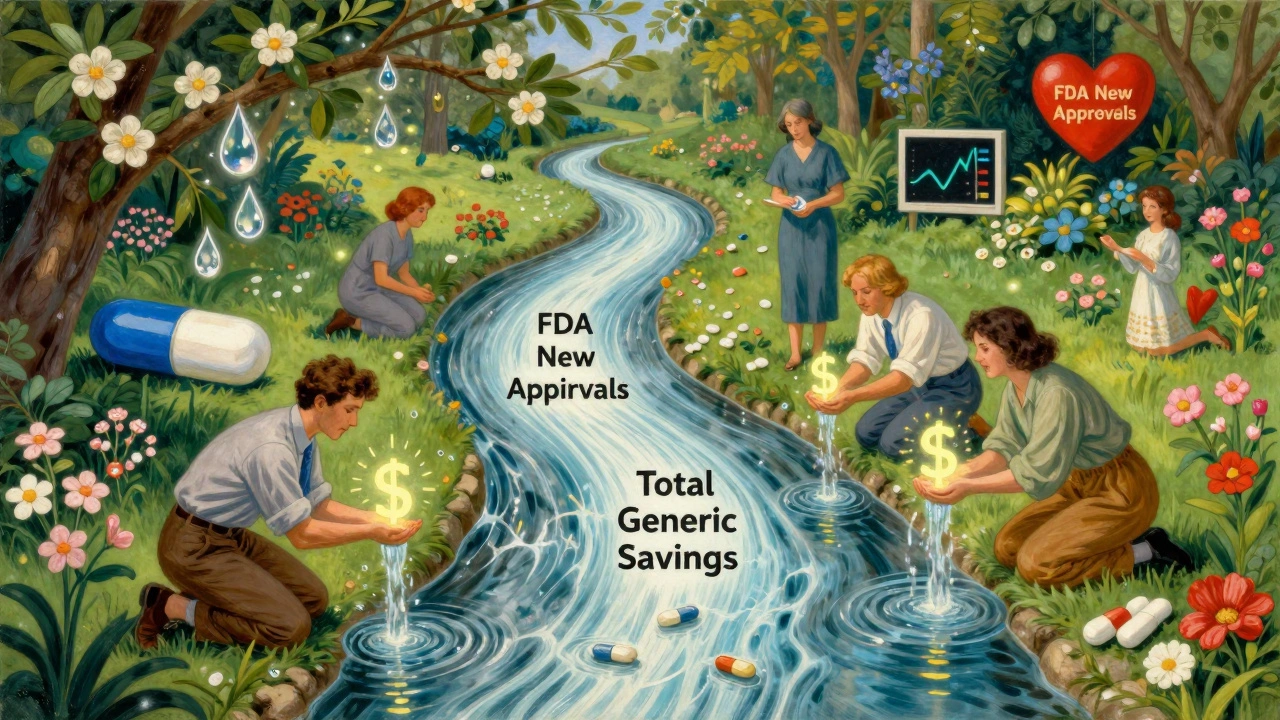
But the FDA doesn’t stop there. They also track total savings from all generic approvals - including those for drugs that already had generics on the market. In 2022, 742 generic applications were fully approved. Together, they generated $18.9 billion in savings during their first year. That’s nearly four times the savings from first-time generics alone. Why? Because when a second or third generic enters a market, prices drop even further. Two generics competing can slash prices by 90% compared to the original brand.
Total Generic Savings: The Bigger Picture
If you only look at the FDA’s numbers, you’re seeing the tip of the iceberg. The real story comes from the Association for Accessible Medicines (AAM), which calculates total savings from every generic drug sold in a year - not just the new ones.
In 2023, generics saved the U.S. healthcare system $445 billion. That’s not a typo. $445 billion. For context, that’s more than the entire annual budget of the Department of Education. It’s also more than the combined GDP of 150 countries.
Here’s how that money breaks down:
- Medicare: $137 billion saved - $2,672 per beneficiary
- Commercial insurers: $206 billion saved - 48% of total savings
- Medicaid: $102 billion saved
Therapeutic areas show where the biggest savings are happening:
- Heart disease: $118.1 billion
- Mental health: $76.4 billion
- Cancer: $25.5 billion
And the savings aren’t just national. California saved $38 billion in 2023. Alaska saved $354 million. Even small states saw hundreds of millions in savings. That’s because generics are used in nearly every prescription - 90% of all prescriptions filled in the U.S. are generic. But they cost just 13.1% of what brand-name drugs do.
Why the Gap Between FDA and AAM Numbers?
It’s easy to get confused. One source says $5 billion. Another says $445 billion. Which one’s right?
Both. They’re measuring different things.
The FDA looks at the immediate financial impact of each new generic approval - what happens in the first year after a drug enters the market. The AAM looks at the total annual savings from all generics currently in use. The FDA’s $5.2 billion in 2022 is a subset of the AAM’s $445 billion. The AAM number includes every generic pill sold since 2010, 2015, 2020 - all the way up to 2023.
Think of it like this: The FDA tracks new cars hitting the road. The AAM tracks how much gas all cars on the road are using. One tells you how fast the fleet is growing. The other tells you how much fuel is being saved overall.
Who Really Benefits?
Patients pay less. That’s the goal. But not everyone feels the full benefit.
On average, a generic prescription costs $6.97 out-of-pocket - compared to $140 for the brand-name version. Most generics are priced at $20 or less. For people on fixed incomes, that’s life-changing. A diabetic patient paying $400 a month for insulin before generics might pay $30 after. That’s not a discount - it’s survival.
But here’s the problem: Pharmacy benefit managers (PBMs) often pocket most of the savings. A 2023 Senate investigation found that only 50-70% of the price drop from generics actually reaches the patient. The rest gets absorbed in rebates, fees, and complex pricing deals between drugmakers, insurers, and PBMs.
State Medicaid programs have seen the clearest benefits. California’s Medi-Cal program saved $23.4 billion in one year. Texas saved $18.9 billion. These aren’t theoretical gains - they’re dollars that kept clinics open, expanded coverage, and reduced state spending.
What’s Next? The Future of Generic Savings
More drugs are losing patents every year. By 2030, over 20 major brand-name drugs - including Humira, Enbrel, and Keytruda - will have generics or biosimilars on the market. The FDA has approved 59 biosimilars as of August 2024, and that number is climbing. Biosimilars aren’t exact copies like traditional generics, but they’re close enough to cut prices by 30-70%.
Projected savings are staggering. The AAM estimates cumulative savings from generics and biosimilars will reach $3.9 trillion between 2014 and 2028. That means annual savings could hit $500 billion by the end of the decade.
But challenges remain. Brand manufacturers are using legal tricks - like patent thickets and REMS restrictions - to delay generic entry. Some drugs are too complex to copy easily. And with specialty drugs becoming more common, the path to low-cost alternatives is getting harder.
The FDA’s 2023 Drug Competition Action Plan is trying to fix this. They’re speeding up reviews, cracking down on delays, and pushing for faster approval of complex generics. If it works, savings won’t just keep growing - they’ll grow faster.
Why This Matters
Generic drugs aren’t just cheaper versions of brand-name drugs. They’re the reason millions of Americans can afford their prescriptions. They’re the reason hospitals can treat more patients. They’re the reason insurance premiums don’t skyrocket.
Every time a generic is approved, it’s not just a regulatory win - it’s a financial lifeline. The $7.1 billion saved in 2019 didn’t just come from a few big drugs. It came from thousands of people who could finally afford their blood pressure medication. From parents who didn’t have to choose between insulin and groceries. From retirees who kept their prescriptions instead of skipping doses.
The numbers are huge. But the real impact? It’s personal. And it’s happening every single day.
alaa ismail
December 2, 2025 AT 07:28Man, I had no idea generics saved that much. My dad’s on a bunch of meds and he pays like $15 a month now instead of $300. Life-changing stuff.
ruiqing Jane
December 2, 2025 AT 09:06The FDA’s methodology is actually brilliant-focusing on first-year savings isolates the true impact of market entry. It eliminates the noise of long-term price erosion and gives policymakers a clean metric to evaluate regulatory efficiency. Without this granular lens, we’d be blind to the explosive, episodic nature of cost reduction in pharmaceuticals.
Fern Marder
December 4, 2025 AT 07:50So like… $445 BILLION?? 😳 That’s more than my student loan debt AND my car AND my rent for the next 10 years. Gen Z needs to know this. 🤯💊
Allan maniero
December 5, 2025 AT 06:26It’s fascinating how the structure of the market creates these lumpy savings patterns-when a blockbuster goes generic, it doesn’t just lower prices, it triggers a cascade of competition. Second and third entrants drive prices even lower, often below 10% of the original brand. This isn’t just about access-it’s about systemic price discovery, and the FDA’s data shows how effectively competition can be engineered through regulation.
Girish Padia
December 5, 2025 AT 15:03They say generics save money but PBMs still rip us off. Why do we even have these middlemen? Just let pharmacies sell generics straight. No one needs 5 layers of corporate greed.
Saket Modi
December 6, 2025 AT 13:34lol at the $445B. where's my cut? 😒
Saravanan Sathyanandha
December 8, 2025 AT 06:59As someone from India, where generics are the backbone of healthcare access, I’ve witnessed this firsthand. In rural clinics, a $1 generic antihypertensive replaces a $150 imported brand-and lives are saved daily. The FDA’s numbers are not just economic data; they’re a global blueprint. The U.S. system, despite its flaws, shows how regulation can weaponize competition to serve the public. We must protect and expand this model-not just here, but everywhere.
Carolyn Woodard
December 8, 2025 AT 08:11One might posit that the disparity between FDA and AAM metrics reflects a deeper epistemological divergence: one quantifies discrete regulatory interventions, while the other aggregates diffuse market phenomena. The former is a snapshot of innovation velocity; the latter, a cumulative reflection of systemic substitution. This dichotomy raises questions about the ontological status of ‘savings’-is it an event or a state? And if the latter, should policy prioritize dynamic entry or static prevalence?
Zoe Bray
December 10, 2025 AT 03:56While the aggregate savings figures are impressive, it is imperative to acknowledge that the structural inequities embedded within the pharmaceutical supply chain-particularly the opacity of PBM rebate systems-undermine the equitable distribution of these savings. Without transparent pricing mechanisms and regulatory enforcement of pass-through requirements, the theoretical benefits of generic competition remain materially inaccessible to a significant portion of the population.
Chris Wallace
December 10, 2025 AT 11:03I’ve been thinking about this a lot since my mom had to switch to a generic for her heart meds. It’s not just the price-it’s the psychological relief. No more agonizing over whether she can afford the next refill. That’s the real value. The $7 billion in 2019? That’s not a number. That’s 7 million people breathing easier. And the fact that we don’t hear this more often? That’s the tragedy.
william tao
December 11, 2025 AT 13:25Let’s be real: this is all a distraction. The real problem? Pharma lobbyists. The FDA’s ‘efficiency’ is just window dressing. They approve generics slowly, then fast-track new patents on ‘improved’ versions-same pill, new name, same price. This isn’t competition. It’s a shell game. And the public? We’re the ones paying for the magic show.
Sandi Allen
December 11, 2025 AT 21:21Wait-so the FDA is ‘speeding up reviews’??!! That’s what they want you to believe!! But who REALLY controls the approval pipeline?!! Big Pharma owns the reviewers!! The REMS loopholes?!! The ‘complexity’ excuses?!! It’s all a coordinated cover-up to protect monopoly profits!! And now they’re pushing ‘biosimilars’-which are NOT generics!! They’re still expensive!! This is a trap!! DON’T BELIEVE THE HYPE!!