
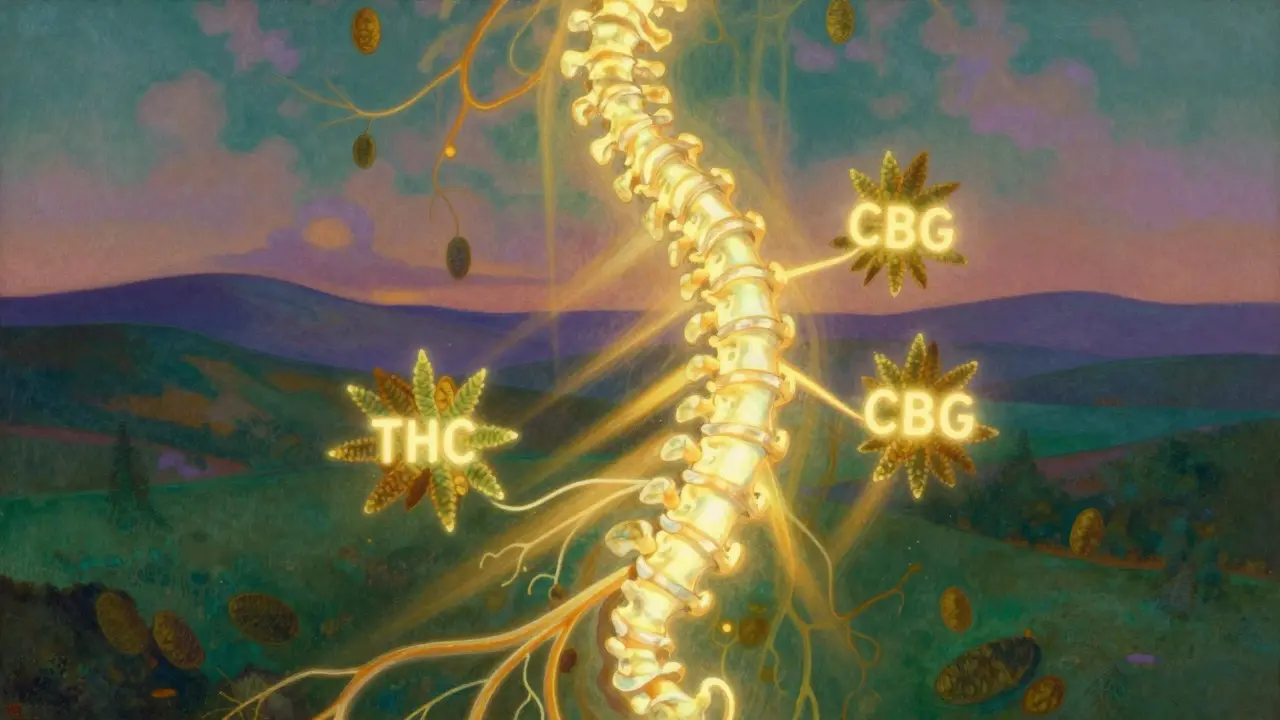
When it comes to chronic pain, millions of people are searching for something that works without the risks of opioids. Cannabinoids - compounds from the cannabis plant - have become one of the most talked-about options. But what does the science actually say? Is CBD really helping people with back pain or arthritis? Does THC offer better relief? And are these products safe when used long-term?
What Are Cannabinoids, and How Do They Work?
Cannabinoids are chemicals naturally found in the cannabis plant. The most well-known are THC (tetrahydrocannabinol) and CBD (cannabidiol), but others like CBG (cannabigerol) and CBN (cannabinol) are gaining attention too. These compounds interact with the body’s endocannabinoid system, a network of receptors that helps regulate pain, mood, sleep, and inflammation.
Unlike opioids, which block pain signals in the brain, cannabinoids work more broadly - reducing inflammation at the source and calming overactive nerves. This makes them especially interesting for neuropathic pain, which comes from damaged nerves and often doesn’t respond well to traditional painkillers.
What Does the Research Show?
The evidence on cannabinoids and pain is messy - and contradictory.
A major 2015 JAMA review of over 70 studies found moderate-quality evidence that cannabinoids help with chronic pain. That’s not strong proof, but it’s more than most alternative treatments have. The review also found they helped with muscle spasticity in multiple sclerosis.
But newer studies paint a different picture. A 2023 analysis from the University of Bath looked at 16 high-quality trials using pharmaceutical-grade CBD. Fifteen of them showed no benefit over placebo. The researchers concluded that CBD alone likely doesn’t help with pain - despite what online ads claim.
Meanwhile, a January 2025 study from Yale School of Medicine found that CBG - a lesser-known cannabinoid - strongly reduced activity in a protein linked to peripheral nerve pain. CBG showed more promise than CBD or even THC in lab tests. But this was a lab study, not a human trial. It’s promising, but far from proof.
The CDC takes a cautious stance: there’s limited evidence cannabinoids help most types of pain, but they acknowledge some benefit for neuropathic pain. Harvard Medical School echoes this, saying there’s no high-quality human study proving CBD alone relieves pain.
Here’s the key takeaway: THC-containing products show more consistent results than CBD alone. The only FDA-approved cannabinoid medication for pain is Sativex, a 1:1 THC:CBD spray approved in Canada and Europe for multiple sclerosis-related pain and cancer pain that doesn’t respond to opioids.
Why Is There So Much Confusion?
The confusion comes from three big problems.
First, most CBD products sold online are poorly regulated. The University of Bath tested 50 consumer CBD products and found that 40% contained less CBD than labeled - some had none at all. Others had way more. A few even had illegal levels of THC. You could be paying for a placebo, or worse, something that gets you high and fails a drug test.
Second, studies use different forms of cannabinoids. One study might use pure CBD isolate. Another uses whole-plant extract with THC, terpenes, and other compounds. The results can’t be compared directly.
Third, many people use cannabinoids for different types of pain. Fibromyalgia, arthritis, nerve pain - each responds differently. A product that helps one person may do nothing for another.
Reddit threads from chronic pain communities reflect this. One user reported a 30% reduction in fibromyalgia pain with CBD oil. Another spent $400 on gummies and felt zero difference. The same pattern shows up in Amazon reviews: 41% of negative reviews say “no pain relief.”
What About Safety?
Cannabinoids aren’t risk-free.
THC can cause dizziness, dry mouth, nausea, and in some cases, anxiety or paranoia. Long-term use may affect memory and mental health in younger users. Products with high THC levels aren’t safe for people with a history of psychosis or substance use disorders.
CBD is often called “non-psychoactive,” but it’s not harmless. High doses - especially from unregulated products - can cause liver toxicity. A 2023 meta-analysis found liver enzyme spikes in some users taking over 1,000 mg of CBD daily. That’s far above what most people take, but it’s still a real risk.
Cannabinoids also interact with other medications. They affect enzymes in the liver that break down blood thinners, antidepressants, and seizure drugs. Taking CBD with warfarin or clobazam could lead to dangerous side effects. Always talk to your doctor before combining cannabinoids with prescription meds.
And don’t forget: even if a product says “THC-free,” it might not be. Testing standards vary. A product labeled as CBD isolate could still contain trace THC - enough to trigger a positive drug test for jobs or probation.
Dosing: How Much Should You Take?
There’s no standard dose. What works for one person may do nothing for another.
Most pain clinics recommend starting low and going slow:
- For CBD: Begin with 10-20 mg per day. Increase by 5-10 mg weekly if no effect after two weeks.
- For THC: Start at 2.5-5 mg. Avoid higher doses unless supervised by a clinician.
- For THC:CBD combinations (like Sativex): Follow prescribed ratios - typically 2.7 mg THC and 2.5 mg CBD per spray, up to 12 sprays per day.
Timing matters too. Sublingual oils (under the tongue) work faster than edibles. Edibles can take 1-2 hours to kick in and last longer. Topicals (creams, patches) may help localized pain but don’t enter the bloodstream much.
Keep a journal. Note what you took, when, how much, and how you felt 1-2 hours later. This helps you find your sweet spot - and gives your doctor useful data.

Real-World Outcomes: What Do Patients Say?
Some people swear by cannabinoids. A patient on Leafly described switching from 120 mg of oxycodone daily to a 1:1 THC:CBD tincture, cutting their opioid dose to 30 mg with better pain control and fewer side effects. That’s a powerful story.
But many others are disappointed. A 2023 analysis of 14,500 Amazon and Trustpilot reviews found that while 28% of users praised CBD for reducing anxiety and 22% said it improved sleep, 41% reported zero pain relief. For chronic pain sufferers, that’s heartbreaking.
Why the gap? Partly because marketing overpromises. Companies sell CBD as a cure-all, even though science doesn’t back it. Patients who’ve tried opioids, NSAIDs, and physical therapy are desperate. They’re willing to spend hundreds on something that might help.
The reality? Cannabinoids may be a tool - not a miracle. For some, they reduce reliance on opioids. For others, they’re just another expense.
What’s Next?
Big changes are coming.
The FDA is reviewing whether cannabis should be moved from Schedule I (no medical use) to a lower classification. If that happens, research funding will surge. Right now, federal restrictions make it hard to run large, long-term studies.
Phase III trials are underway. GW Pharmaceuticals is testing a THC:CBD formula for cancer pain. Columbia University is studying CBD for chronic low back pain. Results should come in 2024-2025.
Meanwhile, companies are racing to develop pharmaceutical-grade CBG. If Yale’s lab findings hold up in human trials, CBG could become the first non-intoxicating cannabinoid approved for pain - with clean dosing and no risk of getting high.
But until then, tread carefully. Don’t let marketing replace science.
Bottom Line: Should You Try Cannabinoids for Pain?
Here’s what the evidence suggests:
- If you have neuropathic pain (nerve pain from diabetes, shingles, MS), a THC:CBD combination like Sativex may help - if available.
- If you’re using CBD alone, don’t expect pain relief. It might help sleep or anxiety, but not your back or joint pain.
- Never replace opioids or other prescribed meds with cannabinoids without medical supervision.
- Buy only from licensed dispensaries or brands that provide third-party lab reports (COAs).
- Start with low doses. Monitor side effects. Talk to your doctor.
Cannabinoids aren’t magic. But for some, they’re a better option than the alternatives. The key is using them wisely - based on science, not hype.
Can CBD oil really relieve chronic pain?
The evidence is weak. Most high-quality studies show CBD alone doesn’t reduce chronic pain more than a placebo. Some people report benefits, but this may be due to reduced anxiety or improved sleep, not direct pain relief. For nerve pain, THC-containing products have stronger support.
Is THC or CBD better for pain?
THC has more consistent evidence for pain relief, especially when combined with CBD. Products like Sativex (1:1 THC:CBD) are approved in some countries for multiple sclerosis and cancer pain. CBD alone shows little to no benefit in clinical trials. However, THC can cause psychoactive effects, so it’s not suitable for everyone.
Are CBD products safe to use?
They can be, but only if they’re high-quality and used properly. Unregulated products may contain harmful contaminants, inaccurate dosing, or hidden THC. High doses of CBD can cause liver toxicity. Always choose brands with third-party lab reports and consult your doctor - especially if you take other medications.
Can cannabinoids replace opioids?
Some patients reduce their opioid use with cannabinoid therapy, but this should only be done under medical supervision. Opioids are still more effective for acute, severe pain. Cannabinoids may help reduce dosage or side effects, but they’re not a direct replacement. Never stop opioids abruptly.
What’s the best way to take cannabinoids for pain?
For systemic pain, sublingual oils or capsules work best. For localized pain (like knee arthritis), topical creams may help. Avoid edibles if you need fast relief - they take 1-2 hours to kick in. Always start with a low dose and increase slowly. Keep a log of your symptoms and responses.
Why is CBG getting attention now?
A January 2025 Yale study found CBG strongly reduced a key protein involved in peripheral nerve pain. Unlike THC, it doesn’t cause intoxication. If future human trials confirm these results, CBG could become a non-addictive, non-psychoactive option for pain - potentially solving the quality and safety issues plaguing CBD products today.
Chris Crosson
March 26, 2026 AT 01:28Been using a 1:1 THC:CBD tincture for my sciatica for over a year now. No magic cure, but it cuts my oxycodone dose in half and lets me sleep through the night. The real win? No brain fog. I used to feel like I was walking through molasses on opioids. Now I can actually read a book without falling asleep. Just make sure you get lab-tested stuff - I lost $200 on a bottle of ‘CBD’ that had zero cannabinoids. Total scam.
Seth Eugenne
March 26, 2026 AT 10:30Hey, I just want to say thank you for writing this. 😊 So many people are getting ripped off by sketchy CBD companies. I had a friend who spent $600 on ‘premium’ gummies and felt nothing. She cried when she realized she got scammed. Please, if you’re considering this, talk to your doctor first. And maybe keep a journal - tracking what works (or doesn’t) is the only way to know if it’s helping you or just your hope.
Alex Arcilla
March 27, 2026 AT 01:19So let me get this straight - we’ve got a plant that’s been used for millennia, now being sold as a ‘wellness product’ by influencers who can’t spell ‘cannabidiol,’ while the science says ‘maybe, kinda, if you’re lucky.’ 🤦♂️ And people are paying $80 a bottle for something that might as well be a placebo with a cool label. Meanwhile, the real answer is sitting in a lab somewhere with a 1:1 spray that’s FDA-approved in Canada. We’re doing capitalism wrong.
Brandon Shatley
March 28, 2026 AT 01:19i read this whole thing and i think… maybe cbd just dont work for pain? like, i tried it for my knee and my back and nothing. but i did sleep better. so maybe its not about pain, its about chillin? i dont know. i think people just want something that works without a prescription. and thats fine. but dont lie to em. if it dont work, say so. i dont mind if its not magic, i mind if its sold like its magic.
Grace Kusta Nasralla
March 28, 2026 AT 16:54It’s funny how we treat pain like it’s a puzzle to solve, not a lived experience. I’ve been in chronic pain for 12 years. I don’t need another study. I need someone to say, ‘I see you.’ Some of us don’t want to be fixed. We just want to be held. And if a little CBD helps me feel less alone… who are we to say it’s not medicine?
Stephen Alabi
March 28, 2026 AT 23:12While I commend the author for a generally well-researched exposition, I must formally object to the conflation of anecdotal efficacy with clinical validity. The utilization of Reddit testimonials and Amazon review aggregates constitutes a profound methodological flaw in the interpretive framework. The peer-reviewed literature, particularly the 2023 University of Bath meta-analysis, unequivocally demonstrates the absence of statistically significant analgesic effect attributable to CBD monotherapy. To suggest otherwise is to perpetuate epistemic injustice in the public health sphere.
Pat Fur
March 30, 2026 AT 18:40CBG could be the real deal. I’m not a scientist, but I’ve been reading everything I can find. If it’s non-intoxicating and actually hits the nerve pain target? That’s huge. No high, no liver risk, just relief. I hope they fast-track it. People are suffering. We need real options, not marketing.
Anil Arekar
April 1, 2026 AT 14:30As a medical professional from India, I have observed that patients often seek alternative therapies due to limited access to regulated pharmaceuticals. While the scientific evidence remains mixed, the cultural and psychological comfort derived from cannabinoid use should not be dismissed. However, unregulated products pose serious risks. I urge all users to prioritize third-party testing and consult licensed practitioners. Health is not a commodity.
Elaine Parra
April 1, 2026 AT 20:15Oh wow, another ‘cannabis is medicine’ think piece. Let me guess - next you’ll tell us vaping weed cures cancer? This is why America is falling apart. You have a man with a PhD writing a 5,000-word article about how CBD doesn’t work, and people still buy it because they’re too lazy to take ibuprofen. Pain is part of life. Stop looking for magic pills. Take a walk. See a PT. Stop wasting money on snake oil.