

What Are Cluster Headaches?
Cluster headaches are not just bad headaches-they’re among the most painful conditions known to medicine. People who experience them describe the pain as a hot poker driven behind the eye, burning through the temple, or like their skull is splitting open. Unlike migraines, which often come with nausea and light sensitivity, cluster headaches strike with brutal precision: one side of the head, usually around the eye or temple, and they hit fast and hard. Each attack lasts between 15 and 180 minutes, but during that time, nothing else matters. Patients often pace, rock, or even bang their heads against walls because sitting still is impossible.
These attacks don’t come randomly. They cluster-hence the name-hitting daily for weeks or months at a time, then disappearing for months or even years. This pattern is called a cluster cycle. Many people get the same number of attacks each day, often waking up 2-3 hours after falling asleep. The timing is so predictable that some call it a biological clock gone wrong.
It’s rare-only about 1 in 1,000 people get them-but when you’re one of them, it feels like the whole world doesn’t understand. Men are three times more likely to be affected than women, and many have a history of smoking, though the exact cause is still unknown. The pain is rated 10 out of 10 on pain scales, and some patients have said they’d rather endure childbirth or a broken bone than another attack.
Why Oxygen Therapy Works
For decades, doctors had few options to stop a cluster headache once it started. Triptans helped, but they came with risks-chest tightness, dizziness, and heart concerns for people with cardiovascular issues. Then came oxygen therapy, and everything changed.
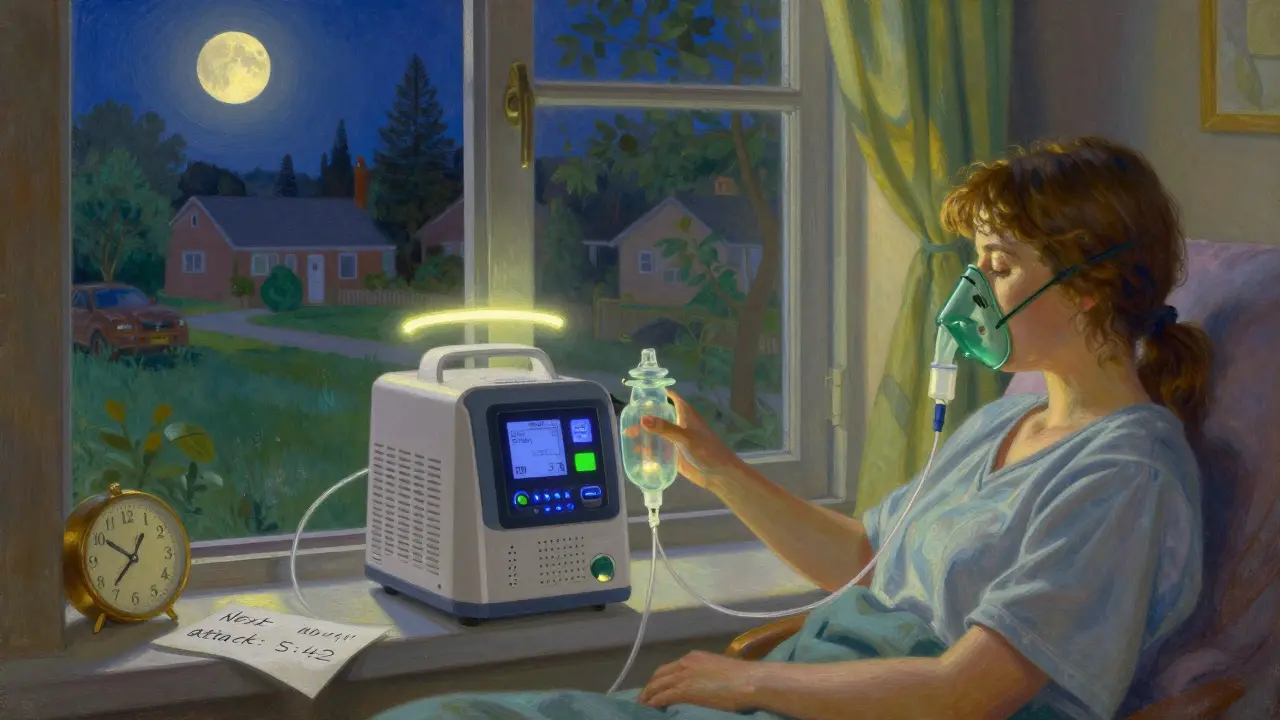
Breathing 100% pure oxygen through a non-rebreather mask at 12 to 15 liters per minute can shut down a cluster headache in as little as 8 to 15 minutes. It works because high-flow oxygen reduces the activity of the trigeminal-autonomic reflex, the brain pathway that triggers the pain and symptoms like watery eyes and a stuffy nose. Think of it like turning off a circuit breaker in your brain that’s stuck in the "on" position.
Studies show that 78% of people get completely pain-free within 15 minutes using this method. Compare that to subcutaneous sumatriptan (injection), which works in about 74% of cases-but 34% of users report side effects. Oxygen has none. No dizziness. No nausea. No heart risk. Just clean, fast relief.
The science is solid. A 2019 Cochrane Review analyzed every major study on acute cluster headache treatments and found oxygen therapy to be the safest and fastest option available. The American Academy of Neurology and the European Headache Federation both give it a Level A recommendation-the highest possible-for acute treatment.
How to Use Oxygen Therapy Correctly
Using oxygen isn’t as simple as turning on a tank. If you do it wrong, it won’t work. Here’s what actually works based on clinical guidelines and real-world use:
- Use a non-rebreather mask with a reservoir bag. Regular nasal cannulas won’t cut it-you need the full 100% oxygen concentration.
- Set the flow rate to 12 to 15 liters per minute. Anything less than 10 L/min has poor results. At 12 L/min, 78% of patients are pain-free in 15 minutes. At 4 L/min? Only 20%.
- Start breathing the oxygen as soon as you feel the pain begin. Waiting even 10 minutes reduces effectiveness dramatically.
- Sit upright and lean forward slightly. Breathe deeply and consistently. Don’t just hold the mask to your face-breathe into it like you’re trying to fill your lungs completely.
- Keep the mask sealed tight. If air leaks in, the oxygen concentration drops. Many users report initial struggles with fit-adjust the straps, try different mask sizes.
Most people learn the technique after 2 or 3 attacks. The first time is always the hardest. One patient on Reddit said, “I fumbled with the mask for 10 minutes while the pain got worse. On the third attack, I got it right in 8 minutes. I cried.”

Equipment You Need
You can’t just grab a portable oxygen tank from the hardware store. This requires medical-grade equipment.
- Oxygen concentrator: Must deliver continuous flow at 15 L/min. Models like the Invacare Perfecto2 or Inogen One G5 (which weighs under 5 pounds) are common. Newer portable units are game-changers-light enough to carry in a backpack.
- Non-rebreather mask: Must have a reservoir bag and one-way valves to prevent breathing back in carbon dioxide. These cost $5-$10 each and should be replaced every few months.
- Tubing: Use medical-grade, kink-resistant tubing. Avoid cheap plastic that collapses under pressure.
Costs vary. A new concentrator runs $1,200-$2,500. Monthly rentals are $150-$300. Many patients get coverage through insurance, but it’s not guaranteed.
Insurance and Access Problems
Here’s the ugly truth: even though oxygen therapy is the gold standard, many patients can’t get it.
In the U.S., Medicare only covers oxygen for cluster headaches if you’ve tried and failed two triptans and have at least one attack per week. Even then, 41% of initial claims were denied in 2022. Private insurers are inconsistent-UnitedHealthcare approves 68% of claims, while Aetna approves just 42%.
Many patients report spending weeks on hold, submitting endless paperwork, or being told, “We don’t cover oxygen for headaches.” Rural patients face even bigger hurdles-only 28% have immediate access compared to 63% in cities.
Some states have passed laws requiring coverage. Between 2020 and 2023, 22 states passed cluster headache-specific oxygen coverage laws thanks to patient advocacy groups like Clusterbusters. But it’s still a patchwork. If you’re struggling, contact your state’s patient advocacy network or ask your neurologist to write a letter of medical necessity.
Who Doesn’t Respond to Oxygen?
Oxygen therapy works for 78-82% of people. But it doesn’t work for everyone. Research shows three key predictors of poor response:
- No history of smoking: Non-smokers are more likely to be resistant (odds ratio 2.3).
- Persistent headaches between attacks: If you still have dull pain even when you’re not in a cluster cycle, oxygen is less likely to help (odds ratio 3.1).
- Attacks lasting longer than 180 minutes: Cluster headaches are supposed to top out at 3 hours. If yours go longer, oxygen may not be enough (odds ratio 2.8).
For these patients, alternatives like injectable sumatriptan, intranasal zolmitriptan, or newer neuromodulation devices (like gammaCore) may be needed. But oxygen should still be tried first-it’s safe, fast, and free of side effects.
Real Stories: Relief, Frustration, and Hope
On Reddit’s r/ClusterHeadaches community, over 1,200 users shared their oxygen therapy experiences. Seventy-two percent said it gave them “significant or complete relief.” One user wrote: “I went from 8 attacks a day to 2 after I started using oxygen. I got my life back.”
But there are heartbreaking stories too. A woman in Ohio spent six months fighting her insurer before finally getting approved. Another man in rural Kansas couldn’t afford the $2,000 concentrator and used a neighbor’s tank during attacks-until the neighbor moved away.
One patient, Mark, started using oxygen after his third attack. He kept the unit in his bedroom, living room, and office. “I don’t wait anymore. If I feel it coming, I’m already wearing the mask.” He’s been pain-free for 11 months. “It’s not a cure,” he says. “But it’s my lifeline.”
What’s Next for Oxygen Therapy?
The field is evolving. In May 2023, the FDA cleared the O2VERA-a portable oxygen concentrator designed specifically for cluster headaches, delivering 15 L/min and weighing just over 5 pounds. In Europe, a new nasal cannula system showed 89% effectiveness in clinical trials, which could mean easier use for people who can’t tolerate masks.
Researchers are now testing demand-valve masks that release oxygen only when you inhale. Early results suggest they could cut treatment time from 15 minutes to under 7 minutes. Three major clinical trials are underway as of late 2023.
For now, oxygen therapy remains the most reliable, safest, and fastest way to stop a cluster headache. It’s not perfect. Access is hard. Cost is high. But for those who respond, it’s life-changing.
What to Do If You Think You Have Cluster Headaches
If you’re having severe, one-sided headaches that come in clusters, wake you up at night, and come with tearing or a stuffy nose, see a neurologist-preferably one who specializes in headaches. Don’t wait. Cluster headaches are often misdiagnosed as migraines or sinus infections.
Ask your doctor about:
- Getting an ICD-10 code (G44.0) for cluster headache
- Prescribing oxygen therapy
- Connecting you with a durable medical equipment provider
- Referral to a headache clinic
Resources like the American Headache Society’s “Find a Headache Doctor” directory and Clusterbusters’ Oxygen Therapy Handbook can help you navigate the system. You’re not alone. And you don’t have to suffer without help.
Jan Hess
January 14, 2026 AT 20:42Haley Graves
January 15, 2026 AT 03:05Diane Hendriks
January 16, 2026 AT 13:03ellen adamina
January 16, 2026 AT 21:57Gloria Montero Puertas
January 17, 2026 AT 17:59Frank Geurts
January 18, 2026 AT 09:32Arjun Seth
January 19, 2026 AT 09:44Mike Berrange
January 20, 2026 AT 01:49Dan Mack
January 21, 2026 AT 23:05Amy Vickberg
January 23, 2026 AT 07:04Nishant Garg
January 24, 2026 AT 09:58Nicholas Urmaza
January 25, 2026 AT 00:42