
Did you know that nearly 50% of American adults took at least one dietary supplement last month, yet more than three-quarters of those people never told their doctor? This silence creates a ticking time bomb inside our healthcare system. You might take your blood pressure pills faithfully, only to reach for a "natural" energy booster or sleep aid without thinking twice. That combination could turn your carefully managed treatment plan upside down.
We often treat herbal products as harmless food items because they are sold in grocery stores or wellness shops rather than behind a pharmacy counter. But nature packs powerful chemicals. Some botanicals can speed up how your body breaks down medicine, rendering your drugs useless. Others slow things down, flooding your bloodstream with toxic levels of medication.
The Silence Between Counter and Cupboard
Imagine walking into a clinic filled with good intentions but dangerous gaps. According to the National Center for Complementary and Integrative Health (NCCIH), queries about these specific clashes jumped by 40% between 2018 and 2022. Yet, a study by the American Academy of Family Physicians found that only 25% of people admit to using herbal products while on prescriptions.
This isn't just an oversight; it's a life-or-death communication failure. In 2022 alone, estimates suggested around 1.3 million people in the U.S. experienced medication errors linked to these hidden factors. When you mix specific plant extracts with potent pharmaceuticals, you aren't adding benefits-you are gambling with chemistry. Your liver and kidneys have a limited capacity to process substances, and competing chemical signals can overwhelm that system.
The Top Three Dangerous Duos
To understand the risk, we need to look at specific, proven conflicts. General warnings don't stick, but real-world pairings do.
| Herbal Supplement | Prescription Drug | Potential Consequence | Risk Level |
|---|---|---|---|
| St. John's Wort | SSRIs, Antidepressants, Blood Thinners | Life-threatening chemical imbalance (Serotonin Syndrome) | Critical |
| Ginkgo Biloba | Warfarin, Aspirin, NSAIDs | Severe internal bleeding or hemorrhage | High |
| Garlic Supplements | HIV Medications, Warfarin | Reduced drug effectiveness (up to 51%) | Moderate-High |
| Goldenseal | Anesthetics, Sedatives | Dangerous sedation or drug buildup | High |
St. John's Wort is perhaps the most notorious offender. People often buy this for mood support, unaware that it acts as a turbo-charger for liver enzymes. If you take antidepressants alongside it, the result can be Serotonin Syndrome-a state where too much serotonin causes agitation, high fever, and seizures. Dr. Daniel P. Kuehl's review from 2017 was blunt: avoid it with all antidepressants. It reduces the plasma concentration of critical transplant drugs like cyclosporine by up to 60%. If you are on HIV protease inhibitors, it can slash their effectiveness by 80%, leaving the virus unchecked.
Ginkgo Biloba is marketed heavily for brain health and memory. However, it thins the blood naturally. If you combine it with blood thinners like Warfarin or Apixaban, you significantly increase bleeding risk. A Reddit user reported a hospital visit after mixing these two, noting that their INR spiked to dangerous levels, leading to severe rectal bleeding. Between 2010 and 2020, Mayo Clinic documented 23 cases of major hemorrhage directly linked to this mix.
Garlic seems innocent enough, but concentrated garlic supplements behave differently than fresh cloves in cooking. University of Washington trials in 2019 showed that garlic extract reduced the absorption of saquinavir (an HIV drug) by over 50%. For patients relying on that precise dosage to suppress the virus, this turns a manageable condition into a crisis.
How Your Liver Processes Conflict
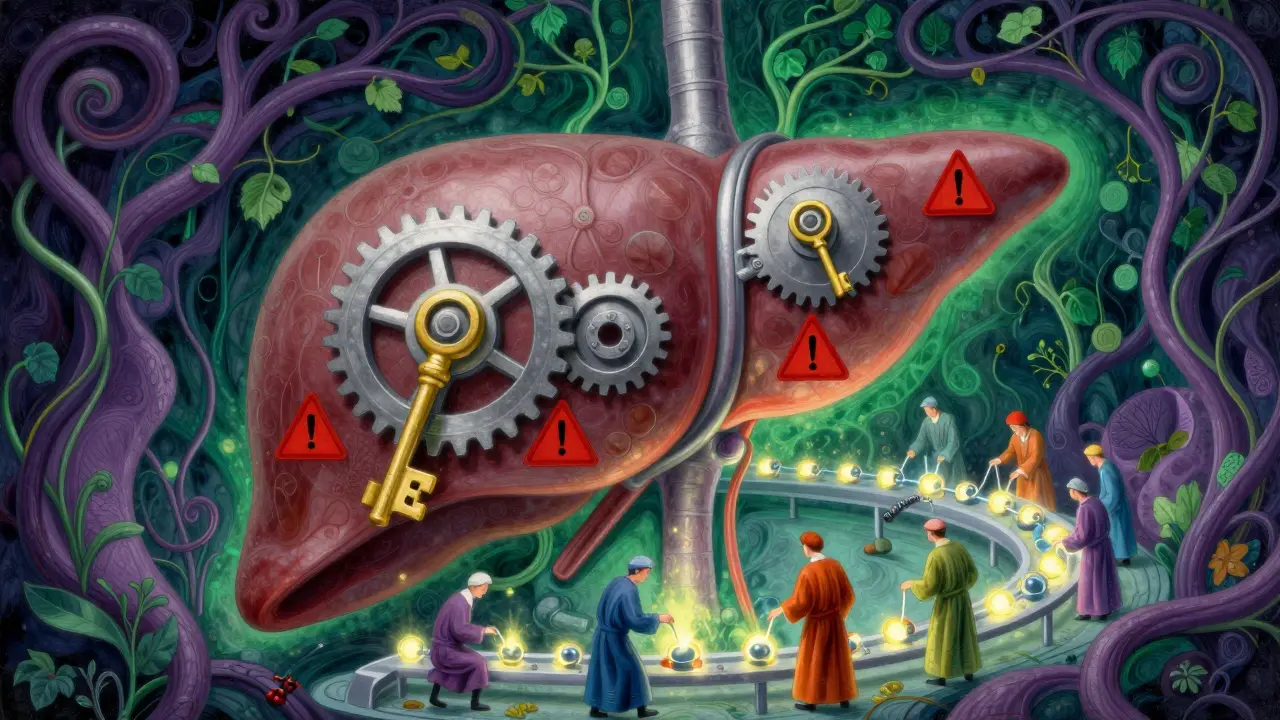
Your liver is the command center for metabolism. Inside its cells are enzyme families responsible for breaking down chemicals. One of the most important is called Cytochrome P450. Think of these enzymes as busy workers on an assembly line. Certain herbs act as "inhibitors," blocking the line so medications pile up in your blood (leading to toxicity). Other herbs act as "inducers," speeding up the line so the drug leaves your system before it works.
Cytochrome P450 Enzymes, specifically the CYP3A4 subtype, handles a vast range of drugs. Goldenseal is known to inhibit this pathway. In a 2018 study, researchers observed a 40% reduction in midazolam clearance when goldenseal was present. Midazolam is a sedative often used during procedures. If the drug doesn't leave your system fast enough, you remain sedated far too long, putting your airway at risk.
You might wonder why cranberry juice is mentioned so often. It has a controversial relationship with Warfarin. Some evidence suggests it raises INR levels (how long your blood takes to clot), causing bleeding. However, other studies show no effect. Because patient responses vary wildly-ranging from zero change to an INR spike of 1.8 units-it remains a "moderate" risk that requires close monitoring.
Where Danger Hides in Plain Sight
Sometimes, the supplement bottle doesn't even mention the culprit. Manufacturers often bundle ingredients into "complex blends" for marketing purposes.
- Brain Health: These labels frequently hide Ginkgo Biloba. ConsumerLab testing in 2022 found it in 73% of products claiming cognitive support.
- Mood Support: Expect to find St. John's Wort here. It appeared in 89% of tested mood products.
- Immune Support: Garlic extract is common here, showing up in 61% of formulations.
You aren't always buying a single ingredient. You might be purchasing a "stress relief tea blend" that contains kava or passionflower alongside other herbs. Each component adds to the cumulative load on your metabolic pathways. Furthermore, many herbal brands are not regulated like prescription drugs. The Dietary Supplement Health and Education Act (DSHEA) of 1994 means manufacturers don't need to prove safety before selling. The FDA usually only steps in after harm occurs.
A Practical Checklist for Safety
Don't let fear stop you from seeking natural options, but do respect the science. You can manage these risks with a routine.
- The Honest Disclosure: At every appointment, lay out exactly what you take. Bring bottles if possible. Labels matter more than memory. Ask your doctor to document every brand and dose in your chart.
- Monitor for Signs: Watch for unexplained bruising, nosebleeds, or extreme drowsiness. These are red flags for interactions affecting blood thinning or sedation.
- Check Online Tools: Resources like the NCCIH Database update quarterly. They categorize interactions as "Life-threatening," "Significant," or "Moderate." Before buying a new jar, run a quick search.
- Watch the INR: If you are on blood thinners and considering herbs, demand weekly INR checks until stability is proven.
Frequently Asked Questions
Are herbal supplements safe to take with any prescription drug?
Not necessarily. While some herbs are low-risk, others interact dangerously with standard medications. Always consult your pharmacist or doctor to verify compatibility, especially if you take heart, blood pressure, or mental health medications.
Does eating vegetables count as an herb-drug interaction risk?
Generally, cooking amounts of foods like garlic or ginger are safe. Risks come from concentrated extracts found in pills, capsules, or teas where the active compounds are much stronger than in food.
What symptoms indicate a reaction to mixing herbs and drugs?
Watch for unusual bruising, nosebleeds, extreme jitteriness, confusion, fainting, or sudden changes in blood pressure. These suggest your body is struggling to process the chemicals.
Can I stop my prescription medication to take herbal alternatives instead?
Never stop a prescribed medication abruptly without medical supervision. Doing so can cause withdrawal or rebound effects that are more dangerous than the original side effects.
Why don't pharmacists check for herbal interactions automatically?
They cannot screen for supplements you haven't disclosed. Since supplements are often bought separately from pharmacies, pharmacists rely entirely on patient honesty to identify potential risks.
gina macabuhay
March 27, 2026 AT 18:09You really expect medical professionals to guess your regimen while you hide behind "natural" labels. This silence creates systemic failures that we all eventually pay for. Ignorance isn't innocence when lethal chemistry is involved.
People who prioritize trends over safety need more accountability.
Tony Yorke
March 29, 2026 AT 17:30Just talk to your doctor about everything.
Austin Oguche
March 29, 2026 AT 19:07Finding balance in treatment options requires honest communication channels
Rohan Kumar
March 30, 2026 AT 21:04Balance? The big pharma industry wants you sedated anyway lol 🙄🤷‍
They profit from your confusion and fear tactics.
Paul Vanderheiden
April 1, 2026 AT 06:46I hope everyone takes care and listens to their bodies first
Rachael Hammond
April 2, 2026 AT 10:58thats super important becuse mistakes happen easily wihout checking labels
tyler lamarre
April 3, 2026 AT 08:53The average consumer lacks the biological literacy to distinguish safe from hazardous compounds which is concerning.
Jeannette Kwiatkowski Kwiatkowski
April 4, 2026 AT 03:16people are idiots for thinking plants are magic cure alls without reading studies on toxicity
It is pathetic how they ignore science for vibes
Devon Riley
April 5, 2026 AT 08:37Please be careful out there because we need our loved ones safe 💙
I worry about friends taking random pills
Richard Kubíček
April 5, 2026 AT 14:26Agreed that safety comes first when mixing meds though we still need more regulation.
Monique Ball
April 5, 2026 AT 19:59It is crucial to understand that your liver functions like a complex processing plant. Many people overlook how herbs affect this system. You must consult your physician before adding anything. St John's Wort is particularly dangerous with antidepressants. Ginkgo Biloba increases bleeding risks significantly. Garlic extracts can reduce HIV medication efficacy by half. These are not minor side effects. They can lead to hospitalization or death. Please read labels carefully. Hidden ingredients are common in blends. Always bring bottles to appointments. Ask specifically about Cytochrome P450 enzymes. Your safety depends on full disclosure. Monitoring INR levels is vital for blood thinner patients. Trust science over marketing claims. Natural does not always mean safe. 🌿💊⚠️
Debra Brigman
April 6, 2026 AT 18:56Your metabolic tapestry needs protection from those toxic botanical threads indeed.
We weave our health with invisible fibers daily.
Aaron Olney
April 6, 2026 AT 20:09This is scary af i cant beleive people dont know
i was almost hospitlaized once from mixing teh wrong stuf