

The FDA Orange Book is the single most important tool for anyone trying to figure out when a brand-name drug will lose its patent protection and allow generic versions to hit the market. If you’re a pharmacist, a generic drug manufacturer, a healthcare provider, or even a patient curious about when a cheaper version of your medication might become available, knowing how to read the Orange Book is essential. It’s not just a list-it’s the official timeline for drug competition in the U.S.
What Exactly Is the FDA Orange Book?
The FDA Orange Book, officially called Approved Drug Products with Therapeutic Equivalence Evaluations, has been around since 1985. It was created by the Hatch-Waxman Act to balance innovation and access. Brand-name drugmakers get patent protection and market exclusivity. Generic companies get a clear path to enter the market once those protections expire. The Orange Book is the public record of that deal. It doesn’t just list drugs. It tracks every patent tied to a drug, every period of regulatory exclusivity, and-most importantly-the exact date each patent expires. This includes extensions granted because the FDA took too long to approve the drug. These extensions, called Patent Term Extensions (PTE), can add years to the original patent life. Without the Orange Book, no one would know when those deadlines hit.How to Find Patent Expiration Dates in the Electronic Orange Book
The Orange Book is now fully digital. You can access it for free at www.accessdata.fda.gov/scripts/cder/ob/index.cfm. Here’s how to find what you need:- Start by searching using the drug’s brand name, active ingredient, or application number. For example, type in “Brilinta” or “ticagrelor.”
- Click on the application number (like “NDA 022314”) for the drug you’re looking at.
- Scroll to the bottom of the page and click “View.”
- You’ll see a table listing every patent associated with that drug. Each row shows the patent number, expiration date (in MMM DD, YYYY format), and a patent use code.
The expiration date you see isn’t just the original patent end date. It includes any extensions granted by the USPTO. For example, if a patent was set to expire in 2027 but got a 2-year extension due to FDA review delays, the Orange Book will show 2029.
What the Patent Use Code Tells You
Each patent in the Orange Book has a code like “U-123” or “U-456.” These aren’t random. They tell you exactly what the patent covers:- U-100 = Method of treating a specific disease
- U-200 = Drug formulation or delivery system
- U-300 = Chemical compound structure
Not all patents listed are equally important. A patent on the pill’s shape (U-200) might expire, but if the method-of-use patent (U-100) is still active, generics still can’t market the drug for that condition. The FDA has a searchable tool for these codes at www.accessdata.fda.gov/scripts/cder/ob/results_patent.cfm. Use it to understand which patents block generic entry and which don’t.
Pediatric Exclusivity: The Hidden 6-Month Extension
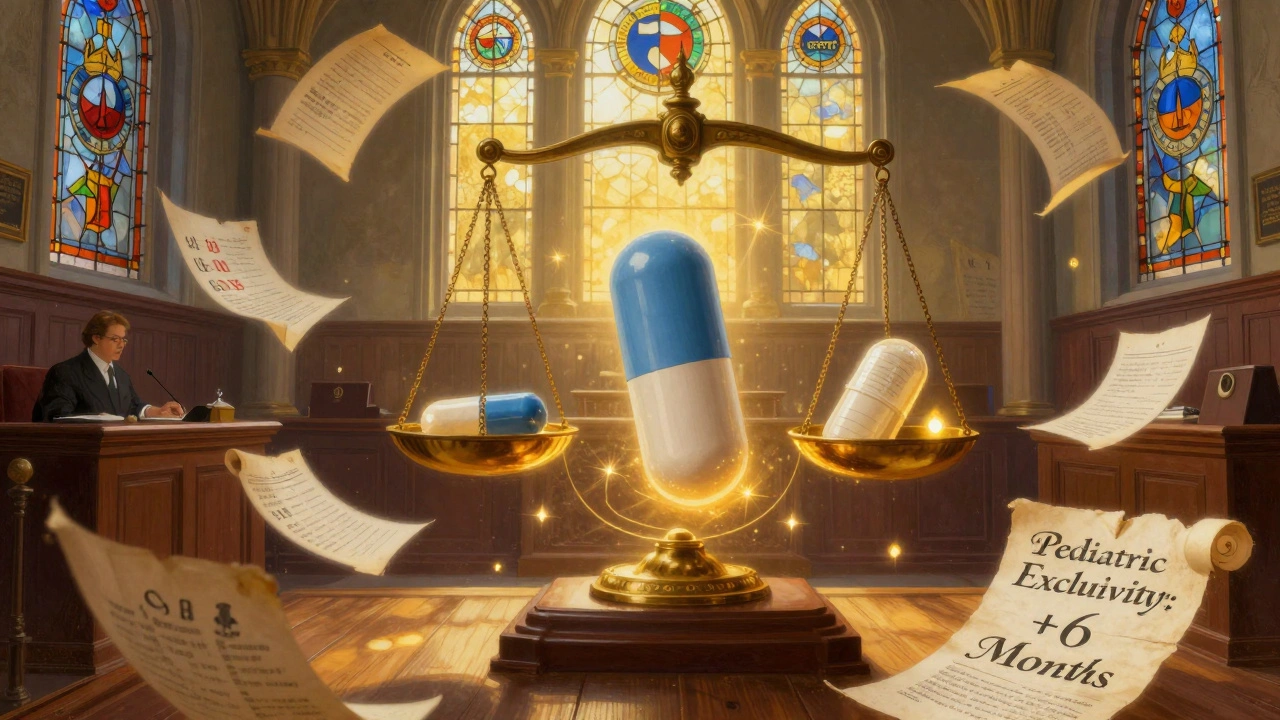
Many drugs get an extra 6 months of protection-not because of a new patent, but because the manufacturer ran pediatric studies. This is called pediatric exclusivity. Here’s the tricky part: it doesn’t create a new patent. Instead, it extends the expiration date of every existing patent and exclusivity period for that drug.In the Orange Book, you’ll see the same patent listed twice:
- One row shows the original expiration date
- The next row shows the same patent number with a new date: 6 months later
This confuses a lot of people. They think there are two patents. There aren’t. It’s one patent with a 6-month extension. If you’re planning a generic launch, you must look for both entries and use the later date.
Exclusivity vs. Patents: Don’t Mix Them Up
The Orange Book lists two types of protection: patents and exclusivity. They’re not the same.- Patents are granted by the USPTO and can cover chemical structures, methods of use, or formulations. They can expire early if maintenance fees aren’t paid.
- Exclusivity is granted by the FDA and doesn’t require a patent. Examples include 5-year exclusivity for new chemical entities, 3-year exclusivity for new clinical studies, or 180-day exclusivity for the first generic to challenge a patent.
Some drugs have both. Some have only one. Some have neither. Exclusivity can block generics even if all patents have expired. Always check both columns. For example, a drug might have no active patents left, but still be protected by 3-year exclusivity until 2026.
Why the Orange Book Isn’t Always Perfect
The Orange Book is authoritative-but it’s not perfect. Here are the big gaps:- Early expirations: About 46% of patents listed in the Orange Book expire early because the patent holder didn’t pay maintenance fees. The FDA doesn’t remove these listings retroactively, so you’ll still see an expiration date that’s no longer valid.
- Delisted patents: If a company requests a patent be removed from the Orange Book, it’s often because the patent was invalidated or is no longer enforceable. But the removal isn’t always immediate.
- Outdated data: Patents issued after drug approval must be submitted within 30 days. If the company delays, the Orange Book lags. Pre-2013 records also lack submission dates, making it harder to track timing.
For serious planning-like launching a generic drug-you must cross-check the Orange Book with the USPTO Patent Center. The NBER study found that 89% of patent expiration dates match between the two systems. But 11% don’t. That’s a big risk if you’re betting on market entry.
Download the Data for Bulk Analysis
If you’re doing research, managing a portfolio, or building a database, don’t rely on the web interface. The FDA offers daily-updated data files at www.fda.gov/drugs/drug-approval-applications-das/orange-book-data-files. These are CSV files with columns like:- Product No
- Patent No
- Patent Expiration
- Drug Substance Flag
- Patent Use Code
- Delist Requested Flag
You can sort, filter, and automate alerts. For example, you could set up a script to flag all drugs with patent expirations in the next 6 months. This is how big generic companies plan their pipelines.

What to Do When You Find an Issue
If you spot a wrong expiration date, a missing patent, or a patent that should’ve been delisted:- Report it to the FDA via their contact form on the Orange Book site.
- Check the USPTO database to confirm the real status.
- If you’re a generic manufacturer, document everything. You may need proof if you file a Paragraph IV certification.
The FDA doesn’t fix historical errors. But they do update listings when sponsors submit corrections. If a patent is invalidated in court, the sponsor is required to delist it. If they don’t, you can request enforcement.
Why This Matters in 2025
By 2025, an estimated 78% of brand-name drug revenue will face generic competition. That means more companies are watching the Orange Book closely. A single patent expiration date can mean millions in revenue-for the brand, for the generic, and for patients who get cheaper drugs.Healthcare systems are pushing for faster generic adoption. Pharmacists are trained to substitute generics as soon as legally allowed. Patients want lower prices. The Orange Book is the legal gatekeeper for all of it.
Don’t assume the date you see is final. Always verify with the USPTO. Always check for pediatric exclusivity. Always look for delisting flags. And never rely on third-party websites that scrape the Orange Book-they often lag or misinterpret the data.
Where can I find the official FDA Orange Book online?
The official Electronic Orange Book is available at https://www.accessdata.fda.gov/scripts/cder/ob/index.cfm. This is the only source directly maintained by the FDA. Avoid third-party sites-they may not be updated daily and can misinterpret patent data.
How do I know if a patent has expired early?
The Orange Book doesn’t automatically remove patents that expire early due to unpaid maintenance fees. About 46% of listed patents fall into this category. To check, go to the USPTO Patent Center and search by patent number. If the patent status says “Expired,” the Orange Book date is outdated.
What’s the difference between patent expiration and exclusivity expiration?
Patents are issued by the USPTO and protect inventions like chemical structures or uses. Exclusivity is granted by the FDA and protects against generic competition even without a patent. A drug can have no active patents but still be protected by exclusivity. Always check both dates in the Orange Book.
Why are some patents listed twice in the Orange Book?
That’s usually pediatric exclusivity. When a drug maker completes pediatric studies, the FDA adds 6 months to all existing patent and exclusivity periods. The Orange Book shows the original date and then the extended date for the same patent. It’s not two patents-it’s one patent with a 6-month extension.
Can I trust the expiration dates in the Orange Book?
The Orange Book is the official source, but it’s not perfect. About 11% of patent expiration dates have discrepancies compared to USPTO records. For legal or commercial decisions, always verify with the USPTO Patent Center. Use the Orange Book as your starting point, not your final answer.
How often is the Orange Book updated?
The web interface updates daily. The downloadable data files are also updated daily and include all changes from the previous day. If a patent is delisted or a new one is added, it should appear in the next day’s update.
What should generic drug makers do if a patent is listed but invalid?
If a patent is invalidated in court, the brand-name company is required to delist it from the Orange Book. If they don’t, the generic company can file a petition with the FDA requesting removal. Until then, the patent remains listed and can block generic approval. Legal counsel is recommended in these cases.
Next Steps for Different Users
- Generic manufacturers: Download the daily data files. Set up automated alerts for expirations in your target drug categories. Cross-check every patent with USPTO records.
- Pharmacists: Use the Orange Book to answer patient questions about generic availability. Know how to explain pediatric exclusivity and why a drug isn’t available yet.
- Patients: If you’re waiting for a cheaper version of your drug, use the Orange Book to see when patents expire. Talk to your pharmacist-they can often tell you if a generic is coming soon.
- Researchers: Combine Orange Book data with FDA approval dates and USPTO records to map out drug competition trends over time.
The FDA Orange Book isn’t magic. But when you know how to use it, it’s the closest thing to a crystal ball for generic drug entry. Don’t guess. Don’t assume. Check the data. Your next prescription could be cheaper because you did.
Victor T. Johnson
December 3, 2025 AT 12:17Nicholas Swiontek
December 5, 2025 AT 01:16Robert Asel
December 5, 2025 AT 10:02Shannon Wright
December 6, 2025 AT 06:04vanessa parapar
December 8, 2025 AT 04:18Ben Wood
December 9, 2025 AT 07:16Sakthi s
December 11, 2025 AT 04:38Rachel Nimmons
December 11, 2025 AT 16:04Abhi Yadav
December 11, 2025 AT 18:02Julia Jakob
December 12, 2025 AT 11:15Robert Altmannshofer
December 13, 2025 AT 15:14