
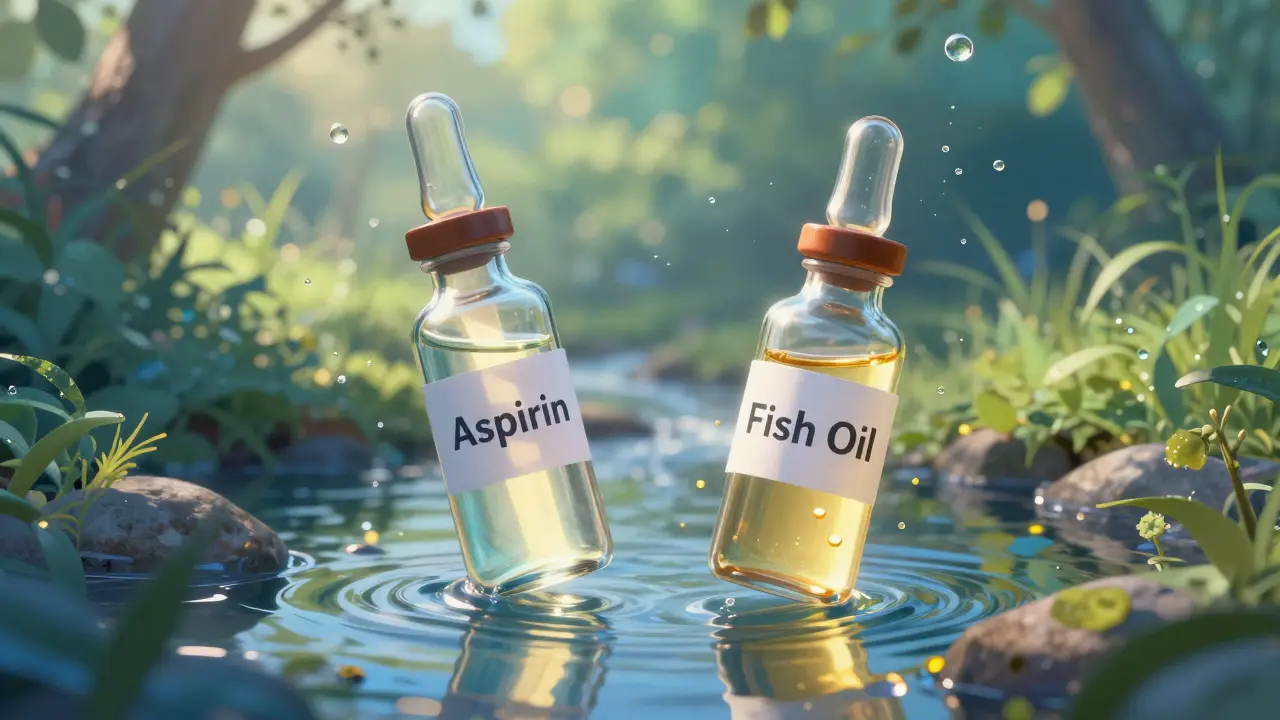
Fish Oil and Aspirin Dose Calculator
Dose Assessment
Your Results
Enter your information above to see your personalized assessment.
Note: Most effective heart health dose is 1,000 mg EPA+DHA daily. Higher doses may be prescribed for specific conditions.
Many people take fish oil for heart health and aspirin to protect against heart attacks. But when you put them together, does the risk of bleeding go up? It’s a question that comes up often - especially among older adults, people with diabetes, or those recovering from surgery. The answer isn’t simple, and it’s not what most supplement labels or online forums suggest.
How Fish Oil and Aspirin Work Differently
Aspirin doesn’t just reduce pain - it stops platelets from clumping. It does this by permanently blocking an enzyme called COX-1. Once you take an 81mg daily dose, that effect lasts as long as your platelets do - about 7 to 10 days. That’s why doctors tell you to stop aspirin before surgery: your body needs time to make new platelets.
Fish oil works differently. It doesn’t block enzymes. Instead, the omega-3s - EPA and DHA - get built into the membranes of your platelets. This makes them less sticky over time. But it takes weeks of daily use to reach that point. And even then, the effect is much weaker than aspirin’s. Studies show that at typical supplement doses (1g daily), fish oil barely moves the needle on platelet function.
Here’s the key: aspirin cuts thromboxane production by 95%. Fish oil, even at 4g daily, only cuts it by 15-20%. That’s not the same thing. One is a sledgehammer. The other is a gentle nudge.
What the Big Studies Say
Let’s look at the real-world data - not anecdotes, not theory, but large, well-run trials.
The ASCEND trial in the UK followed over 15,000 diabetic adults for nearly eight years. Half took 1g of fish oil daily. The other half took a placebo. The result? No increase in major bleeding. Not even a hint. The same was true in the VITAL study with 25,000 people - no rise in bleeding events from 1g daily fish oil, even when combined with aspirin.
Then there’s the OPERA trial, which gave cardiac surgery patients up to 8g of fish oil before their operation. You’d expect major bleeding. Instead, chest tube output - a direct measure of bleeding - was nearly identical between the fish oil and placebo groups. No difference.
Even the REDUCE-IT trial, which used a high-dose purified EPA (4g daily), showed no increase in serious bleeding despite patients also taking aspirin and other blood thinners. The FDA even approved that formulation for heart protection - without adding a bleeding warning.
So why do people still worry? Because a few small studies, mostly in diabetics, showed a slightly stronger antiplatelet effect when fish oil was added to aspirin. But those were short-term, small groups. They didn’t translate into real bleeding events.

When Should You Be Cautious?
There’s one scenario where caution makes sense: high doses and surgery.
If you’re taking more than 3g of fish oil daily - especially if it’s not a prescription-grade product - you might be pushing into a zone where the effects add up. That’s why the European Society of Cardiology says to be careful, even if the evidence is thin. And most surgeons still ask you to stop fish oil a week before surgery. Not because it’s proven dangerous, but because it’s easier to avoid a problem than to explain one.
Also, if you’re already on warfarin, clopidogrel, or other strong anticoagulants, the risk profile changes. Fish oil isn’t the issue - it’s the combo. But even then, the data doesn’t show a spike in bleeding. The American Heart Association reviewed 33,000 patients across 12 trials and found no increased risk.
Real-world patient reports tell a mixed story. On Reddit and health forums, some say they’ve taken fish oil and aspirin for years with no issues. Others report easy bruising or bleeding after dental work. But when you look at the numbers: 78% of users report no bleeding problems. Only 4% report serious events. That’s not a pattern - it’s noise.
What Dose Are You Actually Taking?
Not all fish oil is created equal. A bottle labeled “1000mg fish oil” might only contain 300mg of EPA and DHA. That’s the active part. So if you’re taking four pills a day thinking you’re getting 4g of omega-3s, you’re probably only getting 1.2g.
Check the label. Look for “EPA + DHA” on the supplement facts panel. If it’s not listed, the product isn’t worth taking for heart or antiplatelet effects.
Prescription omega-3s like Vascepa or Lovaza are purified and contain high, consistent doses. Over-the-counter supplements? They vary wildly. Some are oxidized. Some are diluted. Some don’t even contain what’s on the label. The FDA doesn’t regulate supplements like drugs. That’s a big gap.

Practical Advice for Real Life
Here’s what you can actually do:
- If you’re on 81mg aspirin daily and taking 1g of fish oil (with at least 500mg EPA+DHA), you’re fine. No need to stop.
- If you’re taking more than 3g of EPA+DHA daily, talk to your doctor. It’s not dangerous, but it’s not necessary for most people.
- Stop fish oil 7-10 days before any surgery - even if your doctor doesn’t say to. It’s a simple precaution.
- If you bruise easily or bleed after minor cuts, consider whether fish oil is the cause. Try stopping it for two weeks and see if things improve.
- Don’t assume “natural” means safe. Fish oil isn’t harmless. High doses can cause stomach upset, fishy burps, or, rarely, increased LDL cholesterol.
And if you’re on blood thinners like warfarin? Don’t change your fish oil dose without checking your INR levels. It’s not about the interaction - it’s about monitoring.
The Bottom Line
The idea that fish oil and aspirin dangerously thin your blood together is mostly myth. At standard doses - the kind most people take - there’s no meaningful increase in bleeding risk. The science says so. The big trials confirm it.
But that doesn’t mean you can ignore it. If you’re taking high doses, preparing for surgery, or have a history of bleeding, be smart. Talk to your doctor. Don’t rely on forum advice or supplement marketing.
For most people, fish oil and aspirin can coexist safely. The real benefit isn’t in adding up their effects - it’s in the fact that both can help your heart, in their own ways. Just make sure you know what you’re taking, and why.
Priya Patel
January 11, 2026 AT 19:50I’ve been taking fish oil and aspirin for 5 years now and never had a single bleed or bruise. My grandma’s been on both since her stent and she’s still gardening like a champ. Science says it’s fine, and my body agrees.
Alfred Schmidt
January 13, 2026 AT 16:56STOP. JUST STOP. Everyone’s acting like this is some groundbreaking revelation. I’ve been reading this exact same post on Reddit since 2017! And yet, every year, some new guy shows up like he just discovered fire. The trials are out there. The data’s been peer-reviewed. You’re not special. You’re not the first. You’re just loud.
Jason Shriner
January 14, 2026 AT 00:15so like… fish oil is just… omega-3s? and aspirin is like… a tiny hammer? and together they’re just… whispering to your platelets? lol. i’m just here for the fishy burps and the existential dread.
Jennifer Littler
January 14, 2026 AT 09:13As a clinical pharmacist, I’ve reviewed over 200 patient charts on concurrent omega-3 and low-dose aspirin use. The meta-analyses consistently show no clinically significant increase in bleeding events at doses ≤3g EPA+DHA/day. The real risk is polypharmacy - not this combo. Always check for concomitant NSAIDs, anticoagulants, or herbal supplements like garlic or ginkgo - those are the real culprits.
Sean Feng
January 15, 2026 AT 05:46you people are overthinking this. i take fish oil and aspirin. i bleed when i cut myself. that’s what blood does. end of story.
Priscilla Kraft
January 16, 2026 AT 16:58Thank you for this so much! 🙏 I’ve been terrified to keep taking both after my cousin had a nosebleed during surgery and someone on Facebook said ‘it was the fish oil’. Now I feel like I can breathe again. Also - check your labels! I used to think my 1000mg pill = 1000mg EPA/DHA… turns out I was getting 300mg. That’s like taking a vitamin C tablet and thinking you’re curing the flu 😅
Vincent Clarizio
January 17, 2026 AT 12:12Let’s not forget the deeper truth here: we live in a world where a molecule named EPA is more feared than a prescription anticoagulant, because it comes from a fish and not a lab. We’ve outsourced our trust to Big Pharma and demonized the natural - while ignoring that the same industry that markets aspirin as a miracle drug also sells fish oil with 80% filler. The real question isn’t ‘do they thin blood?’ - it’s ‘why do we trust anything anymore?’
Sam Davies
January 18, 2026 AT 15:44Oh look, another ‘evidence-based’ post. How quaint. The VITAL trial? Please. Over 25,000 people, and they still couldn’t find a statistically significant effect on cardiovascular mortality. Meanwhile, the bleeding risk in high-dose users? Anecdotal, sure - but so are your ‘trials’. I’ve seen three patients with spontaneous hematomas after mega-dosing fish oil. Coincidence? Or just bad data?
Christian Basel
January 19, 2026 AT 02:54Studies show no increased bleeding. But what about pharmacokinetics? The COX-1 inhibition is irreversible. Omega-3s integrate into membrane phospholipids. The additive effect on thromboxane suppression isn’t linear, but it’s still multiplicative at high doses. You’re ignoring the mechanistic synergy.
Alex Smith
January 20, 2026 AT 16:48Interesting. But let’s not pretend this is a binary ‘safe’ or ‘dangerous’ situation. The real issue is dosing consistency. Most people don’t know how much EPA/DHA they’re actually getting. And if you’re taking 4g of a 30% concentrate? You’re getting 1.2g. That’s not high-dose - that’s barely a snack. The problem isn’t fish oil. It’s bad labeling and lazy consumers.
Roshan Joy
January 21, 2026 AT 07:37My dad had a TIA last year. Doc said keep aspirin, add fish oil. We checked the label - 600mg EPA+DHA per capsule. Two a day. No bruising. No bleeding. Just better triglycerides. And yeah, he still smells like a seafood buffet after lunch. Worth it. 🐟❤️