
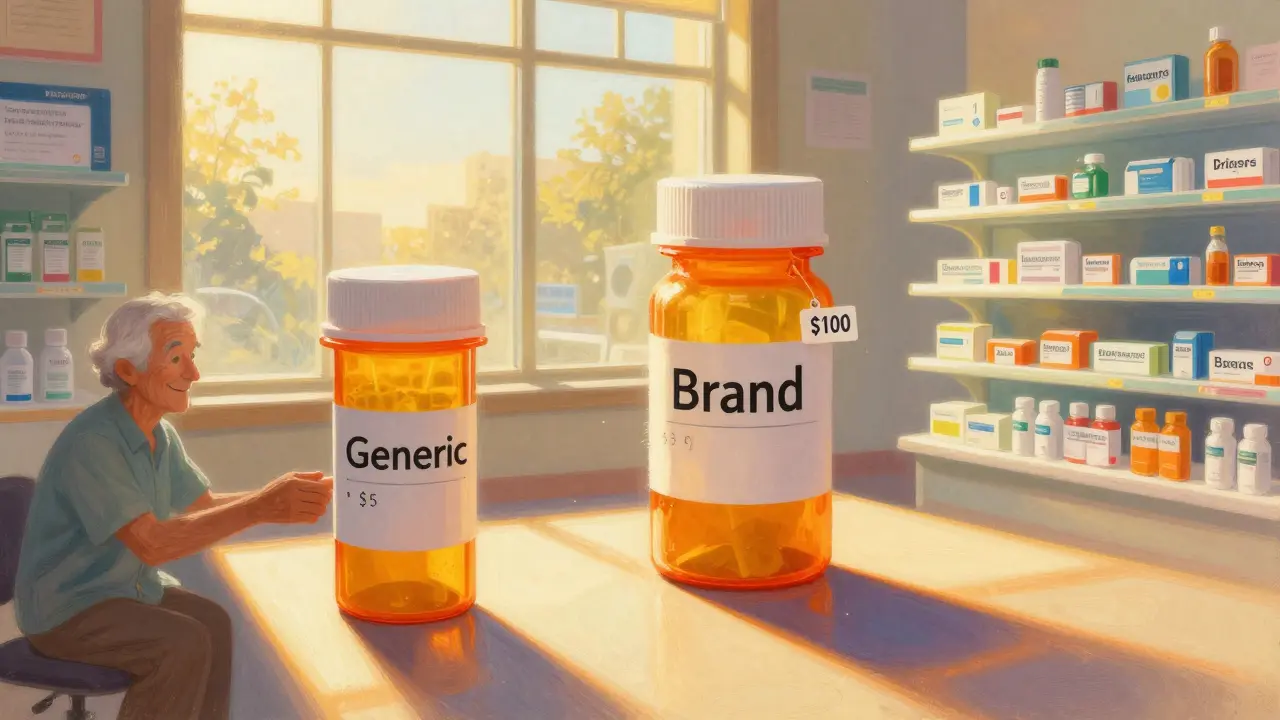
If you’re paying for prescriptions in 2024, you’ve probably noticed a big difference between what you pay for a generic pill versus a brand-name one. It’s not just marketing-it’s how your insurance plan is built. Generic copays are often a fraction of what you pay for brand-name drugs, and that gap can mean hundreds or even thousands of dollars a year. Understanding this system isn’t just helpful-it’s essential if you’re managing chronic conditions, taking multiple medications, or on a fixed income.
How Drug Tiers Work in 2024
Most health plans, including Medicare Part D and private insurance, use a tiered system to control drug costs. Think of it like a ladder: the lower the tier, the cheaper the copay. In 2024, you’ll typically see four or five tiers:- Tier 1: Preferred Generic - The cheapest option. Often $0 to $5 for a 30-day supply.
- Tier 2: Non-Preferred Generic - Slightly higher, usually $5 to $10.
- Tier 3: Preferred Brand - Brand-name drugs your plan encourages. Copays range from $35 to $60.
- Tier 4: Non-Preferred Brand - More expensive brands with no special incentive. Copays jump to $80-$120.
- Tier 5: Specialty - For complex, high-cost drugs like those for cancer or MS. Coinsurance can hit 30% or more, sometimes over $500 per month.
This structure isn’t random. It’s designed to push you toward cheaper, equally effective options. A generic version of a brand-name drug has the same active ingredient, same dosage, same safety profile. The only difference? Price.
Average Copay Numbers in 2024
Here’s what real data shows for out-of-pocket costs in 2024, based on Medicare Part D and commercial plan trends:| Drug Type | Average Copay (Medicare Part D) | Average Copay (Commercial Plans) |
|---|---|---|
| Preferred Generic | $4.50 | $5-$10 (or 10-20% coinsurance) |
| Non-Preferred Generic | $7 | $10-$15 (or 15-25% coinsurance) |
| Preferred Brand | $47 | $40-$70 (or 30-40% coinsurance) |
| Non-Preferred Brand | $100 | $80-$150 (or 40-50% coinsurance) |
| Specialty Drug | $150-$5,030 | $300-$1,000+ (30-50% coinsurance) |
These numbers aren’t guesses-they come from CMS, KFF, and Blue Cross Blue Shield’s 2024 plan data. For example, if you’re on a Medicare Advantage plan, you’re more likely to pay a fixed copay. If you’re on a standalone Part D plan, you might pay a percentage of the drug’s total price. That means if your brand-name drug costs $500, a 47% coinsurance could hit you with $235 out of pocket.
Medicare Advantage vs. Standalone Part D Plans
Not all plans are created equal. In 2024, about 45% of Medicare beneficiaries were in Medicare Advantage Prescription Drug (MA-PD) plans, while 55% were in standalone Prescription Drug Plans (PDPs).MA-PD plans mostly use fixed copays. So if your plan says preferred brand drugs cost $47, you pay $47 every time-no surprises. That makes budgeting easier.
PDPs, on the other hand, often use coinsurance. That means you pay a percentage of the drug’s price. If your drug goes up in cost, so does your bill. For example, if your generic drug price rises from $20 to $30, and your coinsurance is 20%, your copay jumps from $4 to $6. That’s not always obvious when you’re signing up.
Here’s the kicker: 94% of MA-PD enrollees pay a flat $100 for non-preferred brand drugs. But 78% of PDP enrollees pay 47% coinsurance on the same drug. If that drug costs $250, you’re paying $117.50-almost as much as the flat copay. But if the drug costs $500? You’re paying $235. That’s a big difference.
What Happens When You Choose a Brand Over a Generic
Some plans have a rule called “Member Pay the Difference.” If your doctor prescribes a brand-name drug, but a generic is available and covered, you don’t just pay your usual copay. You pay your copay plus the full price difference between the brand and the generic.Example: You need atorvastatin. The generic costs $12. The brand (Lipitor) costs $154. Your plan’s generic copay is $5. But you choose Lipitor because your doctor says it’s better for you. Your plan says: pay your $5 generic copay + $142 difference. Total: $147.
People are shocked by this. Even if the doctor writes “dispense as written,” the plan doesn’t care. The rule still applies. Reddit threads and Medicare forums are full of stories like this. One user paid $95 for a brand-name drug that had a $15 generic alternative. He couldn’t switch because of side effects-but his plan didn’t make an exception.

Extra Help and Low-Income Programs
If your income is low, you might qualify for Extra Help (also called the Low-Income Subsidy). In 2024, this program capped copays at:- Generic drugs: $4.50 per prescription
- Brand-name drugs: $11.20 per prescription
That’s a huge difference from the $100+ others pay. And it’s not just about the copay-it’s about what happens after you hit the coverage gap. Extra Help beneficiaries don’t pay 25% in the donut hole. They pay the same low copays all year.
But here’s the catch: you have to apply. Many people don’t realize they qualify. If you’re on Medicaid, SSI, or have an income under $21,000 (single) or $28,000 (couple), you’re likely eligible. Check with Social Security or your state’s Medicaid office.
The Inflation Reduction Act Changes (2024-2025)
The Inflation Reduction Act of 2022 didn’t just change insulin prices. It’s reshaping the whole system.- Insulin cap: $35 per month for all insulin-brand or generic. Already in effect since 2023.
- Out-of-pocket cap: Starting in 2025, no Medicare beneficiary will pay more than $2,000 a year for drugs. That’s a massive shift.
- Generic copays: 98% of 2025 Medicare plans will offer $0 preferred generic copays. That’s up from 87% in 2024.
- Brand copays: Median non-preferred brand copays are expected to rise to $105 in 2025.
These changes are huge. For people taking multiple brand-name drugs, the $2,000 cap could cut annual costs by nearly 30%. But for those on mostly generics? The savings are smaller because they were already paying little.
What You Should Do Right Now
Don’t wait until you get a bill you can’t afford. Here’s what to do:- Check your plan’s formulary. Every plan must publish it by October 15 each year. Look for your exact medications. Don’t assume the name is the same-check the generic name too.
- Use the Medicare Plan Finder. Enter your drugs, pharmacy, and zip code. It shows you real out-of-pocket costs across plans. It’s updated daily.
- Ask your doctor about alternatives. 72% of Medicare plans have a preferred generic for common brand drugs. Ask: “Is there a generic that works just as well?”
- Calculate your annual cost. A $5 generic copay sounds great. But if your brand drug copay is $100 and you take it every month, you’re paying $1,200 a year. A plan with a $40 brand copay would cost $480. That’s a $720 difference.
- Look into Extra Help. If you’re on a fixed income, apply. It’s free to apply, and it can save you hundreds.

Why This System Exists-and Why It’s Flawed
The tiered system was meant to save money. And it worked. In 2023, 92.7% of prescriptions filled were generics-but they only made up 17% of total drug spending. That’s the power of generics.But the system has cracks. Wholesalers and pharmacies sometimes tie pricing: if you want good deals on brand-name drugs, you have to accept inflated prices on generics. That means your $5 generic might actually cost the plan $15, but you’re still charged $5. The plan makes up the difference elsewhere.
Independent pharmacists report being forced into these deals. It’s not fraud-it’s business. But it distorts the market. And it makes it harder for patients to know what they’re really paying.
Real Stories, Real Costs
A 72-year-old in Florida pays $95 a month for a brand-name heart medication. The generic exists, but she had bad reactions to it. Her plan doesn’t waive the difference. She’s paying $1,140 a year for one pill.A 68-year-old in Ohio switched from a plan with $0 generics to one with $40 brand copays. He takes three brand-name drugs. His annual cost dropped from $1,800 to $480. He didn’t change his meds-he just changed his plan.
According to the Medicare Rights Center, 63% of people using brand-name drugs struggled to afford them in 2024. Only 28% of those on generics did. That’s not about choice-it’s about design.
What’s Coming in 2025
The $2,000 out-of-pocket cap will change everything. By 2025, most people taking expensive drugs won’t pay more than $167 a month-even if their meds cost $10,000 a year. That’s a win.But the system won’t disappear. Generics will still be cheaper. Brands will still cost more. The difference is, now there’s a hard stop. No more sky-high bills. No more choosing between meds and groceries.
For now, know this: your copay isn’t just a number. It’s a reflection of your plan’s structure, your meds, and your income. The right plan can save you thousands. The wrong one can break your budget. Don’t guess. Check. Compare. Ask.
Why is my generic drug more expensive than the brand?
It’s rare, but it can happen due to pharmacy pricing quirks, especially with certain wholesalers who inflate generic prices to maintain relationships with brand drug manufacturers. Always compare cash prices at pharmacies like Costco or Walmart-they often beat insurance copays. Use GoodRx or SingleCare to check.
Can I switch my medication to save money?
Yes, but talk to your doctor first. Many brand-name drugs have generic equivalents that work just as well. In fact, 72% of Medicare plans offer a preferred generic for common brand drugs. Your doctor may be able to switch you without compromising your health.
What if my doctor says I must take the brand name?
You can request a formulary exception from your plan. Submit a letter from your doctor explaining why the generic won’t work. Many plans approve these, especially for conditions like epilepsy, depression, or autoimmune diseases where small differences matter. Don’t assume it’s denied-ask.
Are generic drugs as safe and effective as brand names?
Yes. The FDA requires generics to have the same active ingredient, strength, dosage form, and route of administration as the brand. They must also meet the same strict manufacturing standards. The only differences are inactive ingredients (like fillers), which rarely affect how the drug works.
How do I find the best plan for my meds?
Use the Medicare Plan Finder tool. Enter every medication you take, your pharmacy, and your zip code. Sort by total annual cost-not monthly premium. Look for plans with $0 preferred generics and low brand copays. If you take specialty drugs, check if your pharmacy is in-network. A $10/month premium isn’t worth it if your insulin copay is $80.
Is it worth hiring a Medicare counselor?
If you take three or more medications, yes. Professional plan reviews cost $75-$150 but typically save people $420 a year. Medicare Rights Center offers free counseling to eligible people. Local Area Agencies on Aging also provide free help. Don’t pay full price for meds when free help is available.
Angela Fisher
January 3, 2026 AT 11:38They’re lying to us. 💔 The ‘generic is just as good’ line? Total scam. I’ve been on 3 different generics for my antidepressants-each one made me feel like a zombie with a headache. The brand? I could breathe again. But my plan says I owe $147 extra because I didn’t take the poison they wanted me to. They don’t care if you’re suicidal-they care about their spreadsheets. 🤡
Neela Sharma
January 3, 2026 AT 12:33Life is not a spreadsheet. 🌱
One pill. One breath. One heartbeat.
They turn medicine into a game of chess while we’re just trying to survive.
Let them count the coins.
We’ll keep taking what works.
And we won’t apologize for it.
Shruti Badhwar
January 5, 2026 AT 01:15While the data presented is statistically robust and aligns with CMS and KFF reports, it is imperative to recognize the structural inequities embedded within the tiered formulary system. The financial burden disproportionately impacts marginalized populations, particularly those with chronic conditions who lack access to alternative care pathways. Furthermore, the implementation of the Inflation Reduction Act, while commendable, remains insufficient without concurrent regulatory oversight of pharmaceutical pricing mechanisms. A holistic policy reform must address both payer incentives and manufacturer monopolistic practices to ensure equitable access.
Brittany Wallace
January 6, 2026 AT 05:14I love how this post breaks it all down. 🌍
It’s wild how something so basic-like taking a pill-can feel like navigating a maze built by people who’ve never been sick.
But hey, I’m glad we’re talking about it.
And if you’re reading this and you’re scared to ask your doctor about generics? Just do it.
You’re not being difficult. You’re being smart.
And you’re not alone.
❤️
Michael Burgess
January 7, 2026 AT 14:11Biggest tip I learned the hard way: Always check cash prices. 😅
My $5 generic copay was actually $22 at my pharmacy. But Walmart? $12. Costco? $8.50. GoodRx showed me a coupon for $4.50. Turns out my 'cheap' plan wasn’t cheap at all-just lazy.
Now I use SingleCare for everything. Even my brand meds sometimes cost less than my copay.
Stop letting insurance think they’re doing you a favor. They’re not.
They’re just trying to make you forget you have options.
Liam Tanner
January 9, 2026 AT 14:02My mom switched from a PDP to an MA-PD plan last year. Her non-preferred brand copay dropped from $117 to $100. Sounds minor, but she takes three of them. That’s $500 saved a year. She didn’t even know she could switch until I helped her. If you’re on Medicare, don’t just accept your plan. Review it every fall. It’s free. And it could save your life.
Palesa Makuru
January 11, 2026 AT 01:02Oh please. You think this is bad? Try living in a country where you pay $500 for a single insulin shot and no one even blinks. At least here you have options. Maybe if you stopped whining and started advocating-instead of just posting about it-you’d get somewhere. Also, your doctor probably didn’t say 'dispense as written' because they’re evil. They’re just overwhelmed. Maybe ask them to write a letter instead of blaming the system like a child.
Hank Pannell
January 12, 2026 AT 07:25Let’s deconstruct the tiered formulary through a behavioral economics lens. The system operates on a nudge architecture-leveraging loss aversion and default bias to steer consumption toward lower-cost alternatives. But here’s the paradox: while generics are bioequivalent, pharmacokinetic variability in inactive ingredients can trigger idiosyncratic adverse reactions in up to 12% of polypharmacy patients (per JAMA 2023 meta-analysis). The plan’s 'Member Pay the Difference' clause is a classic case of moral hazard internalization-shifting risk to the patient while maintaining nominal compliance with regulatory standards. The $2,000 cap in 2025? A necessary but insufficient intervention. What’s missing is transparency in wholesale pricing and tiered rebates that inflate brand costs while suppressing generic margins. Until we audit the PBM supply chain, we’re just rearranging deck chairs on the Titanic.