

Hashimoto's thyroiditis is the most common reason people develop hypothyroidism in countries with enough iodine in their diet. It’s not just a slow thyroid-it’s your immune system accidentally attacking your own thyroid gland. This isn’t rare. About 1 in 50 adults have it, and for women over 50, that number jumps to 1 in 10. It’s far more common in women than men-about 10 times more. If you’ve been told your TSH is high but you don’t feel like yourself, this might be why.
What Happens When Your Immune System Attacks Your Thyroid
Your thyroid is a small butterfly-shaped gland at the base of your neck. It makes hormones that control your metabolism, energy, temperature, and even your mood. In Hashimoto’s, your body starts producing antibodies-mainly thyroid peroxidase antibodies (TPOAb)-that target your thyroid cells. These antibodies don’t just sit around; they trigger inflammation and slowly destroy the gland.
Doctors see this in blood tests: high TPOAb in 90-95% of cases, and thyroglobulin antibodies (TgAb) in 60-80%. You can have these antibodies for years before your thyroid starts to fail. That’s called Phase 1: euthyroid with positive antibodies. You feel fine, but your blood tells a different story.
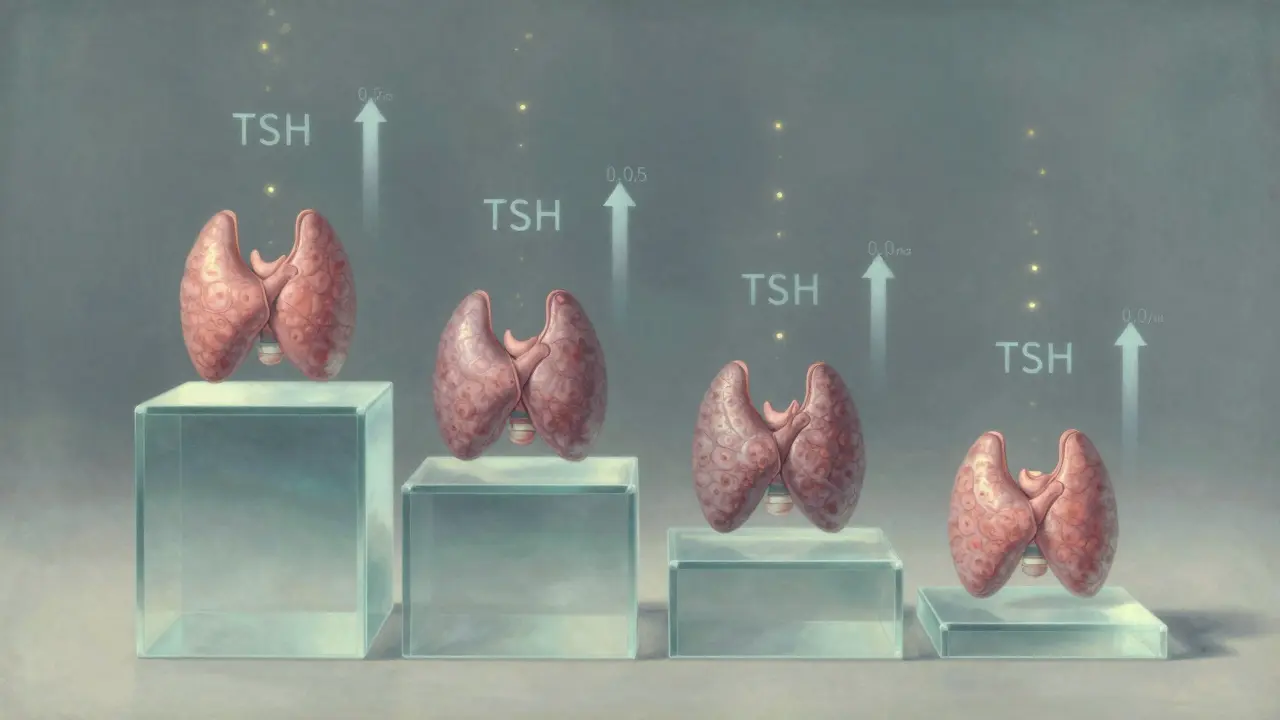
Over time, the damage builds. The thyroid can’t keep up. TSH-thyroid-stimulating hormone-rises because your brain is screaming, “Make more thyroid hormone!” But your thyroid is too damaged to respond. That’s Phase 2: subclinical hypothyroidism. TSH is between 4.5 and 10 mIU/L. Free T4 is still normal. Many people ignore this stage. They shouldn’t.
The Four Phases of Hashimoto’s
This disease doesn’t happen overnight. It unfolds in four clear stages:
- Phase 1: Euthyroid with antibodies - Your thyroid still works. TSH and free T4 are normal. But antibodies are already there. This can last years.
- Phase 2: Subclinical hypothyroidism - TSH climbs above 4.5 mIU/L. Free T4 stays normal. You might feel tired, cold, or foggy. Many doctors don’t treat yet.
- Phase 3: Overt hypothyroidism - TSH jumps above 10 mIU/L. Free T4 drops. Symptoms get worse: weight gain, dry skin, depression, brain fog, constipation. This is when most people get diagnosed.
- Phase 4: Atrophy - The thyroid shrinks. The goiter (swelling) disappears. TSH stays high, but the gland is mostly gone. Treatment becomes stable.
Some people never reach Phase 4. Others move through all four in under two years. It’s unpredictable. That’s why monitoring TSH isn’t optional-it’s essential.
TSH Management: More Than Just a Number
TSH is your main guide, but it’s not the whole story. For most adults, a TSH between 0.5 and 4.5 mIU/L is considered normal. But that range is too broad. Studies show people feel best when their TSH is between 1.0 and 2.0 mIU/L. That’s especially true for younger people, those with heart conditions, or anyone still struggling with symptoms.
For pregnant women, the target is even tighter: under 2.5 mIU/L in the first trimester. A TSH above that increases miscarriage risk by 2.3 times. Many OB-GYNs don’t test thyroid function during pregnancy. That’s a mistake.
And here’s something most patients don’t know: TSH can be wrong. In 5-10% of Hashimoto’s cases, antibodies interfere with the test, making TSH look higher than it really is. That’s why doctors should always check free T4 when symptoms don’t match the TSH. If your TSH is “normal” but you’re still exhausted, ask for a free T4 test.
Levothyroxine: The Standard Treatment
Almost everyone with overt hypothyroidism from Hashimoto’s needs levothyroxine. It’s a synthetic version of T4, the main hormone your thyroid makes. It’s cheap, safe, and effective-for most people.
Dosing starts low, usually 25-50 mcg per day. You take it on an empty stomach, at least 30-60 minutes before food or coffee. Calcium, iron, and even soy can block absorption. If you take a calcium supplement, wait four hours. Same with antacids or fiber supplements.
It takes 4-6 weeks for your body to fully adjust to a new dose. That’s why you don’t retest TSH every month. Wait 6-8 weeks after a dose change. Test in the morning, before taking your pill. If you test after your dose, your TSH will be falsely low.
And don’t take biotin. That’s the supplement people take for hair and nails. It can throw off your TSH test by 20-30%. Stop it at least 3 days before your blood draw.
Why Some People Still Feel Bad on Levothyroxine
Here’s the hard truth: 10-15% of people with Hashimoto’s stay tired, depressed, or bloated-even when their TSH is perfect. Why?
One reason: your body might not convert T4 to T3 (the active hormone) well. Some people take T3 (liothyronine) with T4. But a major 2017 meta-analysis of 87% of patients showed no real benefit over T4 alone. The American Association of Clinical Endocrinologists says don’t do it routinely. Only consider it if you’ve been on optimal levothyroxine for 6 months and still have symptoms.
Another reason: gluten. A lot of people with Hashimoto’s are sensitive to gluten-even if they don’t have celiac disease. Studies show eliminating gluten can lower antibody levels and reduce inflammation. It’s not a cure, but it helps some people feel better.
Stress, sleep, and seasonal changes matter too. TSH levels naturally rise in winter-up to 1.8 mIU/L higher than in summer. That’s why some people need higher doses in January than in July.
What Patients Are Really Experiencing
On patient forums like Reddit’s r/Hashimotos, thousands share their stories. Over half say their TSH fluctuates even when they take their pill every day. Common triggers? Stress (41%), seasonal changes (27%), and gluten (32%).
One surprising thing: 63% of patients report a phase called “hashitoxicosis.” That’s when the thyroid gets so inflamed it leaks stored hormones, causing temporary hyperthyroidism. Symptoms: racing heart, anxiety, weight loss, sweating. It lasts 2-8 weeks. Then the thyroid burns out, and hypothyroidism returns. Many people think they’re getting better-until they crash.
And here’s the frustration: 68% of patients need three or more dose changes before they feel normal. It’s not about being “non-compliant.” It’s about a complex, changing disease. Your body isn’t broken. It’s just fighting itself.

What’s Next? The Future of Hashimoto’s Treatment
Levothyroxine will remain the standard for years. But new research is emerging. Scientists are now studying drugs that block the immune attack-targeting specific T-cells involved in the destruction. There are 12 Phase II trials underway, with results expected by 2028.
Another breakthrough: researchers found that 25% of treatment-resistant Hashimoto’s patients have antibodies that block the TSH receptor-something previously only seen in Graves’ disease. That means some “Hashimoto’s” cases might actually be a hybrid. That could lead to new treatments.
By 2030, doctors may use genetic testing to predict who will respond poorly to levothyroxine. Polymorphisms in genes like CTLA-4 and PTPN22 could help tailor TSH targets. Imagine knowing your ideal TSH before you even start treatment.
For now, the best advice is simple: test consistently, take your pill correctly, track your symptoms, and don’t settle for “normal” TSH if you still feel awful. Your body is trying to tell you something.
When to See an Endocrinologist
You don’t need one right away. Many primary care doctors manage Hashimoto’s well. But see a specialist if:
- Your TSH keeps jumping despite consistent dosing
- You have symptoms but your TSH is “normal”
- You’re pregnant or planning to be
- You have other autoimmune diseases (like type 1 diabetes or celiac)
- You’ve had radiation or thyroid surgery
Endocrinologists know the nuances. They check free T4, look for antibody interference, and adjust for seasonal changes. They don’t just look at the number-they look at you.
Key Takeaways
- Hashimoto’s is an autoimmune disease that slowly destroys the thyroid, leading to hypothyroidism.
- High TSH and positive TPOAb are the main diagnostic markers.
- Target TSH for most adults: 1.0-2.5 mIU/L. For pregnant women: under 2.5 mIU/L.
- Take levothyroxine on an empty stomach, 30-60 minutes before food or coffee.
- Avoid calcium, iron, soy, and biotin within 4 hours of your dose.
- Test TSH in the morning, before taking your pill, and wait 6-8 weeks after a dose change.
- If you still feel bad despite a “normal” TSH, ask for a free T4 test.
- Gluten, stress, and seasonal changes can affect symptoms and TSH levels.
- Hashitoxicosis (temporary hyperthyroidism) happens in up to 63% of patients early on.
ANA MARIE VALENZUELA
December 29, 2025 AT 14:33Let me just say this: if you're still on levothyroxine and feeling like a zombie, you're not 'non-compliant'-you're being gaslit by outdated medical guidelines. TSH isn't a god. It's a flawed metric. I've had TSH at 2.1 and still couldn't get out of bed. Free T4? Check. Free T3? Never tested. That's the problem. Doctors treat labs, not humans. Stop accepting 'normal' as your new baseline. You deserve to feel alive.
And yes, gluten absolutely matters. I cut it out after 3 years of brain fog. My TPOAb dropped 40% in 6 months. If your doctor says 'it's not celiac so it doesn't matter,' fire them. This isn't a diet trend. It's immunology.
Bradly Draper
December 30, 2025 AT 05:31I just wanted to say thanks for writing this. I was diagnosed last year and felt so alone. I didn’t know about phase 1 or hashitoxicosis. I thought I was just lazy. Now I get why I lost 10 lbs in a month then gained it all back. My doctor never mentioned any of this. I’m taking my pill right now, 30 mins before coffee. Small wins.
Gran Badshah
December 30, 2025 AT 07:51My mom had this and they just gave her pills and said 'you're fine' for 7 years. She ended up in hospital with heart issues. Don't wait until you're crashing. Test TPOAb even if you feel okay. If you have family history, get checked. India has no thyroid awareness. I'm telling everyone I know.
Also stop eating bread. It's poison for your thyroid. I cut it out. My energy came back. Simple.
Ellen-Cathryn Nash
December 31, 2025 AT 02:12People who ignore gluten and stress are just choosing denial over health. I’ve seen too many women in their 40s and 50s suffer needlessly because they’d rather take a pill than face the truth: their lifestyle is screaming at them.
And biotin? That’s not a supplement-it’s a lie. It’s not helping your hair, it’s messing with your test results. You’re not fooling your body, you’re fooling yourself. Stop treating your thyroid like a broken radio you can just tune. It’s a sacred organ. Treat it like one.
I’m not mad. I’m just disappointed in how little we’ve learned about our own bodies.
Samantha Hobbs
January 1, 2026 AT 05:52OMG I thought I was crazy. My TSH was 3.8 and I was crying in the shower every morning. My doctor said 'it's fine.' I went to a naturopath and she said 'you're in phase 2' and told me to go gluten-free. I did. I cried less. I slept better. I didn't even know that was possible. Also, biotin is evil. I stopped it. My next test was accurate. Thank you for saying this out loud.
Nicole Beasley
January 3, 2026 AT 05:00THIS. I’ve been in phase 1 for 5 years. Antibodies up, TSH normal, but I feel like I’m underwater. 😔 I just started tracking my symptoms in a journal. I noticed my brain fog spikes every winter. And yes, I’m taking my pill at 6am, no coffee until 7:30. 🙌 I’m also going gluten-free for 30 days. Wish me luck! I’ll report back. 🌱🫶
sonam gupta
January 4, 2026 AT 16:25Julius Hader
January 5, 2026 AT 09:36Just wanted to say I’ve been on levothyroxine for 8 years. My TSH is 1.7. I feel amazing. But I also meditate daily, sleep 8 hours, and avoid soy like it’s poison. It’s not just the pill. It’s the whole package. I used to think I was broken. Now I know I just needed the right system. Don’t give up. You’re not alone. And yes, winter doses are higher. I increase mine by 12.5 mcg in December. It’s science, not magic. 💪