
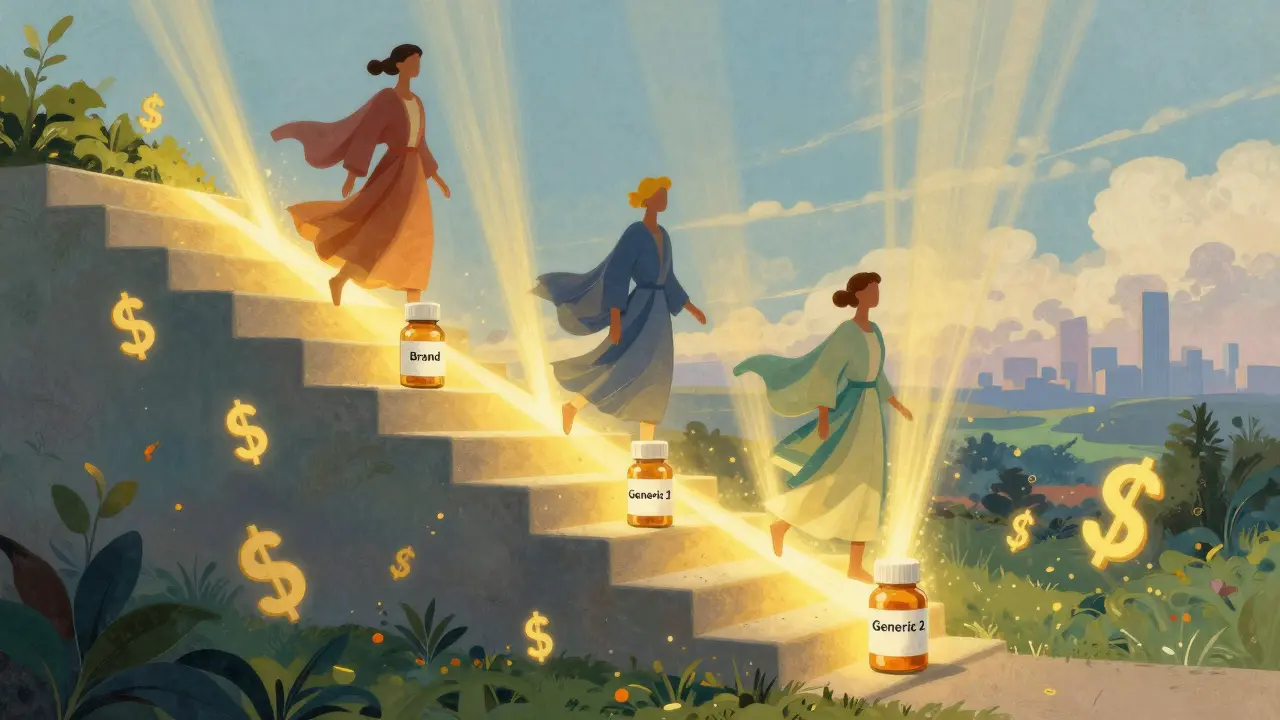
When a brand-name drug loses its patent, the first generic version usually hits the market at about 87% of the original price. That sounds like a big drop-but it’s only the beginning. The real savings come when a second and then a third generic manufacturer enters the race. These later entrants don’t just add choice-they crush prices.
Why the second generic changes everything
The first generic maker has a window of exclusivity, even after the brand’s patent expires. That’s because the FDA gives the first filer a 180-day period to be the only generic on the market. During that time, they can charge more-sometimes close to brand prices. But once that window closes, the floodgates open. When the second generic arrives, prices don’t just dip. They plummet. According to FDA data from 2018-2020, the second generic brings prices down to just 58% of the original brand price. That’s a 31% drop from the first generic’s price. It’s not magic. It’s basic economics: two companies selling the same pill can’t both charge high prices. One undercuts the other. The other responds. And prices keep falling. This isn’t theoretical. In 2021, the Assistant Secretary for Planning and Evaluation at HHS analyzed real-world data from 2016-2019 and found that markets with just two generic manufacturers saw prices drop by 20% within three years. But add a third, and the drop jumps to 36% from the brand price. That’s where the real savings kick in.The third generic: the price breaker
The third generic is where things get dramatic. Once three manufacturers are competing, prices fall to about 42% of the brand’s original cost. That’s more than half off from where they started. In some cases, like with the cholesterol drug simvastatin, prices dropped over 90% after five generics entered the market. Why does the third matter so much? Because competition shifts from duopoly to triopoly. With only two players, there’s an unspoken understanding-they might avoid undercutting each other too hard. But when a third enters, that balance shatters. Now, each company has to fight harder to win shelf space, pharmacy contracts, and insurer deals. They can’t afford to be passive. A University of Florida study in 2017 found that when a market goes from three competitors to two, prices don’t just stabilize-they spike. Some drugs saw price increases of 100% to 300% after one manufacturer exited. That’s the flip side of this system: fewer competitors = higher prices. So the third generic isn’t just helpful-it’s essential to prevent price manipulation.How much money does this save patients?
The numbers are staggering. Between 2018 and 2020, the FDA estimated that the 2,400 new generic drugs approved in that window saved patients and insurers a total of $265 billion. That’s not a guess. It’s based on tracking actual wholesale prices, pharmacy acquisition costs, and manufacturer reports. But here’s the catch: most of those savings came from the second and third entrants. The first generic saved money, yes-but the real windfall came when more manufacturers joined. A 2021 analysis by the ASPE found that markets with three or more generic competitors delivered 60-90% price reductions compared to the brand. That’s the difference between paying $150 for a month’s supply of a drug and paying $15. For patients on Medicare or Medicaid, this isn’t just about convenience. It’s about access. A study from the Blue Cross Blue Shield Association showed that when generic competition is strong, out-of-pocket costs for patients drop by an average of $200 per prescription annually. For someone taking multiple generics, that’s thousands saved each year.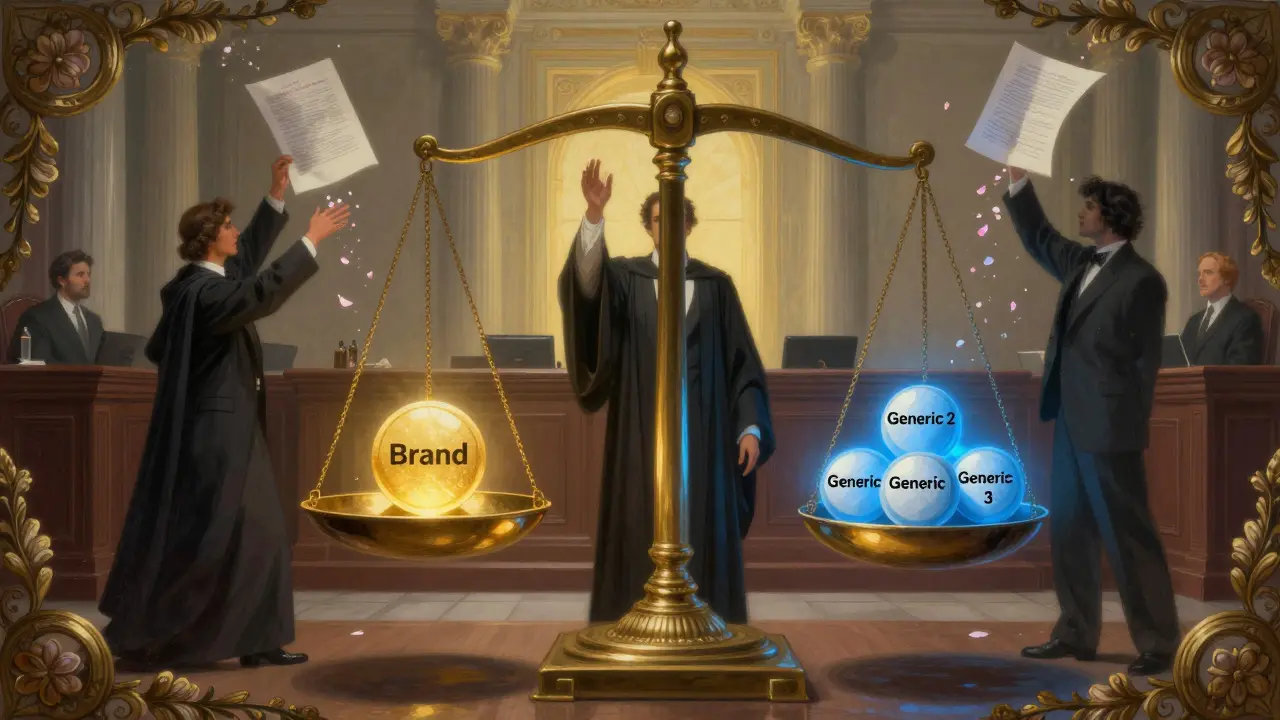
Why aren’t there always three generics?
If this system works so well, why do so many drugs still have only one or two generics? The answer isn’t about science-it’s about strategy. Brand-name companies use legal tricks to delay generics. One common tactic is “pay for delay”-where the brand pays a generic manufacturer to hold off on launching. The Federal Trade Commission estimates these deals cost patients $3 billion a year in higher costs. In 2023, the Blue Cross Blue Shield Association found that pay-for-delay deals cost the U.S. system nearly $12 billion annually. Another problem is “patent thicketing.” Some brands file dozens of minor patents-on packaging, dosing schedules, or inactive ingredients-to block generics from entering. One drug, for example, had 75 patents stretched over nearly two decades, keeping generics out until 2034. Then there’s the supply chain. Three companies-McKesson, AmerisourceBergen, and Cardinal Health-control 85% of the U.S. drug distribution network. Three PBMs-CVS Caremark, Express Scripts, and OptumRx-handle 80% of prescriptions. These giants have enormous power to choose which generics they stock. If they favor a single supplier, even if others are cheaper, the market stays weak. A 2017 University of Florida study found nearly half of all generic drug markets operated as duopolies-with only two manufacturers. That’s half the competition needed to drive prices to their lowest point.What’s being done to fix it?
The government is trying. The 2022 CREATES Act makes it harder for brand companies to block generic manufacturers from getting the samples they need to test their products. The Preserve Access to Affordable Generics and Biosimilars Act targets pay-for-delay deals, with penalties for companies caught in them. The FDA’s GDUFA III program, running from 2023 to 2027, is pushing to speed up approvals for complex generics-like inhalers, injectables, and topical creams-where competition has been slow to develop. These drugs are harder to make, so fewer companies bother. But when they do enter, the price drops are huge. Pharmacy benefit managers are starting to respond, too. Evernorth Health Services found that PBMs get better discounts when there are more generic options. They use that leverage to push for lower prices-especially when three or more manufacturers are available.
What’s next for generic pricing?
The trend is clear: more competitors = lower prices. Evaluate Pharma projects generic drug prices will keep falling 3-5% per year through 2027-assuming enough companies keep entering the market. But consolidation is a threat. Teva bought Allergan’s generics division. Mylan and Upjohn merged to form Viatris. These deals reduce the number of independent players. Fewer manufacturers mean less competition. And less competition means higher prices. The Congressional Budget Office warns that without stronger enforcement of antitrust laws, Medicare could lose $25 billion a year by 2030 because of delayed generic competition. That’s money that could go to patient care, not corporate profits. The bottom line? The second and third generic entrants are the most powerful tool we have to lower drug prices. They’re not just alternatives-they’re price anchors. When they show up, prices drop. When they’re blocked, patients pay more. If you’re taking a generic drug today, ask: How many manufacturers make it? If it’s just one or two, you’re probably paying more than you should. And if you’re a policymaker, a pharmacist, or even a patient advocate-you should be asking why more competitors aren’t allowed in.What you can do
- Ask your pharmacist: “Are there other generic versions of this drug available?” - Check your insurance formulary: Does it list multiple generic manufacturers? - If your drug has only one generic, ask your doctor if switching to another with more competition is an option. - Support legislation that blocks pay-for-delay deals and speeds up generic approvals. The system works when competition is real. Right now, it’s working-but only for some drugs. The rest are waiting for the second or third manufacturer to show up.Why do drug prices drop so much when a second generic enters the market?
When the second generic enters, it forces the first generic to lower its price to stay competitive. Before the second entry, the first generic had little pressure to cut prices. Once there are two sellers, each tries to win business by offering a better price. This drives the price down to about 58% of the original brand cost, according to FDA data.
How much do prices drop when a third generic is added?
Adding a third generic typically brings prices down to 42% of the brand’s original price. That’s a 27% further drop from the second generic’s price. In some cases, prices fall over 90% when five or more manufacturers compete. The key is volume: more sellers = more pressure to lower prices.
Why do some drugs still have only one generic manufacturer?
Brand companies often use legal tactics to delay competition, like paying generics to wait (pay-for-delay) or filing dozens of minor patents to block entry. Also, if a drug is hard to make-like an inhaler or injectable-fewer companies can produce it. And with only three major wholesalers and PBMs controlling most of the market, they may choose to stock only one generic, even if others are cheaper.
Do generic drug prices ever go up?
Yes-when competition disappears. If one of two manufacturers exits the market, prices often spike by 100% to 300%. This happened in multiple cases studied by the University of Florida. It’s not about cost-it’s about control. With fewer sellers, the remaining one can raise prices without losing customers.
How do pharmacy benefit managers (PBMs) affect generic pricing?
PBMs negotiate discounts with drug makers. When there are three or more generic manufacturers, PBMs have more leverage to demand lower prices. But if only one or two generics exist, PBMs have less power. That’s why they push for more competition-they save money for insurers and patients when more options are available.
Can I ask my doctor to switch me to a generic with more competition?
Absolutely. If your prescription has only one generic maker, ask your doctor if another version-made by a different company-is available and covered by your plan. Many drugs have multiple generic brands with identical ingredients. Choosing one with more competition can lower your cost.
Are generic drugs as safe as brand-name drugs?
Yes. The FDA requires all generic drugs to have the same active ingredient, strength, dosage form, and route of administration as the brand. They must also meet the same quality and safety standards. The only difference is the price-and sometimes the color or shape of the pill.
Alex Curran
December 19, 2025 AT 15:25I've seen this play out with my blood pressure med. First generic was $45, second dropped it to $18, third hit $9. I didn't even know there were three versions until my pharmacist mentioned it. Now I just ask for the cheapest one and let them fill it. Simple as that.
Kitt Eliz
December 19, 2025 AT 19:51YESSSS this is the REAL drug pricing revolution 🚀 The FDA data doesn't lie - second and third generics are the ultimate price destroyers 💥 When you get 3+ players, it’s not a market anymore, it’s a bloodbath in the best way possible. PBMs should be screaming for more competitors, not cozying up to monopolies. #GenericWarrior
Laura Hamill
December 20, 2025 AT 05:40They don’t want you to know this but the FDA is in bed with Big Pharma. Why do you think it takes 5 years for a third generic to show up? Because they’re paid off. Pay-for-delay isn’t some loophole - it’s a cartel. And the three big PBMs? They’re just front men. You think your $15 pill is cheap? Wait till you see what they charge the government. This isn’t capitalism - it’s corporate feudalism.
Dikshita Mehta
December 21, 2025 AT 18:17Interesting how the third entrant breaks the duopoly dynamic. In India, we see this with antibiotics - when a third manufacturer enters, prices often halve within months. It’s not about quality, it’s about scale and competition. The FDA’s data aligns with global trends. More players = better outcomes. Simple economic principle.
pascal pantel
December 23, 2025 AT 00:06Let’s cut through the noise. The 58% and 42% figures are cherry-picked from a narrow dataset. You’re ignoring the fact that many generics are bioequivalent but not therapeutically identical. Also, who tracks actual patient outcomes? The FDA doesn’t require long-term studies for generics. So yes, prices drop - but are you getting the same clinical result? Probably not. And that’s the real cost.
Gloria Parraz
December 23, 2025 AT 23:25This is why I fight for patients every day. When I see someone choosing between food and their meds, it breaks my heart. But when a third generic hits? That’s the moment hope shows up. I’ve had patients cry because their copay dropped from $120 to $12. Don’t underestimate this. It’s not just numbers - it’s dignity.
Sahil jassy
December 24, 2025 AT 08:22My dad takes 5 generics. One had 3 makers - he saves $300/month. That’s a vacation. Simple math. If your pharmacy only stocks one, ask for another. They can order it. No big deal. Just speak up.
Carolyn Benson
December 26, 2025 AT 06:24Competition is a myth. The real power lies in who controls the supply chain. Three wholesalers. Three PBMs. One boardroom. The generics are just actors on a stage. The script was written before the first patent expired. You think price drops are organic? No. They’re orchestrated. The illusion of choice is the most dangerous illusion of all.
William Liu
December 28, 2025 AT 03:56This is the kind of info we need more of. Too many people think generics are ‘inferior’ or ‘cheap knockoffs’. Nope. Same active ingredient. Same FDA approval. Just cheaper because someone else made it. More competitors = better for everyone. Keep pushing for transparency.
Aadil Munshi
December 28, 2025 AT 07:47Oh wow, so the third generic is the hero? Cute. But let’s be real - the real hero is the FDA’s slow approval process. If they approved generics in 6 months instead of 2 years, we’d have 10x more competition. Blaming pharma for delays is like blaming the rain for wet sidewalks. The system is broken by design. And yes, I’m still salty about my thyroid med taking 4 years to get a second maker.
Danielle Stewart
December 29, 2025 AT 17:05As a pharmacist, I can confirm: when three manufacturers are available, we see a 40-60% reduction in patient out-of-pocket costs. We actively promote the lowest-cost generic - not because we’re cheap, but because it’s the right thing. Patients deserve access, not corporate math.
Erica Vest
December 29, 2025 AT 19:05Just checked my last script: simvastatin. Five generics available. Cost: $4.27 for 30 pills. Brand was $180. This isn’t just savings - it’s systemic justice. The FDA’s GDUFA program is working. Support it. Advocate for it. This model proves that regulated competition works.
shivam seo
December 30, 2025 AT 08:33Look, I don’t care how many generics there are. The real problem is that Americans pay 3x what Canadians pay for the same pills. Stop blaming manufacturers. Blame the system that lets US drug prices be the highest in the world. Fix that first.