

The U.S. Food and Drug Administration (FDA) collects over 2 million adverse event reports every year. These aren’t just numbers-they’re real stories from patients, doctors, and pharmacists about unexpected side effects from medications. If you’re a researcher, a patient advocate, or even a curious healthcare worker, you can access this data for free. But knowing where to look and how to interpret it? That’s where most people get stuck.
What Is the FDA FAERS Database?
The FDA Adverse Event Reporting System, or FAERS, is the government’s main database for tracking side effects after drugs hit the market. It’s not a clinical trial. It’s real-world data: people taking meds at home, in nursing homes, in emergency rooms. The system started in 1969, but today it holds over 30 million reports. That’s more than any other national system in the world.Every report includes basic info: who took the drug, what they took, what happened, and who reported it. The FDA uses this to spot patterns-like if a new diabetes drug suddenly shows up in hundreds of reports about liver damage. That’s how warnings get added to labels, or sometimes, how drugs get pulled.
But here’s the catch: FAERS doesn’t prove a drug caused the side effect. It just shows a possible link. A report saying someone had a heart attack after taking ibuprofen doesn’t mean ibuprofen caused it. Maybe they had heart disease. Maybe they took it with another med. The database can’t tell you that. It only shows what was reported.
How to Access FAERS: Three Ways
You don’t need special clearance to use FAERS. The FDA makes it public. But they offer three different ways in, depending on what you want to do.
- FAERS Public Dashboard - The easiest way. Just go to the FDA’s website, pick a drug, select an adverse event (like "dizziness" or "kidney failure"), and see how many reports show up over time. No coding. No downloads. It’s built for anyone.
- Quarterly Data Extracts - If you need raw data, the FDA releases files every three months. These are in XML or ASCII format and contain every field from every report. You’ll need software like R or Python to open them. Each file is 1-5 GB. That’s not a typo.
- OpenFDA API - For developers. You can pull FAERS data directly into your app or analysis tool using JSON. You can search by drug name, event code, or date range. But you need to know how to write API calls.
The Public Dashboard is perfect for quick checks. Say you’re worried about a new weight-loss pill. Type it in. See if there’s a spike in reports about high blood pressure or panic attacks. You’ll get charts showing trends over the last year. It’s powerful-but limited. You can’t compare two drugs side by side. You can’t filter by age group beyond broad ranges. That’s where the raw data comes in.
Understanding the Data: MedDRA and Reporting Biases
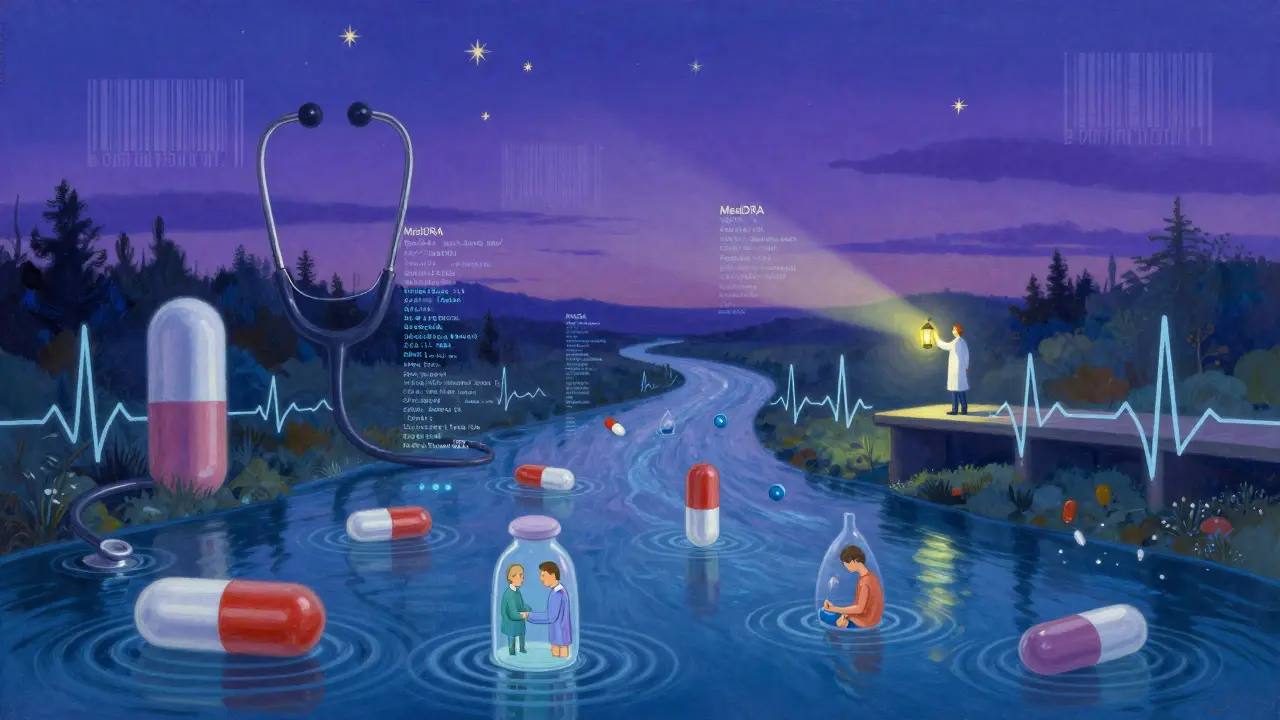
All adverse events in FAERS are coded using something called MedDRA-the Medical Dictionary for Regulatory Activities. It’s a giant dictionary with over 30,000 terms. "Headache" isn’t just "headache." It could be "mild headache," "severe headache," "occipital headache," or "headache with photophobia."
Most users don’t realize how much this matters. If you search for "headache," you’ll miss all the more specific terms unless you know how to expand the search. That’s why many researchers spend 40-60 hours just learning MedDRA before they can do real analysis.
There’s also a big bias in who reports what. About 75% of reports come from drug companies. They’re required to report anything serious. The other 25% come from doctors and patients through the MedWatch program. Patients tend to report mild stuff-rash, nausea. Doctors report serious stuff-hospitalizations, deaths. So if you see a lot of reports about a drug causing fainting, it might mean it’s dangerous. Or it might mean a bunch of doctors noticed it in ERs and filed reports.
And then there’s underreporting. Studies estimate only 1-10% of actual adverse events get reported. If a drug causes a rare side effect that only shows up after five years? It might never show up in FAERS. That’s why the FDA says: "This data alone can’t tell you how common a side effect is."
Who Uses FAERS and Why?
Academic researchers use FAERS the most-55% of users. They’re writing papers on drug safety, looking for signals in rare conditions, or validating findings from clinical trials. One team at Johns Hopkins used FAERS to find that a common antidepressant, when taken with a diabetes drug, increased the risk of low blood sugar in older adults. That interaction wasn’t known before. It led to updated prescribing guidelines.
Pharmaceutical companies (30%) use FAERS too, but mostly through commercial tools like Oracle Argus or IBM Watson. They pay for software that automates signal detection, connects FAERS data to electronic health records, and flags potential risks before the FDA does.
Patient groups (15%) are the unsung heroes. In 2022, a group of parents used FAERS to find a pattern of seizures in children taking a new ADHD medication. Their advocacy led to a safety review and updated warnings. Without public access, that discovery might never have happened.
Limitations You Can’t Ignore
FAERS is a treasure trove-but it’s messy. Here are the real problems:
- No denominator data - You can’t calculate how often a side effect occurs. If 500 people report nausea after taking Drug X, but 5 million people took it? That’s a tiny risk. If only 1,000 people took it? That’s a red flag. FAERS doesn’t tell you how many people used the drug.
- Incomplete reports - About 30% of reports are missing key info: age, gender, dosage, or medical history. That makes analysis harder.
- Reporting delays - It takes months for reports to show up. A new side effect might appear in January, but you won’t see it in the data until April.
- No causality - Again: correlation ≠ causation. A drug showing up in 200 reports about liver damage doesn’t mean it caused it. Maybe those patients had hepatitis.
Experts like Dr. Robert Ball from the FDA say FAERS is best for generating hypotheses-not proving them. You find a pattern, then you go do a real study. That’s how science works.
What’s New in 2026?
On January 16, 2024, the FDA switched to the ICH E2B(R3) standard for electronic submissions. That means reports now include more detail-like exact dosages, timing of symptoms, and whether other drugs were taken. It’s more structured, more machine-readable.
The FDA is also working on two big upgrades:
- A new API for the Public Dashboard, launching late 2024, so developers can pull charts and filters directly into their tools.
- Natural language processing (NLP) by Q3 2025, so you can type "I got dizzy after taking this pill" and the system will match it to the right MedDRA code.
Long-term, the FDA is integrating FAERS with real-world data from Medicare, Medicaid, and private insurers. That means they’ll soon know not just what side effects were reported-but how many people took the drug. That’s the holy grail.

Getting Started: Your Action Plan
If you want to use FAERS, here’s how to begin:
- Start with the Public Dashboard - Go to fda.gov/faers. Try searching for a drug you know. Look at the trend graph. See how many reports there are per quarter.
- Learn MedDRA basics - Download the free MedDRA Quick Reference Guide from the FDA website. Focus on the top 100 terms: headache, nausea, dizziness, fatigue, rash, vomiting, diarrhea.
- Try a real question - "Has there been an increase in reports of suicidal thoughts with this antidepressant since 2020?" Use the dashboard to find out.
- Download a quarterly file - If you’re comfortable with Excel or Python, grab the latest XML extract. Open it in a text editor first. See how the data is structured.
- Use the support tools - The FDA offers free quarterly webinars. Email [email protected] with questions. They respond in 3-5 business days.
Don’t try to analyze everything at once. Start small. Find one drug. Find one side effect. Understand the trend. Then go deeper.
Frequently Asked Questions
Is the FAERS database free to use?
Yes. The FAERS Public Dashboard, quarterly data extracts, and OpenFDA API are all completely free. You don’t need to pay for access, register for an account, or sign a license agreement. The FDA provides this data to support public health research and transparency.
Can I report an adverse event to FAERS myself?
Yes. Anyone-patients, caregivers, or healthcare providers-can report an adverse event through the FDA’s MedWatch program. Visit the FDA’s Safety Reporting Portal (SRP) to submit a report online. You’ll need basic details: the drug name, what happened, and your contact info (optional). Reports from the public make up about 25% of the database and are vital for spotting rare or unexpected side effects.
Why do some drug safety signals disappear from FAERS?
They don’t disappear. FAERS data is cumulative, so older reports are still there. But the Public Dashboard defaults to showing the last 10 years. If you need older data, you must download historical quarterly files. Also, some reports get flagged as duplicates or errors and are removed during FDA’s data cleaning process-this can make a signal seem to vanish, but it’s usually just a data quality update.
How long does it take for a report to appear in FAERS?
It can take 3 to 6 months. Pharmaceutical companies have 15 days to report serious events to the FDA, but it takes additional time for data entry, coding, and validation. Reports from the public via MedWatch may take longer. The FDA releases data quarterly, so a report filed in January won’t show up in the public database until April.
Can I use FAERS data to sue a drug company?
No. FAERS data is not admissible as legal proof of causation. Courts recognize that the database shows associations, not cause-and-effect relationships. While lawyers may use FAERS to identify potential patterns, they must rely on clinical studies, expert testimony, and medical records to prove liability. The FDA explicitly states that FAERS data should not be used to establish legal responsibility.
Is my personal information safe in FAERS?
Yes. The FDA removes all directly identifying information-names, addresses, Social Security numbers-before releasing public data. Reports use initials, approximate age ranges, and gender only. The system follows strict HHS privacy guidelines. Even researchers accessing raw data must sign agreements limiting use to safety analysis only.
Next Steps
If you’re just exploring, stick with the Public Dashboard. It’s designed for you. If you’re doing academic research, download the latest quarterly extract and pair it with free tools like R or Python. Use the FDA’s training videos. Join a webinar. Talk to someone who’s done it before.
Don’t treat FAERS like a magic bullet. It’s a starting point. The real work begins when you ask: Why did this happen? What else was going on? Is this a signal-or just noise?
That’s how safety monitoring works. Not with perfect data. But with honest questions, careful analysis, and the courage to look where others don’t.
Cheryl Griffith
January 17, 2026 AT 13:47I used FAERS last year to check on my mom's blood pressure med after she had a weird reaction. The dashboard showed a tiny spike in dizziness reports-just enough to make me ask her doctor. Turns out, it was interacting with her new supplement. Without this tool, we never would've caught it.
People think these reports are just noise, but they're not. They're the quiet alarms no one else hears until it's too late.
Stephen Tulloch
January 19, 2026 AT 09:32LMAO you guys act like this is some revolutionary secret 🤡
The FDA’s been dumping this data since the 90s. If you can’t figure out how to use OpenFDA or MedDRA, maybe you shouldn’t be touching drug safety data. I’ve automated my whole workflow with Python and it’s *literally* 3 lines of code. Stop pretending this is hard.
Also, ‘patient groups discovered a seizure link’? Cute. They just got lucky. Real researchers use signal detection algorithms, not anecdotal Google searches.
And yes, I’ve published papers using this. You haven’t. 😎
Henry Ip
January 20, 2026 AT 16:34Start small. One drug. One symptom. That’s all you need.
I taught my 72-year-old dad how to use the dashboard last month. He searched for his statin and found 37 reports of muscle pain over the last year. He went to his doctor. They lowered the dose. No more cramps.
You don’t need to be a coder. You just need to care enough to look.
And yeah, the data’s messy. But it’s the only mess we’ve got. Use it wisely.
Ryan Hutchison
January 20, 2026 AT 19:50Let’s be real-this whole system is a joke. The U.S. is the only country that lets random people report side effects. In Germany, only licensed doctors can submit. No nonsense. No grandma typing ‘I felt weird after my pill’ into a form.
And don’t get me started on the 30% incomplete reports. Half of these entries are missing age, gender, dosage. How is this even legal? We’re letting amateurs run public health?
Meanwhile, China’s AI system flags signals in real time. We’re still using Excel files from 2012.
USA: 10/10 for transparency. 1/10 for competence.
Samyak Shertok
January 22, 2026 AT 18:13Ah yes, the sacred FAERS database-the digital oracle of pharmaceutical guilt.
You think you’re uncovering truth? You’re just reading the ghost stories of a broken system. Every report is a scream into a void. No context. No control group. No causality. Just noise dressed up as science.
We treat this like it’s gospel because we’re terrified of admitting we don’t know how drugs work.
And yet-somehow-it still works. The system coughs up patterns. Not because it’s smart. But because enough people scream loud enough that the machine finally hears.
So maybe the truth isn’t in the data.
Maybe it’s in the desperation behind it.
Riya Katyal
January 24, 2026 AT 11:52Wow. So the FDA lets anyone report side effects. Even people who think ‘vibes’ count as medical history.
And you’re all acting like this is a miracle? Honey, my cousin reported that his ‘emotional aura’ got disrupted by metformin. It’s still in the database. I swear to god I’m not making this up.
At least the FDA doesn’t pay for this circus. That’s the only thing keeping it from being a TikTok trend.
Nicholas Gabriel
January 26, 2026 AT 03:57Let me just say this: if you’re using the Public Dashboard and calling it ‘research,’ you’re doing it wrong-but you’re also doing it right.
Yes, the data is messy. Yes, the MedDRA codes are a nightmare. Yes, the lag is ridiculous. And yes, 75% of reports come from pharma companies trying to cover their asses.
But here’s the thing: the 25% from patients? Those are the ones that change things.
I’ve been a patient advocate for 12 years. We used FAERS to track a rise in suicidal ideation reports tied to a popular migraine med. Took us 18 months. We had to cross-reference three quarterly files, filter by age, and manually decode MedDRA terms. We didn’t have a grant. We didn’t have a lab. We just had a spreadsheet and a lot of coffee.
And guess what? The FDA added a black box warning. Not because we proved causation. But because we showed a pattern that no one else was looking at.
You don’t need to be a statistician. You just need to care enough to keep digging.
And if you’re a developer? Please, please, please build better tools for non-coders. The API is a beast. The dashboard is a toddler with a keyboard. Someone fix this.
Also-thank you to the FDA staff who still answer emails. I’ve sent 17 questions. You’ve replied to all of them. That’s rare. That’s worth honoring.
Nick Cole
January 26, 2026 AT 07:26Just read the FAERS FAQ again. The FDA says it’s not for legal proof. But I’ve seen lawyers use it in court anyway.
One guy sued a drugmaker because his wife died after taking a new antipsychotic. He pulled 12 FAERS reports with the same combo. The judge threw it out-but the jury still saw it.
It doesn’t matter what the FDA says. People believe patterns. And that’s dangerous. And powerful.
Just be careful what you believe.