
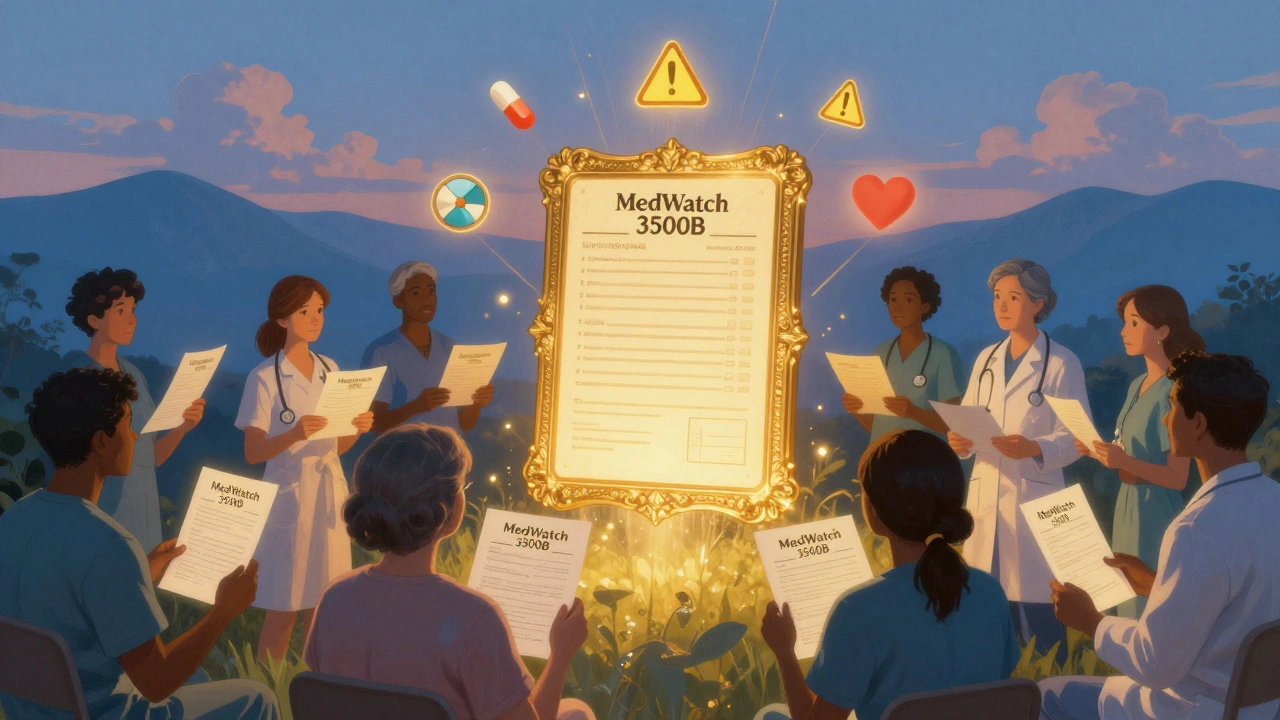
Every year, over 1.3 million adverse drug events are reported to the FDA through MedWatch. But experts estimate that for every report filed, at least 9 others go unreported. If you’ve experienced a bad reaction to a medication-whether it’s a prescription, over-the-counter drug, or even a supplement-your report could help prevent someone else from being hurt. Reporting isn’t just a formality. It’s a critical part of keeping the U.S. drug supply safe.
What Is MedWatch?
MedWatch is the U.S. Food and Drug Administration’s official system for tracking harmful side effects from medical products. It’s not a hotline for emergencies-it’s a safety net for information. The program collects reports from doctors, nurses, pharmacists, patients, and manufacturers about unexpected reactions to drugs, medical devices, vaccines (though vaccines go to VAERS), and even some cosmetics or dietary supplements.
Before MedWatch, safety data came in slowly-through scattered letters, phone calls, or hospital records. Now, nearly 95% of reports are submitted electronically. The FDA uses this data to spot patterns: a new type of liver injury linked to a common painkiller, a rare heart rhythm issue tied to a diabetes drug, or a dangerous interaction between two widely used medications. In 2021, MedWatch data led to 47% of all safety label updates for prescription drugs. That includes black box warnings-the strongest alerts the FDA can issue-for drugs like SGLT2 inhibitors after reports of Fournier’s gangrene surfaced.
Who Should Report?
Anyone can report. You don’t need to be a doctor. If you or someone you care for had a bad reaction to a medication, you can file a report. Healthcare professionals are encouraged to report, too-but many don’t. A 2022 AMA survey found that 78% of doctors say they don’t report because it takes too much time. That’s a problem. The FDA relies on these reports to catch signals early. Even if you’re not sure the drug caused the problem, report it anyway. The FDA doesn’t need proof of causation-just a clear description of what happened.
Manufacturers, hospitals, and pharmacies are legally required to report serious adverse events within 10 days. But voluntary reports from patients and providers make up the bulk of the data-and they often capture milder or longer-term effects that institutions miss.
What Counts as an Adverse Event?
An adverse event is any unwanted or harmful medical occurrence that happens after taking a drug-even if you’re not sure the drug caused it. Examples include:
- Severe rash or swelling after taking an antibiotic
- Unexplained dizziness or fainting after starting a blood pressure pill
- Liver damage, kidney failure, or sudden muscle pain linked to a statin
- Depression or suicidal thoughts following a new antidepressant
- Severe nausea or vomiting from an OTC pain reliever
- An allergic reaction to a supplement or herbal product
The FDA says: When in doubt, report it. You’re not diagnosing. You’re describing. Even if the reaction was mild, if it was unexpected or disruptive, it matters. The system is designed to catch trends-not just life-threatening events.

How to Report: Two Simple Paths
There are two main forms, depending on who you are.
For Patients and Consumers: Form 3500B
This is the simplified version. It’s three pages long, with about 30 questions. You don’t need medical training to fill it out. Go to FDA.gov/MedWatch and click “Voluntary Reporting.” Choose “Consumer/Patient.”
You’ll need:
- Your name and contact info (you can remain anonymous if you prefer)
- The patient’s age, sex, and weight (if known)
- The name of the drug (brand or generic), dose, and how often it was taken
- When you started and stopped the drug
- A clear description of what happened: symptoms, when they started, how long they lasted
- Whether you saw a doctor or went to the ER
- Any other medications or supplements you were taking
Don’t worry about medical jargon. Write in plain language: “I got a red, itchy rash all over my arms two days after starting the pill,” or “I felt like my heart was skipping beats every time I stood up.” The FDA uses standardized medical terms (MedDRA) to code your description later.
For Healthcare Professionals: Form 3500
This five-page form includes more clinical details. It’s meant for doctors, nurses, pharmacists, and hospital staff. You’ll add:
- Patient identifiers (like initials or medical record number-never full SSN)
- Lab results, imaging findings, or biopsy reports if relevant
- Details about prior medical conditions that might relate
- Whether stopping or restarting the drug changed the symptoms
Many hospitals and EHR systems (like Epic or Cerner) now have built-in MedWatch reporting tools. If your system supports it, you can generate the form with one click from a patient’s chart. Some clinics, like those in the Indian Health Service, auto-generate reports when a clinician selects “Adverse Reaction” in the note template.
How to Submit: Online, Mail, or Phone
You have three options:
- Online (fastest and recommended): Use the secure portal at FDA.gov/MedWatch. You can save progress and return later. The form takes 15-20 minutes to complete.
- By Mail or Fax: Download Form 3500 or 3500B, fill it out, and mail it to: MedWatch, HF-2, 5600 Fishers Lane, Rockville, MD 20857. Or fax to 1-800-FDA-0178.
- By Phone: Call 1-800-FDA-1088. A representative will take your report over the phone. This is helpful if you’re not comfortable typing or if you need help filling out the form.
The FDA responds to all reports with an acknowledgment letter within 21 days. If your report includes enough detail to trigger a safety review, you might hear back from an FDA investigator.
What Happens After You Report?
Your report goes into the FDA Adverse Event Reporting System (FAERS), a database that holds over 2 million reports. Analysts use software to look for clusters: if 50 people report the same rare symptom after taking the same drug, that’s a red flag. The FDA may then:
- Issue a safety alert to doctors and the public
- Require a stronger warning on the drug label
- Ask the manufacturer to study the issue further
- Restrict how the drug is used
- In extreme cases, pull the drug from the market
For example, reports of severe skin reactions to the arthritis drug celecoxib led to updated warnings. Reports of pancreatitis linked to GLP-1 weight-loss drugs prompted new safety reviews in 2023. None of this would happen without your report.

Common Mistakes and How to Avoid Them
Many reports are incomplete or unclear. Here’s what to avoid:
- Not naming the drug-just saying “my pill” won’t help. Write the brand and generic name.
- Leaving out timing-when did you start the drug? When did symptoms begin? Did they improve after stopping?
- Assuming causality-you don’t have to prove the drug caused it. Just describe what happened.
- Waiting too long-report within 15 days if possible. The sooner, the better.
- Not reporting minor issues-mild rashes, fatigue, or nausea can be early signals.
Also, don’t attach medical records. The system doesn’t accept files. Just summarize key details in the description box.
What’s New in 2025?
The FDA is making reporting easier. In 2023, they launched a pilot program called MedWatch Express-a mobile app that lets providers submit reports in under 5 minutes using voice-to-text and auto-fill from EHR notes. By January 2025, all hospitals and clinics will be required to report electronically. A new AI assistant is also being tested: it reads clinical notes and auto-fills 40% of the form.
For patients, the FDA has partnered with 30 major pharmacy chains to hand out QR code cards at the counter. Scan it, and you’re taken straight to the MedWatch form. They’re also adding new fields for cannabis-derived products, which have seen a 327% increase in reports since 2020.
Why Your Report Matters
MedWatch isn’t perfect. Experts say only 1% to 10% of adverse events are reported. Many patients don’t know it exists. Doctors are overworked. But every report adds a piece to a larger puzzle. One report might seem small. But 100 similar reports? That’s a signal. And that signal can change how a drug is used-or even save lives.
Think of it this way: you’re not just filing a form. You’re helping the FDA see what clinical trials couldn’t. You’re giving voice to side effects that might otherwise go unnoticed. And you’re helping future patients avoid the same problem.
It takes less than 20 minutes. No cost. No paperwork. Just your experience. If you’ve had a bad reaction to a drug, don’t ignore it. Report it.
Can I report an adverse event if I’m not a U.S. resident?
Yes. You don’t have to be a U.S. citizen or resident to report to MedWatch. If you took a medication sold in the United States and had a reaction, your report is valuable. The FDA collects data from international users, and these reports help shape global safety standards. Just make sure to list the country where you took the drug and where you received care.
Do I need to tell my doctor before reporting?
No, you don’t need permission. You can report directly to the FDA without telling your doctor. However, it’s a good idea to discuss the reaction with your provider first-they may need to adjust your treatment or report it themselves. But if you’re uncomfortable speaking with your doctor, or if they dismiss your concerns, you can still report on your own.
Can I report a reaction to a supplement or herbal product?
Yes. MedWatch accepts reports for dietary supplements, vitamins, and herbal products-even though they’re not FDA-approved like prescription drugs. Many serious reactions come from supplements labeled as “natural” or “safe.” If you had a bad reaction, report it. The FDA uses this data to identify dangerous ingredients and take action against unsafe products.
What if I don’t remember the exact name of the drug?
Try to find the packaging or pill bottle. If you can’t, describe the drug: its color, shape, markings, or where you got it. The FDA can often identify it from your description. You can also call 1-800-FDA-1088 and speak with a representative who can help you fill out the form.
Will my report be kept confidential?
Yes. The FDA protects your privacy. Personal information like your full name, address, or Social Security number is not required and will not be shared publicly. Reports in the FAERS database are anonymized and used only for safety analysis. You can choose to remain anonymous when submitting.
Can I report a reaction that happened years ago?
You can, but the usefulness decreases over time. The FDA prioritizes recent reports because they’re more likely to reflect current manufacturing, dosing, or usage patterns. If the reaction happened long ago and you’re not currently taking the drug, it’s still worth reporting if it was severe or unusual. But for the best impact, report as soon as possible after the event.
Is there a deadline to report?
There’s no legal deadline for patients or healthcare providers to report voluntarily. However, manufacturers and hospitals must report serious events within 10 days. For best results, submit your report within 15 days of recognizing the reaction. The sooner the FDA sees the pattern, the faster they can act.
Can I report a reaction to a vaccine?
No. Vaccines must be reported to the Vaccine Adverse Event Reporting System (VAERS), not MedWatch. Go to vaers.hhs.gov to file a vaccine report. MedWatch is for drugs, medical devices, and other products-not vaccines.
What if I reported and never heard back?
Most people don’t get a follow-up. That doesn’t mean your report didn’t matter. The FDA receives over a million reports a year. Your report is added to a database that analysts review for patterns. If your report helps identify a new safety issue, you may never know-but someone else might be protected because of it.
How do I know if my report led to a change?
You can check the FDA’s Drug Safety Communications page at fda.gov/drugs/drug-safety-and-availability. The FDA publishes updates when new warnings are added, labels are changed, or drugs are restricted. If your report contributed to a change, it will be listed there in general terms-not linked to you personally.
Ali Bradshaw
December 5, 2025 AT 02:18Just reported my weird rash after that new blood pressure med. Took 12 minutes. No doctor visit needed. Felt good to do something real for once.
Maybe next time I’ll actually get a reply.
Annie Grajewski
December 5, 2025 AT 04:02oh wow so the fda actually listens?? i thought they just archived everything until the next big pharma scandal. like lol sure janet. i’ve been telling my dr about my insomnia from that antidepressant for 3 years. she just nodded and upped the dose. 🙄
Jimmy Jude
December 5, 2025 AT 12:07This is the most pathetic system imaginable. You’re supposed to trust a government agency that can’t even get the price of insulin right? The FDA doesn’t care about you. They care about lawsuits and stock prices. Your report? It’s just noise in a room full of lobbyists.
And don’t even get me started on supplements. ‘Natural’ doesn’t mean safe. It means ‘unregulated’ and ‘profitable.’
Meanwhile, Big Pharma is laughing all the way to the bank while you’re Googling ‘is this a stroke or just anxiety?’
Rupa DasGupta
December 6, 2025 AT 06:28I cried when I filed mine… after 6 months of dizziness and brain fog from that ‘safe’ herbal weight loss tea. My mom had a stroke because of it. She’s fine now but I’ll never forgive myself for not knowing sooner.
Thank you for writing this. I felt so alone. 💔
Now I’m telling everyone. Even my cousin in Delhi. He took that same tea. He’s scared now. We’re both reporting.
They need to know. We need to be heard. 🌿😭
Norene Fulwiler
December 7, 2025 AT 12:36As a nurse in rural Nebraska, I see this every day. Patients come in with rashes, tremors, panic attacks - all from meds they didn’t even know could do that. They’re scared, confused, and feel like they’re being dismissed.
But when we sit down and help them file a MedWatch report? It’s the first time they feel like someone’s listening.
It’s not just paperwork. It’s validation.
And yes - we use the built-in EHR tool now. Saves 20 minutes. Do it. Even if it’s ‘just’ fatigue.
You’re not overreacting. You’re saving lives.
Ada Maklagina
December 9, 2025 AT 10:02did it last week
took 15 mins
no one asked me for my ssn
they didn't even ask if i was american
weirdly empowering
also my dog licked my pill bottle and got sick
should i report that too
Harry Nguyen
December 10, 2025 AT 11:42Of course the government wants you to report. It’s all part of the plan to make you feel like you have control while they quietly let Big Pharma keep poisoning the water supply. You think your little form changes anything? They’ve been covering up heart risks from statins since 2007. You’re not a hero. You’re a pawn. And your ‘report’? Just another line in their PR campaign.
Stop believing in the system. Start fighting it.
Katie Allan
December 11, 2025 AT 02:48I’ve been teaching my elderly patients how to file these reports for years. One woman, 82, reported a strange metallic taste after her new cholesterol pill. Turned out it was a rare reaction - and the FDA later updated the warning label.
She didn’t know her report mattered. But it did.
That’s the beauty of this: you don’t need to be a doctor. You don’t need to be perfect. You just need to care enough to speak up.
And if you’re reading this? You already care.
So go ahead. Hit submit.
You’re not alone.
James Moore
December 11, 2025 AT 12:00Let’s be real here - the entire MedWatch system is a bureaucratic charade, a performative gesture designed to placate the public while the FDA remains structurally captured by pharmaceutical lobbying interests. The sheer volume of reports - over a million annually - is not evidence of efficacy, but of systemic failure. If 90% of adverse events go unreported, then the current model is not just inadequate - it is actively misleading. The algorithmic clustering of FAERS data is statistically noisy and prone to false positives, yet the FDA still uses it to justify black box warnings and label changes - which then trigger massive liability insurance hikes, driving up drug prices, which then lead to more non-adherence, which leads to MORE adverse events - a vicious, self-reinforcing cycle. And let’s not forget: the FDA doesn’t even have the staffing to review 5% of these reports meaningfully. So what’s the point? We’re performing the ritual of accountability while the architecture of negligence remains intact. You report. They archive. The drug stays on the market. And the cycle continues. This isn’t safety. This is theater.
Kylee Gregory
December 11, 2025 AT 21:53I used to think reporting was pointless until I saw how one report from a college student led to a warning about a common migraine med causing serotonin syndrome in teens. It wasn’t life-threatening - just dizziness and nausea - but enough people reported it, and now doctors screen for it.
It’s not about being heard. It’s about being part of a network. Your experience becomes data. Data becomes awareness. Awareness becomes safety.
It’s slow. It’s messy. But it works.
So report. Even if it’s small. Even if you’re not sure. You’re not just helping yourself. You’re helping someone you’ll never meet.
Laura Saye
December 12, 2025 AT 18:31From a clinical pharmacology standpoint, the voluntary reporting paradigm leverages post-marketing surveillance to detect signals with low incidence rates that are statistically underpowered in pre-approval trials. The FAERS database, while subject to reporting bias and confounding, remains the largest real-world pharmacovigilance repository in the U.S. The 1:10 underreporting ratio is widely cited in the literature (e.g., JAMA 2019;322:1189–1190).
That said, the integration of EHR-driven auto-reporting tools represents a paradigm shift - reducing cognitive load on clinicians and improving data granularity. The emerging AI-assisted triage models show promise in reducing noise and enhancing signal detection, particularly for delayed-onset reactions like hepatotoxicity or autoimmune phenomena.
Patients, your narrative data is not anecdotal - it’s foundational. You are the frontline sensors of pharmacological safety.
an mo
December 14, 2025 AT 12:52MedWatch is a trap. Every report you submit gets fed into a database that’s shared with pharmaceutical companies. They use it to tweak formulations - not to fix safety, but to avoid liability. They change the inactive ingredients, rebrand, and relaunch. Your report doesn’t make the drug safer - it just makes the company richer.
And don’t get me started on how they use your data to predict who’ll sue. You’re not helping. You’re being mined.
Stop feeding the machine.
aditya dixit
December 14, 2025 AT 21:00I’m from India. Took a U.S.-made diabetes pill while visiting my sister in Chicago. Got a severe rash. Didn’t know where to report. Found this guide. Took 18 minutes. Submitted from my phone.
Two weeks later, I got an email from the FDA saying they’d added my case to their global database.
My sister’s doctor didn’t believe me. But the FDA did.
That meant something.
Thank you.
Now I’m telling my friends in Mumbai to do the same if they ever take American meds.
Lynette Myles
December 15, 2025 AT 12:19They’re tracking you. Every word you type. Every drug name. Every symptom. This isn’t safety. It’s social engineering. The FDA doesn’t want you to report - they want you to think you’re in control. Meanwhile, your data is being sold to insurers, employers, and AI firms that predict your future health risks. You’re not helping. You’re signing up for surveillance.
Don’t report. Don’t trust. Don’t click.