
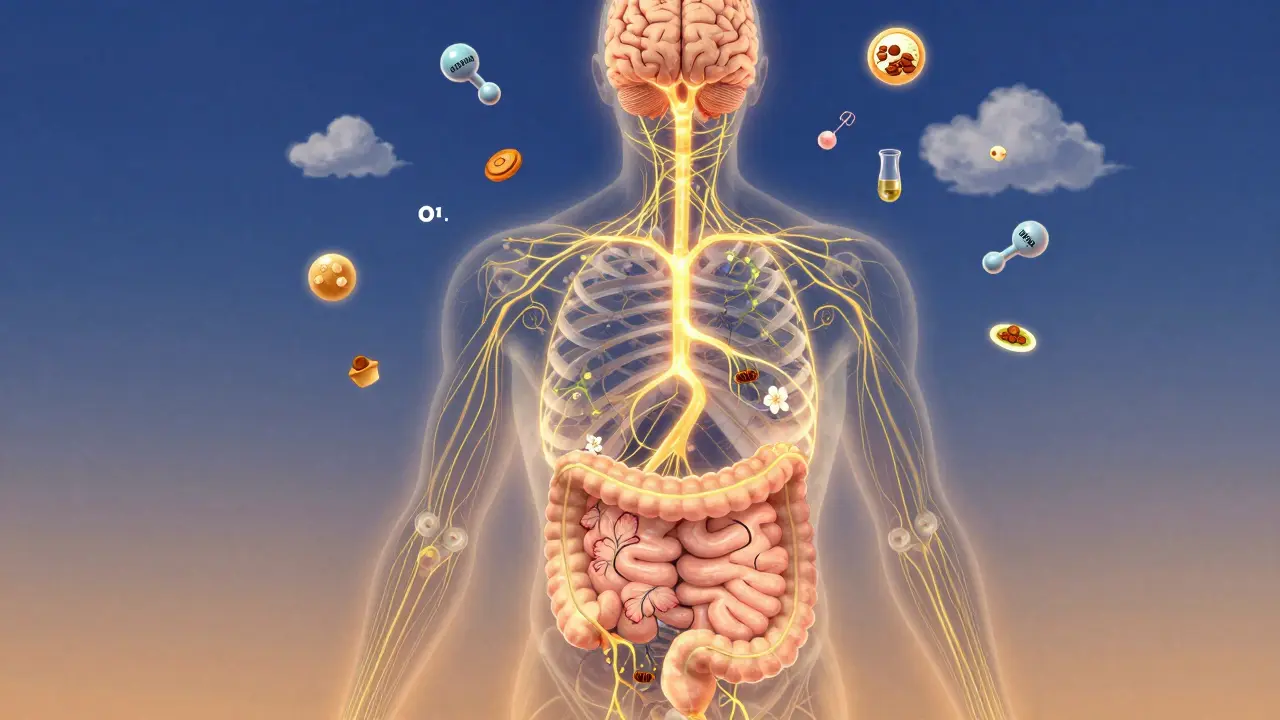
For millions of people, stomach pain, bloating, and unpredictable bowel habits aren’t just annoying-they’re life-limiting. If you’ve been told it’s "just stress" or "all in your head," you’re not alone. But here’s the truth: irritable bowel syndrome isn’t a psychological disorder, and it’s not just a gut problem. It’s a breakdown in communication between your gut and your brain. This is the gut-brain axis, and understanding it changes everything about how you treat IBS.
What IBS Really Is (And What It Isn’t)
IBS isn’t an infection, a tumor, or an inflammation like Crohn’s disease. It’s a functional disorder-meaning your organs look normal on scans, but they don’t work the way they should. The Rome IV criteria, used by doctors worldwide since 2016, define IBS as recurrent abdominal pain at least one day a week over the past three months, linked to bowel movements or changes in stool frequency or form. That’s it. No blood in stool, no weight loss, no fever. If you have those, it’s something else. But here’s what most doctors don’t tell you: 76% of people with IBS also have non-painful discomfort-like pressure, fullness, or a constant "gurgling" feeling. And 60-70% also struggle with anxiety or depression. That doesn’t mean stress caused it. It means your brain and gut are stuck in a loop. One sends a signal, the other misreads it, and the cycle keeps spinning.The Gut-Brain Axis: Your Body’s Hidden Communication Network
Your gut has its own nervous system-called the enteric nervous system-and it’s wired directly to your brain through the vagus nerve. Think of it like a high-speed internet line running from your intestines to your brainstem. It’s not just about pain signals. It’s about how your gut tells your brain when you’re full, when food is moving too fast, or when something’s off. This system also talks to your immune cells and your hormones. When you’re stressed, your body releases cortisol. That slows digestion, makes your gut more sensitive, and changes the bacteria living in your intestines. In return, those bacteria send chemical signals back to your brain that can make you feel anxious or low. It’s a two-way street. Brain scans show real differences in people with IBS. Those with diarrhea-predominant IBS (IBS-D) have thicker areas in brain regions that process body sensations. Those with constipation-predominant IBS (IBS-C) have thinner areas in regions that help regulate emotions and pain. Your brain isn’t broken-it’s rewired by ongoing gut signals.Serotonin: The Gut’s Chemical Messenger
You’ve heard of serotonin as the "feel-good" chemical in your brain. But 95% of your body’s serotonin is made in your gut. Enterochromaffin cells in your intestinal lining produce it to help move food along. In IBS-D, these cells pump out too much-up to 60% more than in people without IBS. That’s why you get sudden urges and loose stools. In IBS-C, the opposite happens. There’s not enough serotonin. Food moves too slowly. That’s why drugs like prucalopride (a 5-HT4 agonist) help-it tricks the gut into making more serotonin. But these drugs aren’t magic. They work only for specific subtypes. And they come with risks. Alosetron, for example, helps IBS-D but can cause dangerous intestinal blockages in rare cases. That’s why it’s tightly controlled.
Dietary Triggers: It’s Not Just Food
You’ve probably tried cutting out dairy, gluten, or spicy food. But the real culprit for many is FODMAPs-fermentable carbs like onions, garlic, apples, and wheat. These don’t get absorbed well in the small intestine. Instead, they travel to the colon, where bacteria ferment them. That creates gas, pulls water into the gut, and stretches the walls. For someone with IBS, that stretch feels like intense pain. Studies show the low-FODMAP diet works for 50-76% of people. That’s better than most medications. But it’s not a lifelong diet. It’s a three-step process: eliminate high-FODMAP foods for 4-6 weeks, then slowly reintroduce them one at a time to find your triggers. Most people find they can tolerate some of these foods again-just not all at once. The hard part? The elimination phase is brutal. Grocery shopping becomes a minefield. Eating out is stressful. And 65% of people give up because it’s too hard. That’s why working with a dietitian who specializes in IBS makes all the difference.Neuromodulation: Training Your Brain to Listen
If your brain keeps misreading gut signals, can you retrain it? Yes. Gut-directed hypnotherapy is one of the most powerful tools we have. It’s not stage hypnosis. It’s a structured therapy where you learn to calm your nervous system and redirect how your brain interprets gut sensations. In clinical trials, 70-80% of people see major improvement. And the effects last. A year later, most still feel better. It’s not easy to find. There’s about one certified practitioner for every 500,000 people. Sessions cost $1,200-$2,500 out-of-pocket. But compared to years of failed medications and endless doctor visits, it’s often worth it. Newer options like transcutaneous vagus nerve stimulation (tVNS)-a device you wear behind your ear-show promise too. In early studies, it reduced pain scores by 45-55%. It’s not FDA-approved yet, but it’s being tested in major hospitals.Probiotics, FMT, and the Microbiome
Your gut is home to trillions of bacteria. In IBS, the balance is off. Studies show lower levels of beneficial strains like Bifidobacterium infantis. Taking this specific probiotic (1 billion CFUs daily) improves symptoms in 30-40% of people-twice as well as placebo. Fecal microbiota transplantation (FMT)-transferring healthy gut bacteria from a donor-is more extreme. Results vary wildly. Some people get relief. Others feel worse. Why? Because we don’t yet know which bacteria to give to whom. The donor’s microbiome matters. The method of delivery matters. And your own gut environment matters too. The future? Personalized microbiome therapy. A new test called VisceralSense™ measures 12 microbial metabolites and neurotransmitter ratios to predict which treatment will work for you. It’s 85% accurate. It’s not widely available yet, but it’s coming.
Sue Stone
January 23, 2026 AT 15:42Finally, someone gets it. I’ve been told ‘it’s just anxiety’ for years-turns out my gut was screaming and my brain was just bad at listening. Low-FODMAP saved me, but only after I stopped blaming myself.
Stacy Thomes
January 23, 2026 AT 19:48YESSSSSS! This is the article I wish I had five years ago when I was crying in the bathroom at work because my stomach felt like a balloon full of angry bees. Gut hypnotherapy changed my life. No joke. I’m not even kidding. DO IT.
Anna Pryde-Smith
January 24, 2026 AT 19:13Oh please. You think this is new? I’ve been screaming about the gut-brain axis since 2018. My doctor laughed at me. Then I spent $2,000 on a hypnotherapy app and now I can eat a burrito without a 3-hour emergency bathroom run. If you’re still on loperamide and calling it ‘management,’ you’re not healing-you’re just tolerating misery.
And don’t get me started on probiotics. Buying some random ‘gut health’ capsule from CVS? That’s like throwing darts at a map of your microbiome. Bifidobacterium infantis? Yes. That one’s backed by science. The rest? Marketing.
Also, FMT? Sounds like a horror movie. I’d rather swallow a live worm than let someone else’s poop into me. But hey, if you’re into that, go ahead. Just don’t act like it’s a cure-all.
And to the people saying ‘just meditate’-try meditating when your intestines feel like they’re being twisted by a drunk janitor. It’s not stress. It’s biology. Stop gaslighting yourself.
dana torgersen
January 25, 2026 AT 14:09...i just... wow... i never thought about serotonin being 95% in the gut... like... wow... and the brain scans? the thickness? the thinness? it’s like... your brain is literally sculpted by your gut... like a clay pot shaped by hands you can’t see... it’s beautiful... and terrifying... i feel like i’ve been living in a fog... and now... i can see the wires... the nerves... the whispers... the screams... the chemical ballet... oh my god... i need to read this again... and again... and again...
Andrew Smirnykh
January 26, 2026 AT 17:00Interesting how the science aligns with traditional practices-like Ayurveda’s focus on agni (digestive fire) or TCM’s spleen-stomach axis. We’ve known for centuries that mind and gut are linked. Modern tech just gave us the diagrams. Still, the real breakthrough is treating the whole system, not just the symptom. That’s progress.
Dawson Taylor
January 28, 2026 AT 07:35Agreed. The gut-brain axis isn’t metaphorical. It’s anatomical. And the fact that we’re finally mapping it with precision-rather than prescribing antispasmodics like candy-is a paradigm shift. The next decade will see IBS reclassified from ‘functional disorder’ to ‘neuro-gastrointestinal condition.’ That’s not semantics. It’s insurance coverage.
Kerry Evans
January 29, 2026 AT 14:16Everyone’s acting like this is some revolutionary discovery. I’ve had IBS since I was 12. I’ve tried everything: elimination diets, probiotics, hypnosis, acupuncture, even a ‘gut cleanse’ that cost me $800 and left me dehydrated. None of it worked. And now you’re telling me to spend $2,500 on hypnotherapy? That’s not treatment. That’s exploitation. If you’re rich, fine. But most of us can’t afford ‘precision medicine’ when we’re still paying rent. Stop pretending this is about science. It’s about profit.
Sallie Jane Barnes
January 30, 2026 AT 03:53Thank you for writing this with such clarity and compassion. I’ve spent years feeling dismissed-by doctors, by friends, even by family. This isn’t ‘just stress.’ It’s a real, measurable, biological loop. And you’re right: knowledge is healing. I started tracking my symptoms with an app, found my FODMAP triggers, and found a therapist who specializes in gut-directed hypnotherapy. It’s not perfect, but I can eat dinner with my kids again. That’s everything. You’re not alone. And you’re not broken. You’re just wired differently-and now we know how to listen.