
What is Obstructive Sleep Apnea?
Obstructive Sleep Apnea is a serious sleep disorder where breathing repeatedly stops and starts during sleep. It affects more than 1 billion people worldwide, according to Dr. Andrey Zinchuk from Yale (2022). Symptoms include loud snoring, gasping for air at night, and extreme daytime fatigue. Left untreated, OSA raises risks for heart disease, stroke, and car accidents. The condition happens when throat muscles relax too much, blocking the airway. This isn’t just about snoring-it’s a medical issue that needs attention.
CPAP Therapy: The Gold Standard Treatment
CPAP Therapy has been the go-to solution for OSA since 1981, when Australian doctor Dr. Colin Sullivan invented it. CPAP machines deliver pressurized air through a mask to keep your airway open while you sleep. Modern versions include standard CPAP (fixed pressure), auto-CPAP (APAP) that adjusts pressure automatically, and BiPAP (bilevel pressure) for different inhalation/exhalation settings. When used consistently for 7+ hours nightly, CPAP reduces severe apnea (39±7 events/hour) to near-normal levels (7±3 events/hour) within six months, per a 2020 NCBI study.
Challenges with CPAP Therapy
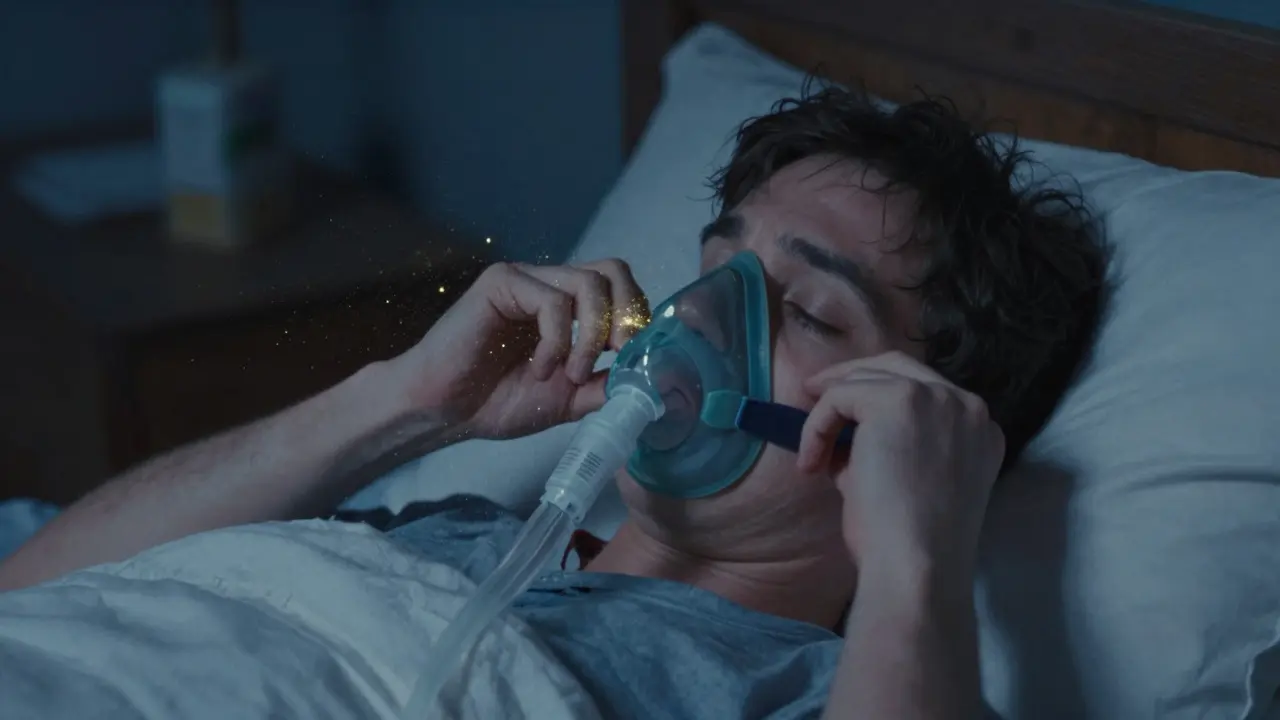
Despite its effectiveness, many people struggle with CPAP. Mask discomfort affects 35% of new users, while 12% feel claustrophobic. Air leakage is common too-61.8% of nasal mask users switch to full-face masks within six months. Adherence is a bigger hurdle: half of CPAP users wear their device less than 4 hours nightly. Medicare and insurers require 4+ hours on 70% of nights for coverage, but only 70% of patients meet this. ResMed’s 2022 report shows median usage stabilizes at 5.2 hours after six months. Without consistent use, CPAP doesn’t work-patients using it for just 2 hours still experience moderate to severe OSA.
Alternative Treatments for Sleep Apnea
For those who can’t tolerate CPAP, several alternatives exist. Oral Appliances reposition the jaw to keep the airway open. They’re especially effective for mild-to-moderate OSA. A 2017 American Academy of Dental Sleep Medicine review found oral appliances are used 77% of nights after one year-much higher than CPAP’s adherence rate. However, they’re less effective for severe cases.
Uvulopalatopharyngoplasty (UPPP) is a common surgery that removes excess throat tissue. Mayo Clinic data shows it succeeds in 40-60% of cases but requires weeks of recovery. It’s usually reserved for patients who can’t use CPAP or oral appliances.
For severe OSA, Hypoglossal Nerve Stimulation (like the Inspire therapy) offers hope. This implantable device stimulates the tongue muscle during sleep to prevent blockages. Studies show a 79% reduction in AHI, but it costs around $35,000 out-of-pocket and requires surgery.
| Treatment | Effectiveness | Adherence Rate | Key Considerations |
|---|---|---|---|
| CPAP | Reduces AHI to near-normal (7±3 events/hour) with consistent use | 5.2 hours/night median usage | Mask discomfort, claustrophobia, high upfront cost |
| Oral Appliances | Effective for mild-moderate OSA (AHI reduction of 50-60%) | 77% of nights after one year | Less effective for severe cases, requires dental fitting |
| UPPP Surgery | 40-60% success rate | N/A (one-time procedure) | Recovery time, risk of complications |
| Hypoglossal Stimulation | 79% AHI reduction | N/A (implant required) | $35,000 out-of-pocket, surgical risks |

Real User Experiences
User feedback shows both successes and struggles. Amazon reviews for CPAP devices average 4.2 stars, with 87% of positive reviews citing reduced snoring and 76% noting improved daytime alertness. But Reddit’s r/CPAP community (45,000 members) has different stories: 68% of negative reviews mention mask discomfort, 29% complain about machine noise, and 42% struggle with travel. One user shared: "After 3 months of leaks, I switched to a nasal pillow mask-now I sleep 7+ hours. My Epworth score dropped from 16 to 7." Another said: "I’ve tried 5 masks over 2 years and still can’t handle more than 2 hours. The claustrophobia is unbearable."
What’s Next in Sleep Apnea Treatment?
New tech is making treatment smarter. ResMed’s AirSense 11 (2022) detects respiratory events 15% better than older models. The FDA-cleared Nightware app (2023) boosts CPAP adherence by 22% using biofeedback. Future innovations include personalized pressure algorithms based on 3D airway scans and closed-loop systems that adjust pressure in real-time. However, 25-30% of patients remain non-adherent despite these advances, driving research into positional therapy devices and drugs targeting airway muscles. The 2024 American Thoracic Society guidelines will likely use arousal threshold (how easily you wake up during breathing pauses) to guide treatment choices-helping patients with low thresholds avoid CPAP altogether.
Is CPAP the only treatment for sleep apnea?
No. While CPAP is the gold standard for moderate to severe OSA, alternatives like oral appliances, surgery, and hypoglossal nerve stimulation exist. Oral appliances work well for mild-to-moderate cases, while surgery or nerve stimulation may help those who can’t tolerate CPAP. Your sleep specialist will recommend the best option based on your OSA severity and health factors.
Why do so many people stop using CPAP?
Mask discomfort is the biggest reason-35% of new users report this. Claustrophobia affects 12%, and air leakage (especially through the mouth) causes 61.8% of nasal mask users to switch within six months. Other issues include dry mouth, machine noise, and inconvenience during travel. Adherence improves with proper mask fitting, heated humidification, and gradual acclimatization. Most sleep clinics offer follow-up support to troubleshoot these problems.
Are oral appliances as effective as CPAP?
For mild-to-moderate OSA, oral appliances can be just as effective as CPAP when used consistently. However, they’re less reliable for severe cases. A 2017 review found CPAP reduces AHI more effectively in severe OSA (4.7 events/hour with 8 hours of use), while oral appliances only lower it to 15-20 events/hour. But oral appliances have much higher adherence rates-77% of nights versus CPAP’s 4-5 hours nightly-making them a practical choice for some patients.
What’s the newest treatment for sleep apnea?
The most recent advancement is Hypoglossal Nerve Stimulation (like Inspire therapy), which uses an implanted device to stimulate the tongue muscle during sleep. It’s FDA-approved for severe OSA patients who can’t use CPAP. Newer tech includes AI-powered CPAP machines that predict breathing issues before they happen and apps like Nightware that use biofeedback to improve adherence. Future innovations will focus on personalized pressure settings based on 3D airway scans and closed-loop systems that adjust pressure in real-time.
How do I know which treatment is right for me?
Your sleep specialist will recommend a treatment based on your OSA severity (measured by AHI), anatomy, and lifestyle. For example, severe OSA (AHI ≥ 30) usually needs CPAP or nerve stimulation. Mild-to-moderate cases might work with oral appliances. If you have a deviated septum or nasal obstruction, surgery could help. Your doctor will also consider factors like weight, neck size, and whether you’re a mouth breather. A sleep study is required to determine the best option.
Natasha Bhala
February 6, 2026 AT 20:43ive been using cpap for years now. finding the right mask made all the difference. dont give up its worth it
Lakisha Sarbah
February 7, 2026 AT 14:10i had the same struggle with mask discomfort. after trying 3 different masks, i found one that works. it took time but now i sleep better
Ariel Edmisten
February 8, 2026 AT 20:32cpap is hard but works. find a good mask and keep at it
Eric Knobelspiesse
February 10, 2026 AT 05:46cpap is the gold standard but 50% of people dont use it right. maybe the real issue is that we expect people to just accept it without support. its not just about the machine but the whole system
Heather Burrows
February 12, 2026 AT 05:07people who cant use cpap properly should just admit theyre not serious about their health. its not the machines fault
Ritu Singh
February 13, 2026 AT 17:30While CPAP therapy remains the standard treatment for obstructive sleep apnea, it is essential to recognize the cultural and socioeconomic factors that influence adherence. In many parts of the world, access to healthcare and education about sleep disorders is limited. A holistic approach that includes community support and education may improve outcomes globally.
Mark Harris
February 14, 2026 AT 11:30Hey! Dont give up on CPAP! I used to hate it but now its my best friend. The key is consistency and finding the right mask. You can do it!
Savannah Edwards
February 14, 2026 AT 14:11Ive been dealing with OSA for years and tried several treatments. CPAP was tough at first, but after switching to a full-face mask and using a humidifier, it became manageable. I also learned about oral appliances and considered them, but my doctor said theyre better for mild cases. Its important to remember that everyone's experience is different. Some people find CPAP easy, others struggle for months. The key is working with your doctor to find what works for you. I've also read about hypoglossal nerve stimulation, which sounds promising, but its expensive and requires surgery. For now, CPAP is still the best option for me. It's not perfect, but it's made a huge difference in my energy levels and overall health. I encourage anyone struggling to reach out for support-there are communities online where people share tips and experiences. It's a journey, but you're not alone.
Mayank Dobhal
February 16, 2026 AT 11:29CPAP works if you stick with it.
Marcus Jackson
February 17, 2026 AT 04:04CPAP adherence issues are often due to poor patient education. Studies show that patients who get proper training are more likely to stick with it. Also, many dont realize that adjusting the pressure settings can help. Its not the devices fault, its the lack of support.
Gouris Patnaik
February 17, 2026 AT 18:08in India, the healthcare system is underfunded so CPAP machines are hard to get. but people still complain about CPAP. they should be grateful for any treatment. its a first-world problem
Jesse Lord
February 19, 2026 AT 15:17its important to remember that everyone's journey with OSA is different. what works for one person might not work for another. the key is finding the right treatment for you and not giving up
AMIT JINDAL
February 20, 2026 AT 04:30As a medical professional, I can tell you that CPAP is the only real solution for severe OSA. Many people dont understand the science behind it. 😂 The newer machines are amazing but you need to be educated. Its not just about the device, its about understanding your airway anatomy. #medicaladvice
Catherine Wybourne
February 20, 2026 AT 21:45CPAP is great, but its not a magic wand. Some people just need to accept that sleep apnea is a lifelong condition. But hey, at least we have alternatives now, right? 🤷♀️