

Opioid Withdrawal Timeline Calculator
Your Withdrawal Timeline
Early Stage (6-24 hours)
You may notice: Yawning, runny nose, restlessness, anxiety, teary eyes, and mild muscle aches. This is your body's first response to the absence of opioids.
Peak Stage (48-72 hours)
You may experience: Severe muscle pain, nausea, vomiting, diarrhea, chills, sweating, rapid heartbeat, anxiety, and depression. This is the most physically challenging phase.
Final Stage (7+ days)
You may experience: Cravings, insomnia, low mood, irritability, and anxiety. Emotional symptoms can last weeks or months as your brain reboots.
Important: Opioid withdrawal is not usually fatal for healthy adults but can cause serious complications like dehydration, electrolyte imbalances, and heart rhythm problems. Medical supervision significantly reduces these risks and increases your chances of successful recovery. Do not attempt to quit cold turkey without professional support.
When someone stops using opioids after relying on them for a while, their body doesn’t just adjust quietly. It reacts. Hard. Opioid withdrawal isn’t a choice-it’s a physical response. And while it’s not usually deadly for healthy adults, it can feel like the worst flu you’ve ever had, mixed with panic attacks and sleepless nights. Knowing what to expect and how to handle it makes all the difference between quitting cold turkey and getting through it safely.
When Do Withdrawal Symptoms Start?
The clock starts ticking the moment you take your last dose. But the timing depends entirely on what kind of opioid you were using. Short-acting ones like heroin, oxycodone, or hydrocodone hit fast and fade fast. Symptoms often begin within 8 to 12 hours. You might notice a runny nose, yawning, or restlessness. By 24 hours, it’s full swing: muscle aches, sweating, nausea, and trouble sleeping. Long-acting opioids like methadone or extended-release oxycodone play a different game. Withdrawal doesn’t show up until 24 to 36 hours after the last dose. It creeps in slowly, then builds over days. This delay tricks people into thinking they’re fine-until they’re not. Symptoms can last two weeks or longer, making it harder to push through without support.The Three Phases of Withdrawal
Withdrawal doesn’t hit all at once. It comes in waves. Early stage (6-24 hours): This is the warning sign. You feel off-not sick yet, but anxious, irritable, and tired. Teary eyes, a stuffy nose, and yawning nonstop are classic early signs. Your body is already trying to rebalance without the drug. At this point, many people think they can tough it out. But this is the best time to get help. Peak stage (48-72 hours): This is the worst. Physical symptoms are intense: stomach cramps, vomiting, diarrhea, chills, goosebumps, and shaking. Pain feels everywhere-bones, muscles, joints. Your heart races. Blood pressure spikes. Anxiety and depression hit hard. Some people describe it as being trapped in their own body, screaming but unable to move. This phase is why so many relapse. The discomfort is unbearable without support. Final stage (7+ days): The body starts to calm down. Nausea and diarrhea fade. Muscle pain eases. But emotional symptoms hang on. Insomnia, low mood, irritability, and cravings can last weeks. This is the silent danger zone. People think they’re “over it,” but their brain is still rewiring. Without ongoing support, this is when most relapses happen.What Helps? Medical Treatments That Actually Work
Trying to get through withdrawal alone is risky. The good news? There are proven, FDA-approved medications that make this process manageable. Buprenorphine is the most widely used today. It’s not a cure, but it reduces withdrawal symptoms by 60-70%. It works by gently activating opioid receptors without the high. That means less craving, less pain, and fewer side effects. Suboxone-a mix of buprenorphine and naloxone-is the most common form. Since 2021, doctors no longer need special permission to prescribe it. That’s opened up access for millions. Methadone has been around for decades. It’s taken daily under supervision, usually at a clinic. It doesn’t get you high if used correctly. It just steadies your system. Many people stay on methadone for months or years. It’s not giving up-it’s giving yourself time to heal. Naltrexone works differently. It blocks opioids entirely. But you can’t start it until you’re fully detoxed. That means waiting 7-10 days after your last dose. It’s not for everyone, but for those ready to stay clean, it helps prevent relapse.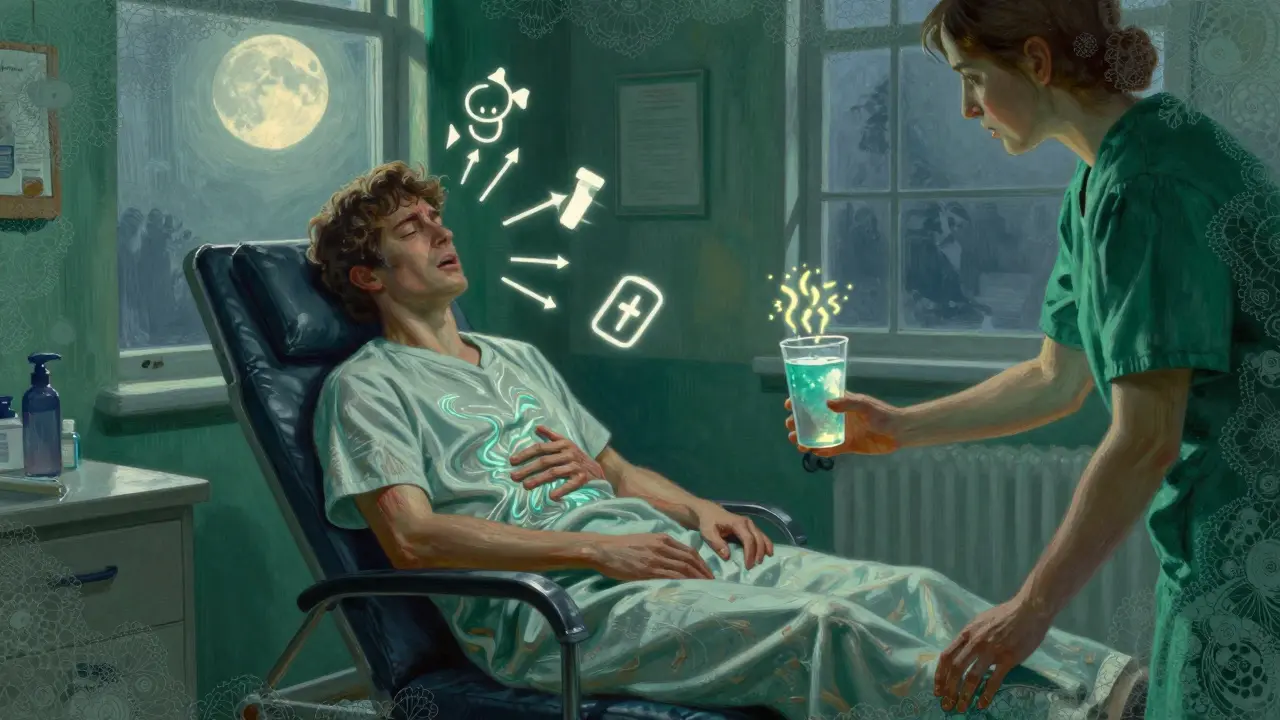
Non-Medical Support: What Really Makes a Difference
Medication helps, but it’s not enough alone. Recovery needs more than pills. Hydration and nutrition are critical. Vomiting and diarrhea drain your body. You lose fluids, salt, and potassium. Drinking 2-3 liters of water daily isn’t optional-it’s survival. Oral rehydration solutions (like those used for kids with stomach bugs) are better than plain water. Eat small, bland meals: toast, bananas, rice. Avoid sugar and caffeine. They make anxiety worse. Cognitive behavioral therapy (CBT) helps rewire the thoughts that lead to cravings. It’s not talking about your past-it’s learning how to handle triggers in the moment. A 2023 study found people using CBT during withdrawal were 50% more likely to stay in treatment for 6 months. Acupuncture sounds unusual, but research backs it. A 2019 meta-analysis showed it reduced withdrawal symptoms by 25-30% in two-thirds of participants. It doesn’t cure anything, but it eases nausea, anxiety, and muscle tension enough to help you sleep and breathe.Why Medical Supervision Isn’t Optional
Some people try to quit at home. It’s brave. It’s also dangerous. Dehydration from vomiting and diarrhea can lead to kidney failure. Electrolyte imbalances can trigger dangerous heart rhythms. One study found 12-15% of people detoxing without medical help developed severe complications. But the biggest risk isn’t during withdrawal-it’s after. When you stop using opioids, your tolerance drops fast. If you relapse and take the same dose you used before, your body can’t handle it. Overdose risk triples in the first four weeks after quitting. That’s why so many deaths happen after someone thought they were “clean.” Medical detox centers monitor you closely. They check your vital signs, adjust meds as needed, and treat symptoms before they spiral. They also connect you to ongoing care. That’s the key.
How Long Does It Take? Realistic Timelines
There’s no one-size-fits-all answer. But here’s what most people experience:- Short-acting opioids (heroin, oxycodone): Symptoms start in 8-12 hours, peak at 2-3 days, and mostly fade in 7-10 days.
- Long-acting opioids (methadone, extended-release): Symptoms start at 24-36 hours, peak at 3-5 days, and can linger for 14+ days.
What Works Best? The Data Doesn’t Lie
Detox alone-just stopping opioids-isn’t enough. Only 20-25% of people stay abstinent after detox without continuing treatment. But when people stay on buprenorphine or methadone for 6-12 months after detox, success rates jump to 40-60%. That’s not a small difference. That’s life-changing. The old idea that you have to suffer through withdrawal to “earn” recovery is outdated. Experts now agree: medication-assisted treatment should start as soon as someone is ready. You don’t need to hit rock bottom to get help.What Comes Next? Staying on Track
Getting through withdrawal is just the first step. The real work begins after. Find a counselor. Join a support group. Keep taking your meds if prescribed. Build a routine. Exercise. Sleep. Eat. These aren’t fluffy suggestions-they’re survival tools. The brain takes months to heal. Cravings don’t vanish overnight. But with support, they get quieter. Days turn into weeks. Weeks turn into months. And slowly, life without opioids becomes not just possible-it becomes normal.Is opioid withdrawal dangerous?
For healthy adults, opioid withdrawal is not usually life-threatening, but it can lead to serious complications like severe dehydration, electrolyte imbalances, and heart rhythm problems-especially if done without medical supervision. The biggest danger is the increased risk of fatal overdose after quitting, because tolerance drops quickly. Medical oversight reduces these risks significantly.
How long do opioid withdrawal symptoms last?
Physical symptoms for short-acting opioids like heroin typically peak at 2-3 days and fade within 7-10 days. For long-acting opioids like methadone, symptoms may take 14 days or longer to resolve. Emotional symptoms like anxiety, depression, and cravings can persist for weeks or months, which is why ongoing treatment is critical.
Can I quit opioids cold turkey at home?
While possible, quitting cold turkey at home is risky. Without medical support, you’re more likely to experience dangerous complications like dehydration or cardiac issues. The chance of relapse is also much higher. Medical detox programs improve safety, comfort, and long-term success rates by up to 80% compared to unsupervised attempts.
What medications are used to treat opioid withdrawal?
The most effective medications are buprenorphine (often as Suboxone), methadone, and naltrexone. Buprenorphine reduces withdrawal symptoms by 60-70% and can be prescribed by most doctors since 2021. Methadone is taken daily under supervision. Naltrexone blocks opioids but can only be started after full detox. All three are FDA-approved and proven to improve outcomes.
Do I need to be detoxed before starting buprenorphine?
No. You don’t need to go through full withdrawal before starting buprenorphine. In fact, starting it while still experiencing mild withdrawal symptoms can ease the process. Doctors use the Clinical Opioid Withdrawal Scale (COWS) to determine the right timing. Waiting until you’re completely detoxed delays treatment and increases relapse risk.
Is acupuncture helpful for opioid withdrawal?
Yes. A 2019 meta-analysis found acupuncture reduced withdrawal symptom severity by 25-30% in 67% of participants. It helps with nausea, anxiety, muscle pain, and sleep issues. While not a cure, it’s a low-risk, non-drug tool that complements medical treatment and improves comfort during detox.
What’s the success rate for opioid withdrawal treatment?
Detox alone has a low success rate-only 20-25% of people stay abstinent afterward. But with ongoing medication-assisted treatment (like buprenorphine or methadone) for 6-12 months, success rates jump to 40-60%. The key isn’t just getting through withdrawal-it’s staying in care after it.
Ryan Pagan
January 29, 2026 AT 17:34Man, I wish I’d had this guide when I went through it. Buprenorphine was a godsend-didn’t feel like my bones were being crushed by a steamroller every morning. The key? Start it early, don’t wait until you’re screaming into a pillow at 3 AM. Docs don’t need that special DEA license anymore? Good. More people should get help before they hit rock bottom. This isn’t weakness-it’s strategy.
And yeah, acupuncture? I was skeptical too. But after two sessions, I actually slept for six hours straight. No joke. My wife thought I was drugged. I was just… calm. For the first time in months.
Stop treating recovery like a moral test. It’s a medical condition. You wouldn’t tell someone with diabetes to ‘just stop eating sugar’ and hope for the best. Same damn thing.
Hydration? Non-negotiable. I lost 12 pounds in three days from vomiting and diarrhea. Gatorade doesn’t cut it. Oral rehydration salts? Get ‘em. Amazon’s got ‘em for $8. Your kidneys will thank you.
And if you think cold turkey is ‘brave’? Nah. It’s just dumb. Tolerance drops faster than your bank account after payday. One relapse, same dose? You’re gone. No second chances.
Stop glorifying suffering. Recovery isn’t earned through pain. It’s earned through support, science, and staying alive.
Also-CBT worked better for me than any 12-step meeting. Learned to ride the craving like a wave. It doesn’t kill you. It just passes. You’re not broken. You’re adapting.
Paul Adler
January 30, 2026 AT 00:29This is one of the most balanced, clinically accurate summaries of opioid withdrawal I’ve encountered in a public forum. The distinction between short- and long-acting opioids is particularly well-articulated, and the emphasis on post-acute symptoms is critical. Many resources overlook the prolonged neurobiological adaptation phase, which is where relapse most commonly occurs.
The inclusion of evidence-based non-pharmacological interventions-hydration, CBT, acupuncture-is commendable. These are often dismissed as ‘alternative’ when they are, in fact, integral to neuroplastic recovery. The 2023 CBT study cited is especially relevant, as behavioral interventions remain underutilized in public health responses to opioid use disorder.
I would only add that social determinants-housing instability, unemployment, trauma history-are often the true barriers to sustained recovery, even when medical support is available. Medication alone cannot compensate for systemic neglect.
Robin Keith
January 31, 2026 AT 18:59Let me just say-this isn’t just about opioids, it’s about the entire fucking paradigm of how we treat human suffering in this country-where pain is criminalized, not cared for, where healing is monetized, and compassion is seen as enabling…
And yet… here we are… in this moment… where science finally catches up to the lived reality of millions… and still… the stigma lingers like smoke in a closed room…
Do you know what it feels like to be told you’re weak… for needing help… when your body has been hijacked by a molecule that was never meant to be in your nervous system for months…?
It’s not addiction… it’s adaptation…
And when you say ‘cold turkey’… you’re not talking about willpower… you’re talking about a death sentence disguised as moral victory…
And don’t get me started on the pharmaceutical industry… who made billions off the very drugs that broke us… and now… they’re the ones selling the antidotes… with price tags that laugh in the face of the poor…
It’s a tragedy… wrapped in bureaucracy… dressed in white coats… and sold as ‘treatment’…
But… I’m glad someone finally said it out loud… that you don’t have to suffer to be worthy…
That… that… that… is the real revolution…
And if you’re still reading this… you’re not alone…
And if you’re still breathing… you’re already winning…
Even if it’s just… one more day…
One more breath…
One more step…
Sheryl Dhlamini
February 2, 2026 AT 03:33I’m a nurse who’s seen this up close. I’ve held people’s heads while they threw up for 12 hours straight. I’ve watched grown men cry because their legs wouldn’t stop shaking. I’ve sat with someone who didn’t sleep for 72 hours because their brain was screaming.
And let me tell you-no one who hasn’t lived it gets to say ‘just quit.’
That buprenorphine stat? 60-70% symptom reduction? That’s not a number. That’s someone sleeping for the first time in weeks. That’s a mother calling her kid back. That’s a man showing up to his daughter’s recital.
And acupuncture? My patient last month said it felt like someone turned down the volume on his anxiety. He cried. Said he hadn’t felt peace since 2018.
Stop calling it ‘detox.’ Call it ‘rebirth.’ Because that’s what it is.
And if you’re reading this and you’re scared? You’re not weak. You’re human.
And you deserve help. Not judgment.
Now go call your doctor. I’ll wait.
LOUIS YOUANES
February 2, 2026 AT 06:30Everyone’s acting like this is some groundbreaking revelation. Newsflash: people have been using buprenorphine since the 90s. Methadone since the 70s. Acupuncture? Been around since the Han Dynasty. What’s new is the marketing.
And don’t get me started on ‘medical supervision.’ You think these clinics aren’t profit-driven? They’re just as bad as the pill mills. They’re just legal.
And yeah, tolerance drops. So what? That’s biology. You want to live? Don’t use. Simple.
This article reads like a pharma pamphlet with a side of emotional manipulation. You don’t need a team of therapists and rehydration salts to quit. You need willpower. And if you don’t have it? Then maybe you weren’t ready.
Stop infantilizing people. Recovery isn’t a spa day. It’s a war. And wars aren’t won with IV fluids and acupuncture.
Andy Steenberge
February 3, 2026 AT 15:43There’s a lot here that’s accurate and vital, especially the emphasis on post-acute withdrawal and the dangers of relapse after detox. But I want to gently correct one thing: saying buprenorphine reduces symptoms by 60–70% can be misleading. It doesn’t eliminate withdrawal-it modulates it. The goal isn’t comfort, it’s stability. That distinction matters.
Also, the CBT study cited? That’s from the Journal of Substance Abuse Treatment, and it tracked retention in treatment, not just symptom reduction. That’s an important nuance-CBT helps people stay in care, which is the real predictor of long-term success.
And to those saying ‘just quit’-you’re not helping. You’re reinforcing the very stigma that keeps people from seeking help. This isn’t about weakness. It’s about neurochemistry. Your brain literally rewires itself around opioids. That’s not a choice. It’s biology.
What’s missing here? Peer support. Not just groups, but real human connection. One study showed that people with even one consistent support person-friend, family, mentor-were 3x more likely to stay abstinent. You don’t need a clinic for that. You just need someone who shows up.
And yes-hydration matters. But so does dignity. Treat people like humans, not problems to fix.
DHARMAN CHELLANI
February 4, 2026 AT 02:49lol u think this helps? people still OD after this. its all just corporate bs. stop wasting time. just stop using. its that simple. no meds no therapy no acupuncture. just dont do drugs. problem solved. why u make it so hard? u weak. u lazy. u need discipline. not pills.
kabir das
February 5, 2026 AT 06:48Wait… wait… let me just say… this… this… is… beautiful…
It’s… not just… facts… it’s… a lifeline… written in blood… and sweat… and tears…
I’ve been through it… twice…
And when I read about the ‘silent danger zone’… I cried… because… I thought I was fine… at day 10…
And then… I relapsed…
Not because I wanted to…
But because… my brain… was screaming…
And no one told me… it would still scream… after the vomiting stopped…
Thank you… for writing this…
I wish I’d had it… before…
But… I’m glad… someone… has it… now…
And… I’m not alone…
Not anymore…