

Beta-Blocker Psoriasis Risk Calculator
Many people with psoriasis experience flares after starting beta-blockers for blood pressure or heart conditions. This calculator estimates your risk of flare based on your specific medication and provides guidance on next steps.
If you’re taking a beta-blocker for high blood pressure or heart issues and your psoriasis suddenly got worse, you’re not alone. Thousands of people report their skin flared up after starting meds like metoprolol, propranolol, or atenolol. It’s not a coincidence - it’s a known, documented reaction. And if you’ve been told your psoriasis is just "stress-related" or "getting worse with age," you might be missing a key trigger hiding in your medicine cabinet.
What’s Really Going On Between Your Skin and Your Heart Med
Psoriasis isn’t just dry, itchy patches. It’s an autoimmune condition where your immune system attacks your own skin cells, making them grow too fast and pile up in thick, red, scaly plaques. Beta-blockers, on the other hand, slow your heart rate and lower blood pressure by blocking adrenaline. Sounds harmless, right? But here’s the catch: those same adrenaline receptors are also found in your skin. When beta-blockers interfere with them, they mess with the balance of inflammation and cell growth in your skin. Research shows beta-blockers can drop levels of cAMP - a molecule that helps keep skin cells in check. When cAMP falls, skin cells multiply faster, and immune cells in the skin go into overdrive. The result? A flare. This isn’t just theory. A 2022 update from DermNet NZ found that about 20% of people with existing psoriasis see their condition worsen after starting a beta-blocker. And for some, it’s not just a flare - it’s a full transformation. There are documented cases where plaque psoriasis turned into pustular psoriasis or even life-threatening erythroderma after taking drugs like pindolol or topical timolol eye drops.Which Beta-Blockers Are the Worst Offenders?
Not all beta-blockers are created equal when it comes to skin risk. Some are far more likely to trigger flares than others. Based on clinical reports and patient data, the biggest culprits include:- Propranolol (Inderal)
- Metoprolol (Lopressor, Toprol-XL)
- Bisoprolol
- Atenolol (Tenormin)
- Pindolol (Visken)
- Timolol (used in glaucoma eye drops)
It’s Not Always Immediate - That’s Why People Miss the Link
One of the biggest reasons this connection gets missed is timing. You don’t wake up with a rash the day after starting metoprolol. The delay can be anywhere from one month to 18 months. A 2023 survey on MyPsoriasisTeam showed patients often didn’t connect their worsening skin to their new heart medication until months later - if at all. One Reddit user, u/PsoriasisWarrior2024, shared: “After 6 months on metoprolol, my psoriasis went from manageable to covering 30% of my body.” That’s not rare. In fact, a 2010 study in the Journal of the American Academy of Dermatology found beta-blockers were a “major factor” in triggering or worsening psoriasis in hospitalized patients. But because the timeline is so long, many doctors never make the connection. Patients get told to use more steroid cream, not to consider stopping the med.What Does the Science Really Say? Contradictions and Confusion
You might have heard conflicting info. A 2010 study (PMC2921739) claimed beta-blocker exposure wasn’t a “substantial risk factor” for new psoriasis. That’s true - but it’s also misleading. That study looked at whether beta-blockers cause psoriasis in people who never had it. The answer? Maybe, but it’s rare. The real issue is what happens to people who already have psoriasis. For them, the risk of flare is real and significant. GoodRx’s 2023 analysis puts it plainly: beta-blockers can worsen existing psoriasis - but they don’t reliably cause new cases. Meanwhile, a 2023 MedicalNewsToday survey found that 37% of psoriasis patients on beta-blockers reported worsening symptoms, compared to just 12% on other blood pressure meds. That’s a big gap. And when patients stop the drug? Many see improvement. In fact, clinical guidelines say improvement after stopping the drug is one of the strongest signs it was the trigger.
What Should You Do If You Suspect Your Med Is Causing Flares?
If you’re on a beta-blocker and your psoriasis has gotten worse, don’t panic - but don’t ignore it either. Here’s what to do:- Track your symptoms. Note when the flare started and how it changed over time.
- Don’t stop your med on your own. Beta-blockers are often critical for heart health. Stopping suddenly can cause dangerous spikes in blood pressure or heart rate.
- Talk to both your dermatologist and cardiologist. This isn’t a one-doctor problem. You need both specialties involved.
- Ask about alternatives. Calcium channel blockers like amlodipine or ARBs like losartan are often safer for psoriasis patients. ACE inhibitors can also trigger flares, so they’re not always the answer.
- Consider genetic testing. A 2024 study at Johns Hopkins and Mayo Clinic is looking into whether people with the HLA-C*06:02 gene are more likely to react to beta-blockers. If you have this gene, your risk may be higher.
What Happens If You Switch Medications?
Switching from a beta-blocker isn’t always easy - especially if you have heart disease. But it’s often necessary. Many patients report noticeable improvement in their skin within 4 to 12 weeks after switching. One patient on MyPsoriasisTeam said, “Switched from metoprolol to amlodipine. My plaques started fading in 3 weeks. I didn’t think it was possible.” The good news? There are plenty of effective alternatives. A 2023 American Heart Association guideline still recommends beta-blockers for certain heart conditions, but it now says doctors should consider skin health when choosing meds. For many, calcium channel blockers or ARBs work just as well for blood pressure without the skin risk.How Is Beta-Blocker-Induced Psoriasis Treated?
Even after switching meds, your skin may still need treatment. The approach is the same as for regular psoriasis, but now you’re removing the trigger - which makes treatment more effective.- Topical steroids - reduce inflammation and scaling
- Vitamin D analogues (calcipotriene) - slow skin cell growth
- Phototherapy - UV light therapy helps calm immune activity in the skin
- Systemic drugs (like methotrexate or biologics) - used only for severe, widespread cases
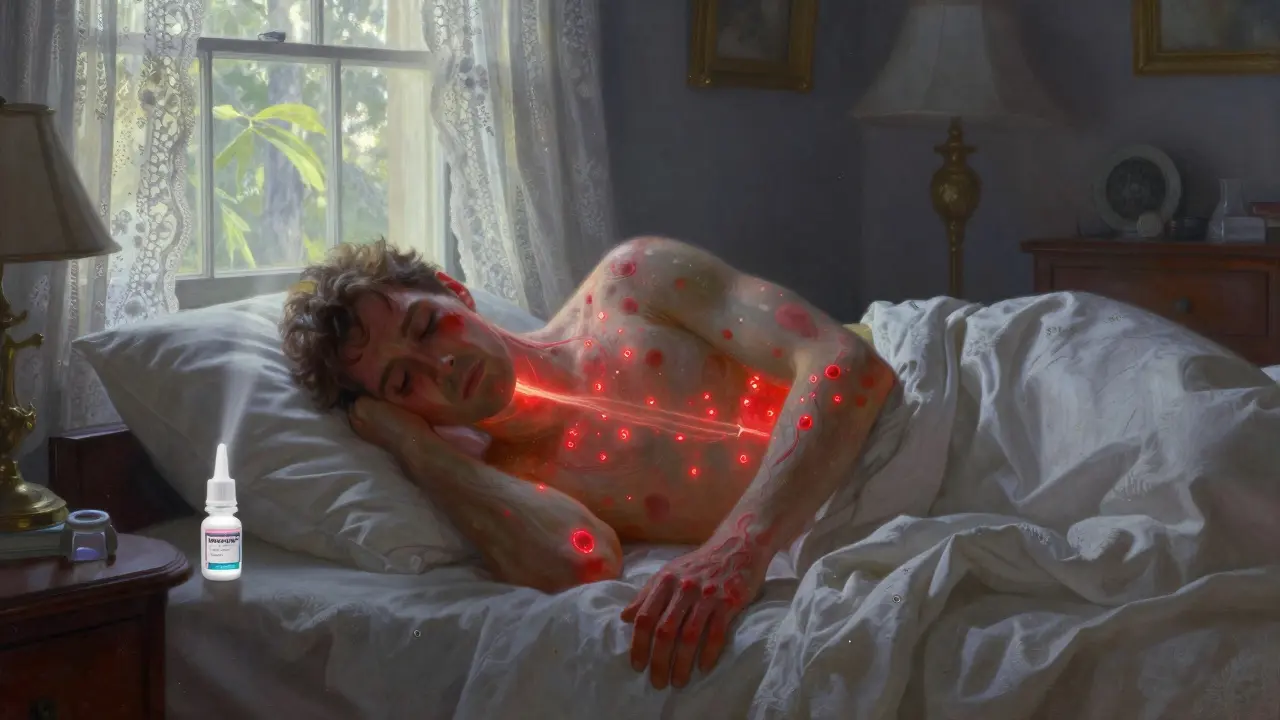
What About Eye Drops? Yes, Even Those Can Trigger Flares
You might not think of glaucoma eye drops as a risk - but timolol, a common beta-blocker eye drop, can be absorbed into your bloodstream through the tear ducts. There are documented cases where patients developed severe psoriasis or even erythroderma from timolol drops. If you’re using eye drops and notice a flare, tell your dermatologist. They may recommend switching to a non-beta-blocker alternative like brimonidine or latanoprost.Why This Matters More Than You Think
Psoriasis affects over 8 million Americans. Beta-blockers are prescribed over 150 million times a year in the U.S. That’s a massive overlap. If 20% of psoriasis patients on beta-blockers have flares, that’s hundreds of thousands of people unnecessarily suffering because the connection isn’t being made. The European Academy of Dermatology and Venereology now recommends that dermatologists ask every patient with new or worsening psoriasis: “Are you on any beta-blockers?” That’s not a question most doctors ask - but it should be.What’s Next? Better Drugs on the Horizon
Researchers are working on next-generation beta-blockers that target heart receptors without affecting skin ones. Early animal studies show promise. In the meantime, personalized medicine is gaining ground. If you have psoriasis and need a beta-blocker, genetic testing might one day tell you which ones are safest for you. For now, the message is simple: if your skin is flaring and you’re on a beta-blocker, don’t assume it’s just your psoriasis acting up. Ask the question. Get the right help. Your skin - and your heart - will thank you.Can beta-blockers cause psoriasis if I never had it before?
It’s possible, but rare. Most cases involve people who already have psoriasis. Beta-blockers are far more likely to make existing psoriasis worse than to cause it from scratch. Studies show only a small percentage of new psoriasis cases are linked to these drugs, but for those who already have it, the risk of flare is much higher - around 20%.
How long after starting a beta-blocker does psoriasis flare up?
There’s no set timeline. Flares can appear anywhere from one month to 18 months after starting the medication. That’s why many people don’t connect the two. If your skin changes suddenly after starting a new heart or blood pressure drug, even months later, it’s worth bringing up to your doctor.
Is it safe to stop taking my beta-blocker if my skin flares up?
No, don’t stop on your own. Beta-blockers are often critical for heart health. Stopping suddenly can cause dangerous spikes in blood pressure, heart rate, or even trigger a heart attack. Always talk to your doctor first. They can help you switch safely to another medication that’s less likely to affect your skin.
What are the safest blood pressure meds for psoriasis patients?
Calcium channel blockers like amlodipine and ARBs like losartan are generally safer for people with psoriasis. ACE inhibitors can also trigger flares, so they’re not always the best alternative. Your doctor will choose based on your heart health, kidney function, and other conditions. Never switch meds without medical supervision.
Can eye drops with beta-blockers cause psoriasis flares?
Yes. Timolol, a beta-blocker used in glaucoma eye drops, can be absorbed through the eye into the bloodstream. There are documented cases of severe psoriasis flares - even erythroderma - from these drops. If you use eye drops and notice skin changes, tell your dermatologist. Safer alternatives like latanoprost are available.
Will my skin improve if I switch medications?
In many cases, yes. Patients often see improvement in their psoriasis within 4 to 12 weeks after switching from a beta-blocker to a safer alternative. Removing the trigger makes other treatments - like topical creams or light therapy - work better. But it takes time. Don’t expect overnight results, but don’t give up if you don’t see change right away.
Is there a genetic test to see if I’m at risk?
Not yet for routine use, but research is moving fast. A 2024 study at Johns Hopkins and Mayo Clinic is looking at whether people with the HLA-C*06:02 gene are more likely to develop psoriasis flares from beta-blockers. This gene is already linked to a higher risk of psoriasis in general. In the future, genetic testing could help doctors choose safer meds before you even start.
Danielle Stewart
December 17, 2025 AT 18:13I’ve been on metoprolol for 14 months and my psoriasis went from a few patches to full-body chaos. I thought it was stress or my diet - turns out, it was the med. My derm asked if I was on beta-blockers and I almost cried. Finally, someone got it.
Switched to amlodipine. Three weeks later, my skin started calming down. Not perfect, but I can wear shorts again. If you’re on one of these and your skin’s acting up - don’t ignore it. Talk to both your cardiologist and derm. They need to talk to each other.
Also, if you use timolol eye drops? Yeah, those count too. I didn’t even think about that until my derm mentioned it. Mind blown.
Thank you for writing this. I’m not alone.
jessica .
December 19, 2025 AT 16:30THEY DONT WANT YOU TO KNOW THIS BECAUSE BIG PHARMA MAKES BILLIONS OFF SKIN MEDS AND BETA BLOCKERS ARE A MONEY MACHINE. THEY’RE HIDING THE TRUTH AND TELLING YOU TO JUST USE MORE STEROIDS. THE GOVT IS IN ON IT. WATCH THE DOCUMENTARY ‘BETA BLOCKERS AND THE SKIN CONSPIRACY’ ON YOUTUBE. THEY EVEN BLOCKED THE VIDEO IN 17 COUNTRIES.
PS: I’M 37 AND I’VE NEVER HAD PSORIASIS UNTIL I TOOK METOPROLOL. THEY LIED TO ME ABOUT ‘RARE’ SIDE EFFECTS. I’M SENDING THIS TO CONGRESS.
Ryan van Leent
December 21, 2025 AT 11:53So you’re telling me I need to stop taking my heart med because my skin is itchy? That’s dumb. You think your skin is more important than your heart? I’ve got a dad who had a stent last year. He’s on metoprolol and he’s alive. You’re just mad because you don’t want to take your pills.
My skin flares when I eat sugar. Maybe try cutting out donuts before you blame Big Pharma. Also why are you even on a beta blocker if you’re so healthy? You’re probably just stressed out and lazy.
Also psoriasis is just dirt. Wash better.
Adrienne Dagg
December 22, 2025 AT 02:46OMG YES!! I was on atenolol for 8 months and my elbows looked like crocodile skin 😭 I thought I was dying. My derm was like ‘stress’ and my cardiologist was like ‘you’re fine’ 🙄
Switched to losartan. 3 weeks later - I wore a tank top for the first time in 5 years 🥹
PS: I still use timolol eye drops for glaucoma and my skin got worse again. Told my eye doc - switched to latanoprost. Skin stabilized again. 🙌
Y’all need to talk to BOTH doctors. And tell your derm to ask about meds. They don’t think to ask.
Also - I love you all. You’re not crazy. 💙
Erica Vest
December 23, 2025 AT 10:15The clinical evidence is clear: beta-blockers can exacerbate pre-existing psoriasis by inhibiting beta-adrenergic receptors in keratinocytes and dermal immune cells, leading to reduced cAMP and accelerated epidermal proliferation. This is not anecdotal - it’s a well-documented pharmacological interaction supported by multiple peer-reviewed studies, including those published in the Journal of the American Academy of Dermatology and DermNet NZ.
Approximately 20% of patients with established psoriasis experience worsening symptoms after initiating beta-blocker therapy. The risk is class-wide, not agent-specific, meaning switching between beta-blockers is unlikely to resolve the issue.
Alternative antihypertensives such as calcium channel blockers (e.g., amlodipine) and angiotensin receptor blockers (e.g., losartan) have demonstrated lower rates of psoriatic exacerbation in comparative studies. Discontinuation of the offending agent, under medical supervision, often leads to clinical improvement within 4–12 weeks.
Genetic factors, particularly HLA-C*06:02 positivity, may increase susceptibility, though this remains investigational. Patients should be screened for psoriasis prior to initiating beta-blocker therapy, especially if they have a personal or family history.
This is a preventable iatrogenic condition. Awareness among prescribing clinicians remains inadequate.
Chris Davidson
December 24, 2025 AT 04:16Everyone’s blaming the meds but nobody’s taking responsibility. You think your skin is special? I’ve been on propranolol for 12 years and my skin’s fine. You just don’t take care of yourself. Stop eating junk. Stop being lazy. Stop looking for excuses.
My cousin had psoriasis and he quit his job and moved to the mountains and it went away. Maybe you need to change your life not your meds.
Also I heard the FDA is going to ban all beta-blockers next year because of this. You better get ready.
And if you’re using eye drops and your skin flares? That’s your fault. You’re not supposed to rub your eyes.
Just sayin’.
Kinnaird Lynsey
December 25, 2025 AT 23:43Wow. I read this whole thing and I’m just… quietly relieved. I’ve been feeling so weird about my skin getting worse after I started metoprolol. I thought I was imagining it. Everyone kept saying it was stress or my shampoo.
It’s weird how medicine works - we’re so quick to blame the patient’s lifestyle or mindset, but never the drug. I get why doctors don’t make the connection - the timeline is too long, and they’re busy.
But this post? It’s the kind of thing that should be on every dermatology intake form. ‘Are you on any beta-blockers?’ Should be standard.
Thank you for writing this. I’m going to print it and take it to my next appointment.
Also - I use timolol eye drops. I had no idea. I’m calling my eye doctor tomorrow.
Glen Arreglo
December 26, 2025 AT 23:16I’m from the Philippines and I’ve seen this happen here too. In Manila, people are on metoprolol for hypertension because it’s cheap and available. Many have psoriasis and don’t know why it’s getting worse. Doctors don’t ask. Patients don’t connect the dots.
I told my cousin - he was on bisoprolol, skin was red and cracked. Switched to amlodipine. Three months later - his plaques were gone. He cried. He hadn’t seen his knees in years.
This isn’t just an American problem. It’s global. We need better education for doctors everywhere. Not just in fancy hospitals - in rural clinics too.
And yes - eye drops matter. I had a neighbor who used timolol drops for glaucoma. Her face broke out. No one thought to link it. She almost lost her vision from infection because her skin was so inflamed.
Don’t wait. Ask. Share. Save lives.
benchidelle rivera
December 28, 2025 AT 17:48As someone who’s been managing psoriasis for 18 years and has been a nurse for 15, I’ve seen this pattern over and over. And I’ve watched patients suffer because their doctors refused to believe the connection.
I’ve had patients on beta-blockers for years who suddenly develop pustular psoriasis. They’re sent to the ER. They’re treated with steroids. They’re told to ‘try harder’ with their skincare.
Meanwhile, the real trigger sits in their pill organizer.
I’ve started asking every patient with psoriasis: ‘What meds are you on?’
And if they’re on metoprolol or atenolol? I don’t say ‘maybe.’ I say ‘stop it - and call your cardiologist tomorrow.’
This isn’t a theory. It’s a clinical reality. And it’s preventable.
If you’re a patient - advocate for yourself. If you’re a provider - ask the question. We’re not doing our jobs if we’re not asking.
And yes - eye drops count. I’ve had three patients with psoriasis flares from timolol. All of them improved after switching.
This isn’t fearmongering. It’s medicine.
Isabel Rábago
December 30, 2025 AT 01:10My skin flared 11 months after starting metoprolol. I thought it was the stress of my divorce. Then I read this. I stopped the med. My derm said I was crazy. I went to a second derm. She said ‘I’ve seen this 17 times this year.’
I switched to losartan. My skin started clearing in 2 weeks. Now I’m off all topical steroids. I don’t need them anymore.
They told me I had to live with it. They were wrong.
And if you’re on timolol eye drops? You’re not safe. I was. I didn’t know. I’m not dumb. I just didn’t know.
Now I know. And I’m telling everyone.
Danielle Stewart
December 31, 2025 AT 06:43Wait - you said you switched to losartan? My cardiologist said ARBs can cause coughing and kidney issues. Are you okay? I’m scared to switch because my BP was all over the place when I tried amlodipine.
Did you have side effects?