
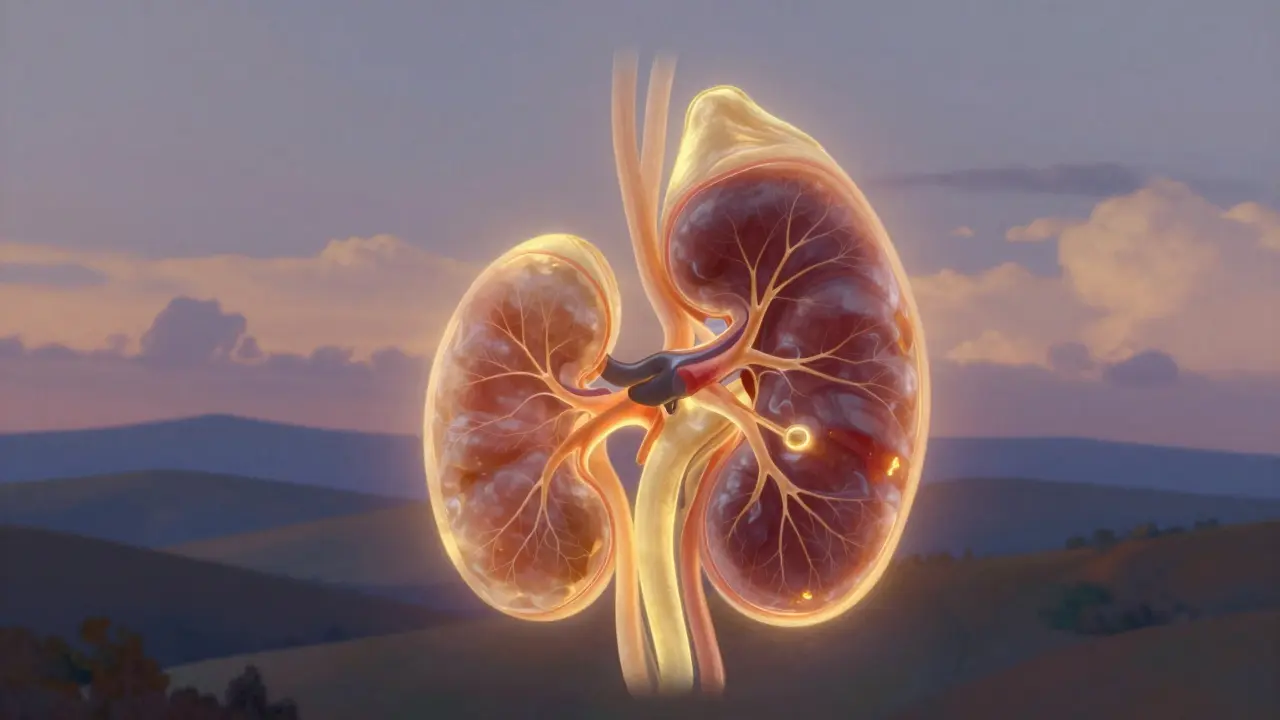
When your doctor suspects a blockage in your urinary tract or wonders if your kidneys are shrinking, they often reach for one tool first: renal ultrasound. It’s quick, safe, and doesn’t zap you with radiation like a CT scan. For patients with flank pain, a history of kidney stones, or high blood pressure, this simple scan can answer critical questions-Is there a blockage? How big are the kidneys? Is the blood flow still normal? The answers help decide whether you need surgery, medication, or just more monitoring.
What Renal Ultrasound Actually Shows
Renal ultrasound uses sound waves, not X-rays, to create real-time images of your kidneys and bladder. It measures three key things: size, shape, and signs of blockage. Normal adult kidneys are about 9 to 13 centimeters long-roughly the size of a fist. If one kidney is significantly smaller, it might mean long-term damage from high blood pressure, chronic infection, or past obstruction. Cortical thickness-the outer layer of kidney tissue-should be over 1 centimeter. Thinning here signals scarring or loss of functional tissue.
The most common sign of obstruction is hydronephrosis. That’s when urine backs up into the kidney because it can’t drain properly. Think of it like a clogged sink: the basin fills up, and pressure builds. On ultrasound, this shows up as dark, fluid-filled spaces inside the kidney called the renal pelvis and calyces. A normal pelvis diameter is under 7 millimeters. Above that, it’s considered dilated-and the higher the number, the worse the backup.
How Obstruction Changes Blood Flow
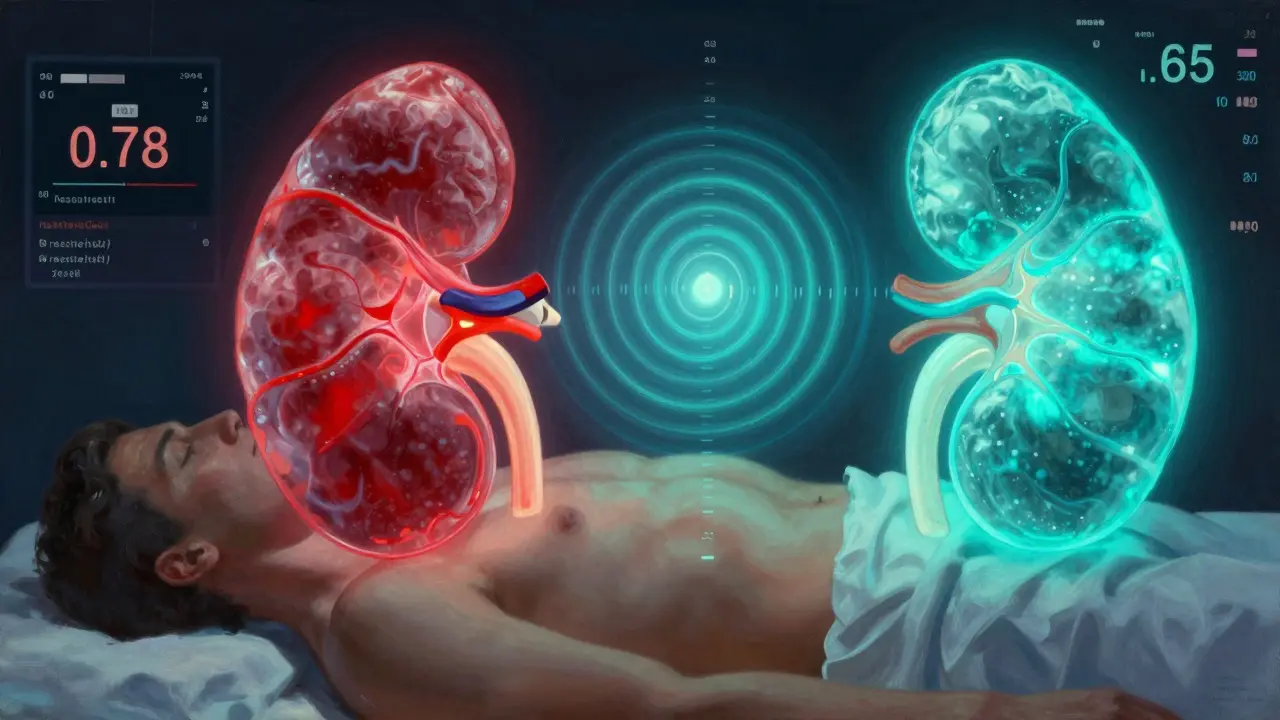
Ultrasound doesn’t just take pictures-it also listens. Using Doppler technology, it measures how fast blood flows through the tiny arteries inside the kidney. One number matters most: the resistive index (RI). It’s calculated from the speed of blood flow during heartbeats. A healthy kidney has an RI below 0.70. Once it climbs above that, it’s a red flag.
A 2015 study in the Nigerian Journal of Clinical Practice found that an RI of 0.70 or higher correctly identified obstructive uropathy in 87% of cases, with 90% accuracy. That’s better than many blood tests. Why? When urine backs up, pressure builds in the kidney. That pressure squeezes the tiny blood vessels, making it harder for blood to flow. The heart has to pump harder, and the waveform changes. The RI captures that change. It’s not perfect-obesity, diabetes, or advanced kidney disease can also raise RI-but in the right context, it’s a powerful clue.
Comparing Ultrasound to Other Imaging
CT scans are often seen as the gold standard. They find tiny stones, show exact anatomy, and even track how fast urine drains. But they expose you to radiation-about 10 millisieverts per scan. That’s like 3 years of natural background radiation. For someone with recurrent kidney stones, repeated CTs add up fast.
MRI and nuclear scans have their uses too. MR urography gives detailed images without radiation, but it costs 3 to 5 times more than ultrasound and still misses small stones. Nuclear scans measure kidney function, but they involve radioactive tracers and don’t show structure well.
Ultrasound wins in three areas: safety, speed, and cost. A typical renal ultrasound costs $200-$500 in the U.S., takes 15-30 minutes, and requires no prep. You can do it in the ER, the clinic, or even at the bedside. Emergency doctors use point-of-care ultrasound to rule out obstruction in minutes, cutting diagnosis time by nearly an hour compared to waiting for formal imaging.
When Ultrasound Falls Short
It’s not magic. Ultrasound struggles in people with high body weight. Sound waves can’t penetrate thick layers of fat well. When BMI exceeds 35, the image quality drops sharply. One nephrologist at Mayo Clinic noted that in obese patients, ultrasound often becomes unreliable-and they’re forced to use CT or MRI instead.
It also can’t tell you exactly how fast urine is draining. A CT scan with a special 3D algorithm can measure drainage rate. Ultrasound can’t. It shows dilation, but not the flow. That’s why some patients still need a follow-up scan or nuclear test if the diagnosis is unclear.
And then there’s the operator. A 2018 study found that inexperienced sonographers could measure kidney length with up to 20% variation compared to experts. That’s a big deal when you’re tracking changes over time. Training matters. The American Institute of Ultrasound in Medicine recommends at least 40 supervised exams before someone can reliably interpret renal scans.
Advanced Techniques on the Horizon
Ultrasound is evolving. New tools like shear-wave elastography measure how stiff the kidney tissue is. When urine backs up, pressure builds-and the tissue gets stiffer. Studies from 2013 show this stiffness increases linearly with obstruction. It’s not mainstream yet, but hospitals are testing it for monitoring patients after surgery.
Even more exciting is super-resolution ultrasound. Researchers are now able to see tiny blood vessels inside the kidney that were invisible before. This could let us spot early signs of scarring or reduced blood flow long before kidney function drops. One 2024 review in Nature Reviews Nephrology even suggests this might one day let us count individual nephrons-the filtering units of the kidney-without a biopsy.
Artificial intelligence is also stepping in. Some systems now automatically detect hydronephrosis and grade its severity. That reduces human error and makes monitoring easier for patients who need weekly checks after kidney surgery.
What the Numbers Mean in Practice
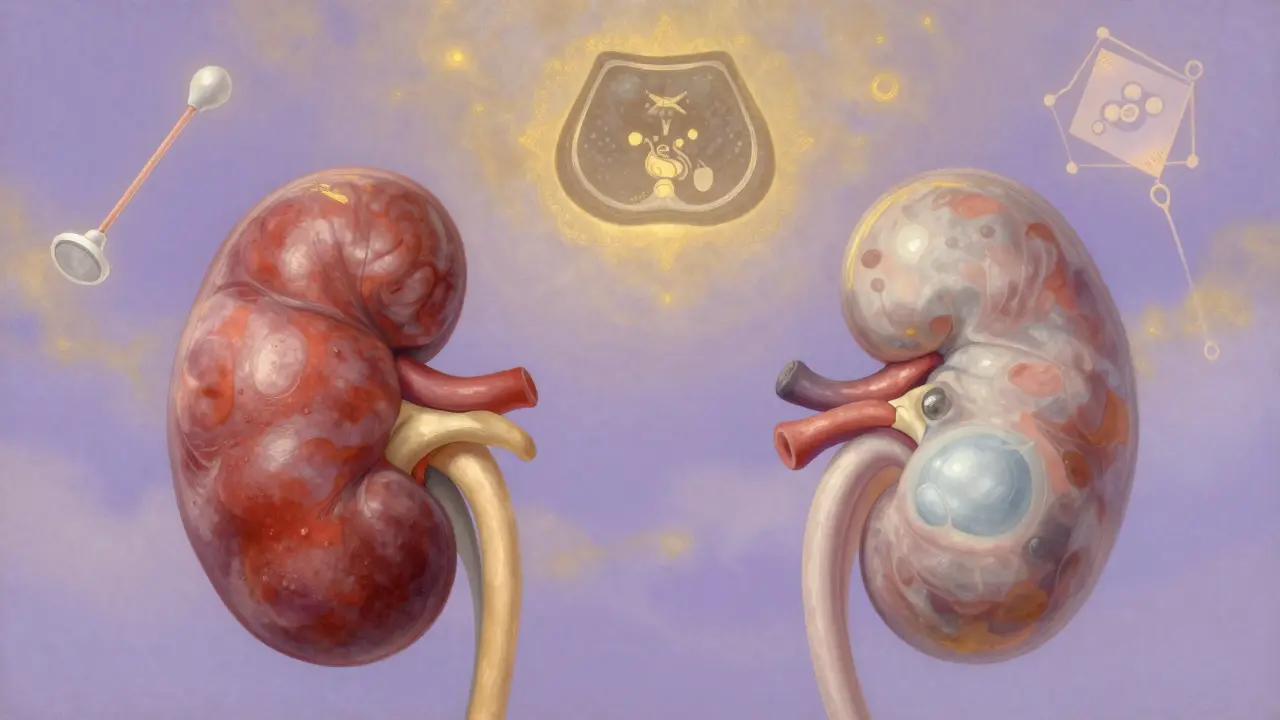
Let’s say a 48-year-old man comes in with sudden left-sided pain. His ultrasound shows:
- Left kidney length: 11 cm (normal)
- Right kidney length: 8 cm (small)
- Left renal pelvis diameter: 15 mm (dilated)
- Left RI: 0.78
- Right RI: 0.65
That’s a classic picture. The right kidney is small-likely chronically damaged. The left kidney is swollen and has high resistance. He probably has a stone stuck in the ureter. The RI confirms it’s not just swelling-it’s pressure affecting blood flow. He’ll likely need a stent or lithotripsy.
Now imagine a 72-year-old woman with chronic kidney disease. Her left kidney is 10 cm, right is 9 cm. Pelvis diameter is 6 mm. RI is 0.72 on both sides. No dilation. But the RI is borderline high. That suggests she’s got subtle, long-term pressure on both kidneys-maybe from an enlarged prostate or bladder issues. She doesn’t need surgery, but she needs regular monitoring.
Why It’s Still the First Step
Despite all the fancy tech out there, renal ultrasound remains the starting point for a reason. It’s safe for pregnant women. It’s ideal for kids. It’s affordable. It’s fast. It doesn’t require contrast dye, which can harm kidneys. And it can be repeated as often as needed-weekly, even daily-without risk.
Over 12 million renal ultrasounds are done in the U.S. every year. Nearly every hospital uses it. The American College of Radiology gives it the highest rating (8-9 out of 9) for initial evaluation of suspected obstruction. That’s higher than CT.
It’s not about replacing other tools. It’s about using the right tool at the right time. Ultrasound tells you if there’s a problem. CT tells you what the problem is. Together, they save lives.
What Patients Should Know
You don’t need to fast or prep for a renal ultrasound. Drink water if you’re thirsty-it helps fill the bladder and gives a clearer view. The scan is painless. A gel is applied to your skin, and a probe is moved over your back and sides. You might feel slight pressure, but no pain.
Results are often available right away. In an emergency, the doctor may tell you the findings before you leave. In a clinic, expect a written report within a few days.
Don’t be surprised if your doctor orders more tests later. Ultrasound is a great first step, but not always the last. If the scan is unclear, or if you have symptoms that don’t match the images, further testing is normal.
Can renal ultrasound detect kidney stones?
Yes, but not always. Ultrasound detects about 80% of kidney stones larger than 3 millimeters. Smaller stones, especially those in the ureter, are harder to see. CT scans are better at finding tiny stones, but ultrasound is still preferred for initial screening because it avoids radiation. If ultrasound doesn’t show a stone but symptoms strongly suggest one, a CT may follow.
Is renal ultrasound safe during pregnancy?
Yes, it’s the safest imaging option for pregnant women. Unlike CT or X-rays, ultrasound uses no ionizing radiation. It’s commonly used to evaluate kidney swelling, infection, or obstruction in pregnant patients-especially since urinary tract issues are common during pregnancy due to pressure from the growing uterus.
Why does my doctor check both kidneys?
Comparing both kidneys helps spot problems. A kidney that’s smaller than the other may have chronic damage. A kidney with more dilation than the other likely has a blockage. Even the blood flow (resistive index) should be similar. Differences between sides are often the first clue to disease.
What does a high resistive index mean?
A resistive index (RI) above 0.70 suggests increased resistance to blood flow inside the kidney, often due to pressure from urine backup. It’s a strong indicator of obstruction, especially if it’s only on one side. But it can also rise in chronic kidney disease, diabetes, or advanced age. So it’s not a standalone diagnosis-it’s one piece of the puzzle.
Can ultrasound show kidney scarring?
Indirectly. Ultrasound can’t show scar tissue directly, but it can show its effects: thinning of the kidney’s outer layer (cortex), reduced size, or abnormal texture. If the cortex is less than 1 cm thick, it usually means long-term damage. Newer techniques like elastography are starting to detect stiffness changes linked to scarring, but standard ultrasound still relies on size and shape clues.
Haley DeWitt
February 18, 2026 AT 18:04Wow, this is such a clear breakdown! I work in radiology and I can’t tell you how many times I’ve seen patients panic because they think ultrasound ‘missed’ something - when really, it did exactly what it’s supposed to do: flag the red flags without frying them with radiation. Seriously, if we could just get the public to trust the tool instead of the shiny CT machine…
Also, love the part about the RI. That number is *everything* in the ER. I’ve had attendings say ‘If RI > 0.7, assume obstruction until proven otherwise.’ And honestly? They’re right.
Adam Short
February 20, 2026 AT 06:28Let’s be real - the US is still the only country that treats ultrasound like it’s some kind of magic wand. In the UK, we use it as a first-line tool too, but we don’t act like it’s the holy grail. We combine it with clinical context. Here? It’s ‘ultrasound first, then panic, then CT.’
Also, 12 million scans a year? That’s not efficiency - that’s overuse. Someone’s getting paid to push this thing. And don’t get me started on ‘point-of-care’ in the ER - half the time, it’s a med student with a tablet trying to find a kidney.
Linda Franchock
February 20, 2026 AT 06:59Okay but can we talk about how wild it is that we’re still using 1970s tech as the gold standard? I mean - ultrasound is basically sonar for human bodies. And yet, it’s the most accurate, safest, cheapest option? 😂
Also, the part about BMI > 35? Yeah. I had a patient last week - 6’1”, 320 lbs - ultrasound looked like a blurry potato. We had to do a CT. And he was SO relieved. He said, ‘I just wanted to know if I was dying, not if my fat was blocking the signal.’
Also, I love that you mentioned the operator skill. My cousin is a sonographer. She did 80 supervised scans before she was allowed to touch a patient. And she still says, ‘If I’m not sure, I say so.’ That’s professionalism.
Geoff Forbes
February 20, 2026 AT 18:19Ultrasound is fine for peasants. Real medicine? CT. MRI. Nuclear. If you’re not using those, you’re not practicing modern medicine. You’re doing triage with a ruler. And don’t even get me started on that ‘resistive index’ - it’s a number pulled out of a guy’s butt who’s never seen a real kidney. I’ve seen RI > 0.7 in healthy 22-year-olds. It’s meaningless.
Also, 200-500 bucks? In the US? That’s a steal. In my town, it’s $1200. And they still say ‘it’s cheap.’
Kancharla Pavan
February 21, 2026 AT 23:22You people are delusional. This whole system is a scam. Ultrasound? A tool of the pharmaceutical-industrial complex to keep you coming back for more scans. Every time they ‘detect’ something, they sell you a follow-up. Every time they say ‘monitor,’ they’re lining their pockets. They don’t care if you’re healthy - they care if you’re a customer.
And that ‘resistive index’? It’s not a medical metric - it’s a profit metric. They make you believe it’s science when it’s just a number they invented to justify billing codes. Wake up. You’re being played. The kidneys don’t lie - but the machines? They’ll tell you whatever gets the insurance to pay.
And don’t get me started on AI. AI is just a fancy word for ‘we replaced the radiologist with a bot trained on corporate data.’ What’s next? AI telling you to drink more water because your kidney ‘looks tired’?
They’re not healing you. They’re monetizing fear.
And yes - I’ve seen it. I’ve seen patients get scanned 5 times in 6 months for the same ‘obstruction’ that never changed. That’s not medicine. That’s a vending machine with a stethoscope.
Real medicine? Fasting. Hydration. Movement. Not 12 million scans a year. That’s not healthcare. That’s capitalism with a stethoscope.
And if you think ultrasound is safe? What about the long-term effects of prolonged exposure to high-frequency waves? No one’s studied that. Why? Because the manufacturers don’t want to know.
Question everything. Trust nothing. The system is rigged.
Dennis Santarinala
February 23, 2026 AT 13:59Just wanted to say - this post was beautifully written. I’m a nurse in a rural ER, and we do 3-5 renal ultrasounds a week. I’ve seen people come in in agony, and within 10 minutes, we know if it’s a stone or just a really bad UTI. It’s life-changing.
Also, the part about pregnancy? I had a 19-year-old come in last month, terrified she’d hurt the baby with a scan. We did the ultrasound, found a tiny stone, and she cried because she was so relieved she didn’t need to take pain meds. That’s why this matters.
And yeah - operator skill matters. My best tech has 17 years of experience. She can tell if a kidney’s about to fail just by the texture of the cortex. That’s art. Not just tech.
Thank you for writing this. It’s rare to see someone explain this without jargon.
John Haberstroh
February 23, 2026 AT 16:20Man, I love how ultrasound is basically the Swiss Army knife of nephrology. No radiation? Check. No prep? Check. Can be done in a parking lot if you’ve got a portable machine? Double check.
But here’s the thing nobody talks about - it’s the *only* imaging tool that lets you watch the kidney *move*. Like, you can see the capsule shift with breathing. You can watch the ureter twitch when a stone tries to pass. That’s not just imaging - that’s live-action biology.
And super-resolution ultrasound? Dude. Imagine being able to see individual nephrons like pixels on a screen. That’s not science fiction - it’s next year’s journal article. We’re entering a time where we can watch kidney disease unfold in real time. No biopsy. No guesswork.
Also, the fact that we’re using AI to grade hydronephrosis? I’ve seen algorithms outperform radiologists on consistency. Not because they’re smarter - but because they don’t get tired after 40 scans in a row.
Ultrasound isn’t outdated. It’s just getting upgraded… quietly.
guy greenfeld
February 24, 2026 AT 17:14Wait… so you’re telling me the government doesn’t *want* us to know that ultrasound can’t detect small stones? That’s why they push it so hard - because if we knew how unreliable it was, we’d demand CTs… and then they’d have to pay for them.
And the ‘resistive index’? That’s a number cooked up by the American College of Radiology to justify their funding. They need a metric that’s vague enough to be ‘scientific’ but specific enough to bill for.
And what about the 20% variation in kidney length? That’s not ‘operator error’ - that’s a conspiracy. Someone’s manipulating the standards so they can keep re-scanning people.
They’re not trying to heal you. They’re trying to keep you in the system.
And why is there no mention of the fact that ultrasound techs are trained to *find* pathology? Not to confirm health. They’re incentivized to say ‘yes, there’s something.’
Wake up. This isn’t medicine. It’s a performance.
Sam Pearlman
February 26, 2026 AT 11:22Bro, I had a kidney stone last year. Got the ultrasound. Said ‘probably a 4mm stone in the ureter.’ Then I went to the ER, got a CT, and they found *three* stones. One was 1mm. Ultrasound missed it. Full stop.
So yeah - ultrasound is fine if you’re okay with being wrong 20% of the time. I’m not. I want to know exactly what’s going on. Not ‘maybe.’ Not ‘probably.’
Also, why is everyone acting like ultrasound is the ‘safe’ option? What about the fact that the probe is pressed into your lower back for 20 minutes? That’s not ‘painless.’ That’s ‘I’m being held down by a stranger with cold jelly.’
And the ‘no prep’ thing? I drank 3 liters of water for 3 hours before my scan. I was so bloated I looked pregnant. That’s not ‘no prep’ - that’s ‘preparation you didn’t know you needed.’
Ultrasound is fine. But don’t sell it as the holy grail. It’s just the first step. And sometimes, the first step is a trap.
Steph Carr
February 28, 2026 AT 02:00As someone who’s had 3 kidney stones, 2 UTIs, and a pregnancy with hydronephrosis - I’ve done more ultrasounds than I care to admit.
Here’s the truth: it’s not perfect. But it’s the *only* thing that doesn’t make you feel like a lab rat. No radioactive juice. No claustrophobic tube. No ‘we’re going to need to do more tests’ after 10 minutes.
And honestly? The fact that it’s operator-dependent? That’s not a flaw - that’s a feature. It means you need a *human* to interpret it. Not a bot. Not a machine. A person who’s seen 500 kidneys and knows when something looks ‘off’ even if the numbers say ‘normal.’
Also, the RI? Yeah, it’s not perfect. But in a 72-year-old with CKD? A 0.72 on both sides? That’s a red flag. And if you’re not listening to that, you’re not listening to your patient.
Ultrasound isn’t magic. But it’s the closest thing we have to a quiet conversation with your own body.
Prateek Nalwaya
March 1, 2026 AT 06:37I’m an Indian nephrologist, and I can tell you - in rural India, ultrasound is the only imaging we have. We don’t have CTs. We don’t have MRI. So we rely on this. And guess what? It works.
I’ve seen 16-year-olds with bilateral hydronephrosis from untreated stones. Ultrasound caught it. We intervened. Kidneys saved.
And yes - the operator matters. We train our techs for 6 months. Not 40 scans. 6 months. Because we can’t afford mistakes.
So when Westerners say ‘it’s unreliable,’ I laugh. It’s not unreliable - it’s under-resourced. And yet, it still saves lives.
Ultrasound isn’t about tech. It’s about access. And that’s why it’s still the first step - everywhere.
PRITAM BIJAPUR
March 1, 2026 AT 20:33Every time I read about renal ultrasound, I think of my grandfather. He was 82, diabetic, with a 10-year history of kidney issues. We did the ultrasound. One kidney was 7.8 cm. Cortex: 0.7 mm. RI: 0.79. No dilation. Just… thinning. Silent atrophy.
No stone. No obstruction. Just time.
That scan didn’t tell us how to fix him. But it told us how to respect him.
We stopped chasing numbers. We stopped ordering tests. We started listening.
Ultrasound doesn’t just show anatomy. It shows mortality. And sometimes, that’s the most important thing of all.
It’s not about what’s broken.
It’s about what’s left.
Haley DeWitt
March 3, 2026 AT 01:24^ This. This right here. This is why we do this.
Jonathan Ruth
March 3, 2026 AT 06:38Ultrasound is fine for basic triage. But if you're a real doctor, you don't stop at ultrasound. You go straight to CT. Period. Anything less is malpractice waiting to happen. And don't give me that 'cost' nonsense - if you can't afford a CT, you shouldn't be practicing medicine. Or paying for it.