

Valerian Medication Interaction Checker
Is your combination dangerous?
This tool checks if valerian root supplements may interact dangerously with your medications. Remember: valerian is not a safe alternative to prescription sedatives.
Combining valerian with sedating medications can be dangerous - even if you think it’s just a natural remedy. Many people take valerian root to help with sleep or anxiety, believing it’s harmless because it’s herbal. But when mixed with prescription sedatives, alcohol, or even over-the-counter sleep aids, it can slow your breathing, make you dangerously drowsy, or even stop your breathing entirely. This isn’t theoretical. It’s a real, documented risk - and it’s happening more often than you’d think.
What Is Valerian, Really?
Valerian (Valeriana officinalis) is a flowering plant whose roots have been used for over 2,000 years to calm nerves and help people sleep. Ancient Greeks and Romans used it. Today, it’s one of the most popular herbal sleep aids in the U.S. and Australia. But unlike pharmaceuticals, valerian supplements aren’t tested for consistency, purity, or strength by the FDA or any major health regulator. One bottle might contain enough valerenic acid to affect your brain chemistry. Another might have almost none. You won’t know which you’re getting unless you pay for a third-party tested product - and even then, results vary.
The active ingredients in valerian - like valerenic acid and valepotriates - work by increasing GABA, a calming neurotransmitter in your brain. That’s the same mechanism used by benzodiazepines like Xanax and sleep pills like Ambien. So if you’re already taking something that boosts GABA, adding valerian is like turning up the volume on a speaker that’s already at maximum. You’re not just adding more sound - you’re risking a blowout.
Which Medications Are Dangerous to Mix With Valerian?
The list of medications that can interact dangerously with valerian is long - and includes things many people don’t even think of as sedatives.
- Alcohol - Even one drink with valerian can make you feel extremely sleepy or dizzy. Driving or operating machinery after this combo is risky.
- Benzodiazepines - Xanax, Klonopin, Ativan, Valium. These are prescribed for anxiety and insomnia. Valerian can double their sedative effect.
- Barbiturates - Older sleep and seizure meds like phenobarbital. Rare today, but still in use. The risk here is severe respiratory depression.
- Opioids - Oxycodone, hydrocodone, codeine. Mixing these with valerian increases the chance of overdose - slowed breathing, unconsciousness, death.
- Antidepressants - Some, like trazodone or mirtazapine, have strong sedative effects. Valerian can push them over the edge.
- Over-the-counter sleep aids - Products like NyQuil, Tylenol PM, or Unisom contain diphenhydramine or doxylamine. These are antihistamines that cause drowsiness. Add valerian? You’re asking for trouble.
WebMD classifies the interaction with alcohol and alprazolam as major - meaning do not take together. For other sedatives, it’s labeled moderate - meaning use extreme caution. But here’s the problem: moderate doesn’t mean safe. It just means the risk isn’t guaranteed. That’s cold comfort if you end up in the ER because you couldn’t wake up.
Why Is This Risk So Hard to Predict?
Valerian isn’t one thing. It’s a messy mix of chemicals. Different brands use different parts of the root. Some use dried powder. Others use alcohol extracts. Some are standardized to contain valerenic acid. Others aren’t. A 2022 NIH report confirmed that even supplements labeled as “standardized” can vary wildly in active ingredient levels. One study found valerenic acid content ranged from 0.01% to 0.8% - a 80-fold difference.
That means two people taking the same “dose” of valerian could have completely different experiences. One might feel mildly relaxed. The other might fall asleep mid-sentence. And if that second person is also on a benzodiazepine? The outcome could be deadly.
There’s also the issue of delayed effects. Valerian doesn’t always kick in right away. You might take it at night, feel fine in the morning, and then take your morning anxiety pill - unaware that the valerian is still in your system. GABA effects can linger for hours. That’s why people often don’t connect the dots until it’s too late.

What About That Study That Said It’s Safe?
You might have heard about a 2005 study from Mexico that found valerian didn’t increase sedation when mixed with common CNS depressants in mice. That study is often cited by supplement sellers to downplay risks. But here’s what they don’t tell you:
- It used Valeriana edulis, not Valeriana officinalis - the species most people take.
- It was done on mice. Human brains process GABA differently.
- It tested pure extracts in controlled doses. Real-world supplements? Unpredictable.
That study doesn’t prove safety. It just shows that under very specific lab conditions, one type of valerian didn’t cause an effect in rodents. It doesn’t override decades of clinical warnings, pharmacological data, and real-world case reports.
Who’s at the Highest Risk?
Not everyone who takes valerian will have a bad reaction. But certain people are far more vulnerable:
- Older adults - Metabolism slows with age. Sedatives stay in the system longer.
- People with liver disease - Their bodies can’t break down drugs or herbs efficiently.
- Patients on multiple sedatives - Even small additions can tip the balance.
- People preparing for surgery or dental work - Many take valerian to calm nerves before procedures. But if they don’t tell their doctor, they could be given anesthesia that pushes them into respiratory arrest.
Dental offices in Sydney and across Australia have reported cases where patients arrived overly sedated after taking valerian before a procedure. Some needed oxygen support. Others had to reschedule. And none of them had told their dentist.
What Should You Do?
If you’re taking any sedating medication - prescription or not - stop using valerian. Period. Don’t assume it’s safe because it’s “natural.” Don’t rely on a supplement label. Don’t wait for a doctor to ask you about it. Most doctors don’t ask. They assume you’re not taking anything herbal.
Here’s what to do instead:
- Stop taking valerian if you’re on any CNS depressant - even if you’ve been doing it for years.
- Talk to your doctor about your sleep or anxiety. There are safer, regulated options.
- Be honest about every supplement, herb, or tea you take. Write them down. Bring the bottle.
- Ask your pharmacist to check for interactions. They’re trained to spot these.
- Consider non-drug solutions - Cognitive behavioral therapy for insomnia (CBT-I) is more effective long-term than any pill or herb.
If you’re trying to quit a sedative, don’t use valerian as a replacement. That’s like replacing a faulty car brake with a rubber band. You might think it’s helping - until you need to stop.
What If You’ve Already Combined Them?
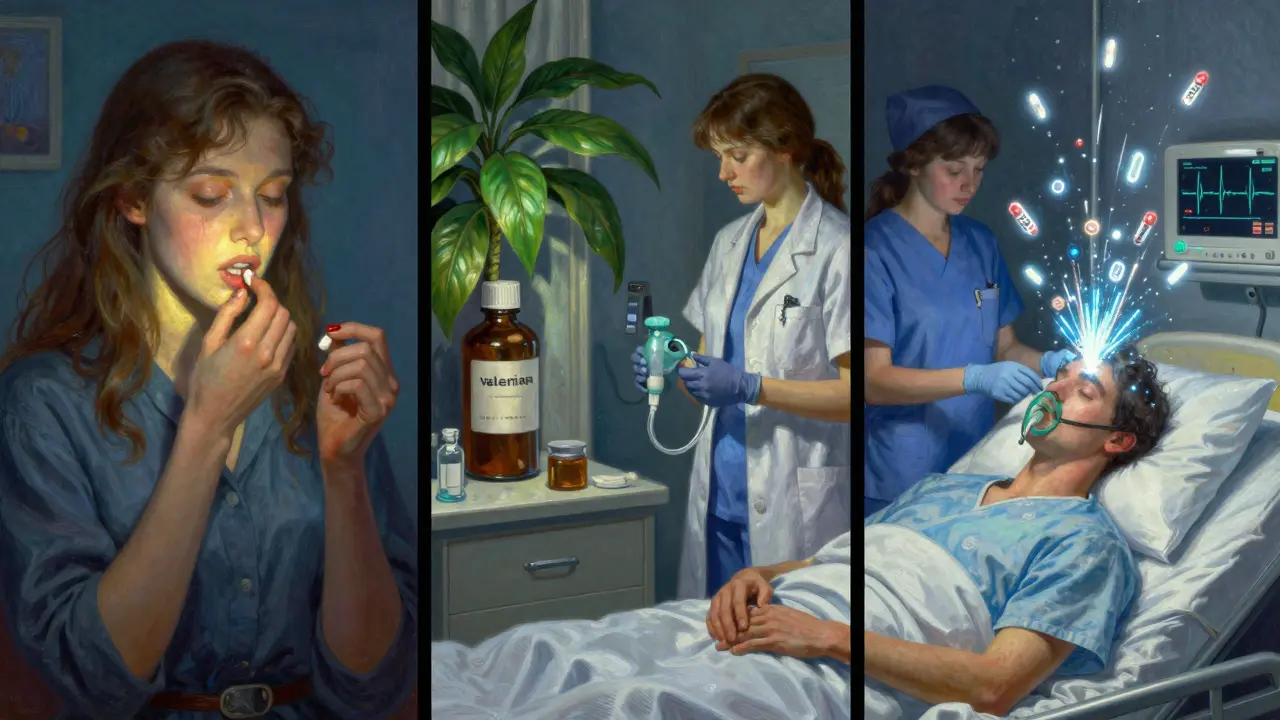
If you’ve taken valerian with a sedative and feel unusually drowsy, confused, slow to respond, or have trouble breathing - get help immediately. Call emergency services. Don’t wait. Don’t try to sleep it off. CNS depression doesn’t always show symptoms right away. It can creep up slowly.
If you’re not having symptoms but are worried, stop both substances and talk to your doctor within 24 hours. They may want to check your liver function or adjust your medication.
Bottom Line
Valerian isn’t the villain. But it’s not harmless, either. When paired with sedating medications, it becomes a silent multiplier - quietly boosting effects you didn’t ask for and can’t control. The science is clear: the risk is real. The warnings are consistent across Mayo Clinic, NIH, WebMD, and the American Academy of Family Physicians. The one study that says it’s safe? It’s not enough to override that.
If you care about your health, don’t gamble with your nervous system. Natural doesn’t mean safe. Herbal doesn’t mean harmless. And when it comes to CNS depression - there’s no second chance.
Can I take valerian with melatonin?
It’s not recommended. Melatonin is a hormone that helps regulate sleep, and while it’s not a classic sedative, it can still cause drowsiness. Combining it with valerian may increase sleepiness and reduce alertness the next day. If you’re using melatonin for sleep, stick with it alone - or talk to your doctor about switching to a proven treatment like CBT-I.
Is valerian safe if I don’t take any medications?
For healthy adults without medications, short-term use of valerian (up to 4-6 weeks) is generally considered low-risk. But even then, side effects like headaches, dizziness, or upset stomach can happen. Long-term safety isn’t well studied. If you’re using it for chronic insomnia, you’re masking an underlying issue - like stress, sleep apnea, or poor sleep hygiene - that needs real attention.
Does valerian show up on drug tests?
No, valerian doesn’t show up on standard drug screens. But that doesn’t mean it’s safe. Employers or doctors aren’t testing for it - they’re testing for illegal drugs or controlled substances. Just because it’s undetectable doesn’t mean it’s harmless, especially if you’re operating machinery, driving, or taking other meds.
What are the signs of too much CNS depression?
Signs include extreme drowsiness, confusion, slurred speech, slow or shallow breathing, difficulty staying awake, dizziness, loss of coordination, or passing out. If you or someone else shows these signs after taking valerian with a sedative, call emergency services immediately. Don’t wait. This can be fatal.
Are there any herbal alternatives to valerian that are safer with medications?
There’s no herbal sleep aid that’s proven safe with sedatives. Chamomile and passionflower are often considered milder, but they also affect GABA and carry similar risks. The safest alternative is not another herb - it’s improving sleep habits: consistent bedtime, no screens before bed, dark and cool room, regular exercise, and avoiding caffeine after noon. If those don’t work, talk to your doctor about FDA-approved, non-addictive options.
Madhav Malhotra
January 11, 2026 AT 16:16Man, I never thought about valerian being this sneaky. I’ve been taking it with my chamomile tea for years thinking it’s all chill vibes. Guess I’m switching to warm milk and deep breathing now. Thanks for the wake-up call!
Jason Shriner
January 11, 2026 AT 23:23so like... nature's chill pill? lol. next you'll tell me oxygen is dangerous if you're on a ventilator. natural =/= safe? wow. mind blown. i'm going to start drinking bleach now for 'balanced' health.
Sam Davies
January 12, 2026 AT 03:20How delightfully quaint that we still believe in the myth of the 'harmless herb.' The Enlightenment was nice while it lasted, but now we're back to the age of folk medicine and placebo-driven hubris. Valerian? Please. It's just GABA with a yoga mat and a hemp bracelet.
Roshan Joy
January 12, 2026 AT 09:03Thanks for breaking this down so clearly! 😊 I’ve been using valerian for stress but never realized how much it could interact with my antidepressant. I’m going to my pharmacist tomorrow with the bottle in hand. You’re right-doctors don’t always ask, but we should always tell. 💪
Matthew Miller
January 13, 2026 AT 10:36Anyone who takes valerian with meds is a walking OSHA violation. This isn't 'natural wellness,' it's Russian roulette with your brainstem. You think you're being holistic? You're just a liability with a reusable water bottle.
Adewumi Gbotemi
January 14, 2026 AT 15:57in my country we use herbs all the time but we also know when to stop. if you sick, go to doctor. if you sleepy, sleep. no need to mix things. simple.
Michael Patterson
January 16, 2026 AT 15:46Okay so I read this whole thing and I’m still not convinced. I mean, sure, the FDA doesn’t regulate it, but neither does the government regulate my grandma’s chicken soup. If it works, it works. Also, I’ve been taking valerian with my zoloft for 3 years and I’m fine. So maybe the risk is overstated? Or maybe I’m just lucky? 🤷♂️
Vincent Clarizio
January 17, 2026 AT 09:23Let’s not pretend this is about safety-it’s about control. The pharmaceutical industry hates that people can walk into a store and buy something that might help them sleep without a prescription. They need you dependent. Valerian isn’t the danger; the system that demonizes natural remedies while selling you addictive benzos is. Wake up.
Christian Basel
January 17, 2026 AT 22:46Given the pharmacokinetic variability of valerenic acid isoforms and the CYP450-mediated hepatic metabolism of concomitant CNS depressants, the additive GABAergic potentiation presents a clinically significant risk profile, particularly in polypharmacy cohorts with compromised metabolic clearance. TL;DR: don’t mix.
Priya Patel
January 19, 2026 AT 12:36OMG I just realized I took valerian last night before my Xanax... 😳 I felt so out of it this morning but thought it was just bad sleep. I’m done. No more herbs with meds. You saved me, thank you!! 💕
Jennifer Littler
January 20, 2026 AT 07:38As a clinical pharmacist, I see this every week. Patients don’t disclose herbs because they think it’s ‘not medicine.’ But it’s pharmacology. Period. I’ve had three ER consults this month alone for GABA synergy overdose. Please, just tell your provider. It’s not judgment-it’s care.
Alfred Schmidt
January 21, 2026 AT 06:22YOU’RE ALL IGNORANT!!! I’VE BEEN TAKING VALERIAN WITH ALCOHOL FOR TEN YEARS AND I’M FINE!!! YOU PEOPLE ARE SCARED OF NATURE!!! WHY DO YOU TRUST BIG PHARMA OVER THE EARTH??? I’M 72 AND I STILL RUN MARATHONS!!!
Sean Feng
January 21, 2026 AT 10:52