

It’s Friday night. You’ve stuck to your plan all week-low-sugar lunches, daily walks, no late-night snacks. But now? The weekend is here. Pizza. Drinks. Dessert. More drinks. And suddenly, Monday morning hits and the scale says you’ve gained half a kilo. Again.
This isn’t just you. It’s happening to millions of people who are otherwise doing everything right. Research shows that weekend weight gain is one of the biggest reasons people stall or even regain weight after losing it. It’s not about one bad weekend. It’s about the pattern-week after week, year after year.
Why Weekends Are the Biggest Threat to Your Progress
It’s not that people eat more on weekends because they’re lazy. It’s because the rules change. Social events, relaxed routines, and the belief that “I can start again Monday” create a perfect storm.
A 2008 study from Washington University tracked 48 adults over a year. What they found was shocking: people consumed 36% of their daily calories from fat on Saturdays-higher than any weekday. And while they lost weight during the week, they stopped losing-sometimes even gained-on weekends. The same pattern showed up in a 2023 study of 368 Australian adults: a consistent 0.3% weekly weight fluctuation, with the lowest weight on Friday and the highest on Sunday.
That might sound small. But over a year, that adds up to an average gain of 0.26% of your body weight. For someone who weighs 80kg, that’s nearly 200 grams a year. Multiply that over five years? You’re talking 1kg of extra fat-just from weekends.
And it’s not just food. People also move less. Fewer steps. More sitting. Less structure. A 2020 study found that even people who exercised more on weekdays still gained weight on weekends because they ate more to “compensate.” Exercise didn’t cancel out the extra calories-it just made them feel entitled to eat more.
Weekend Eating Isn’t the Same as Holiday Binges
You’ve probably heard about Christmas weight gain-0.7kg on average during the holidays. That’s real. But weekend weight gain is sneakier. It’s quieter. It doesn’t come with a party hat. It happens every single week, without fail.
The big difference? Holiday weight gain sticks. Weekend weight gain often gets “undone” during the week. That’s why people think they’re fine. “I lost it by Wednesday,” they say. But here’s the truth: your body doesn’t reset that easily. Fat doesn’t vanish just because you eat less Monday through Thursday. Those weekend calories get stored. And over time, your metabolism adapts to the higher intake.
Think of it like a bank account. You deposit 100 extra calories every Friday night. You withdraw 50 during the week. But you never fully clear the balance. The debt keeps rolling over. Eventually, you’re paying interest on a debt you didn’t even notice was growing.
What Doesn’t Work (And Why)
Many people try to fix weekend weight gain with the same tools they use for weekdays: more exercise, stricter diets, willpower.
Here’s what science says about those approaches:
- Exercise alone doesn’t cut it. The Washington University study showed that people who increased their activity by 20% still gained weight on weekends. Why? Because they ate more. Exercise doesn’t burn enough to offset a big meal. One hour of brisk walking burns about 300 calories. One slice of pepperoni pizza? 350.
- Strict dieting backfires. If you’re starving yourself all week, your brain sees the weekend as a reward. That’s when cravings explode. The result? Bingeing, guilt, and a cycle of restriction and rebellion.
- Waiting until Monday to “start again” is a trap. Your body doesn’t wait for Monday. It starts processing calories the moment you eat them. The longer you delay action, the harder it is to reverse the damage.
The truth? You can’t out-exercise a bad weekend. And you can’t out-willpower a biological drive to eat when food is plentiful and social pressure is high.

What Actually Works: 5 Science-Backed Strategies
Here’s what the research says works-no extreme diets, no punishing workouts. Just smart, sustainable habits.
1. Weigh Yourself Every Morning
Six intervention studies found that people who weighed themselves daily were far more likely to maintain their weight than those who didn’t. Why? Because feedback changes behavior.
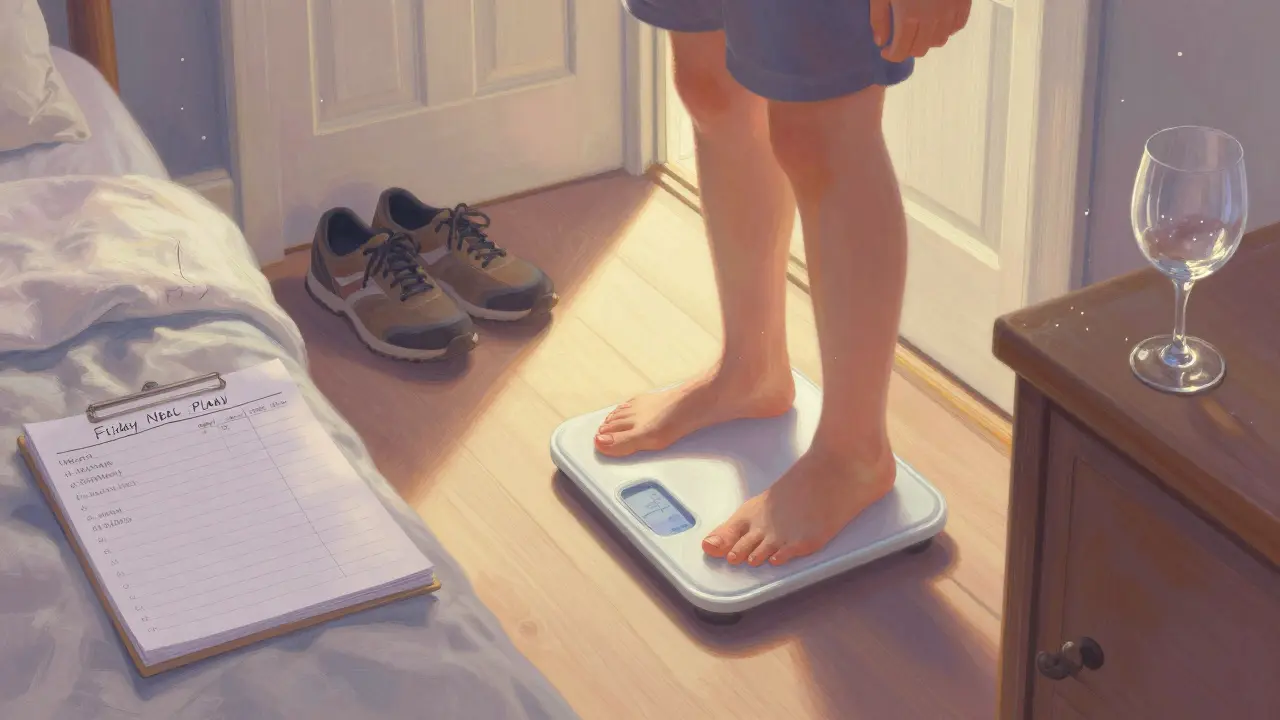
Don’t wait until Monday. Step on the scale Friday night and Saturday morning. If you see a 0.5kg jump by Sunday, you know something shifted. That’s your signal-not to panic, but to adjust. Maybe skip the second drink. Maybe choose grilled chicken over fried. Small tweaks matter.
2. Plan Your Weekend Meals (Yes, Really)
People who plan their meals eat 12-18% fewer calories on weekends, according to a 2020 analysis. It doesn’t mean you need to meal prep pizza. It means knowing what you’ll eat before you’re hungry.
Try this: Every Friday night, write down two meals you’ll have on Saturday. One main dish. One snack. Done. That’s it. No rigid calorie counting. Just intention.
Example: Saturday lunch-grilled salmon with roasted veggies. Saturday snack-apple with almond butter. No guesswork. No impulse buys.
3. Add 2,000 Steps on Weekends
A 2021 trial with 598 young adults found that adding just 2,000 steps per day-about 20 minutes of walking-cut obesity risk by nearly half. That’s not a marathon. That’s a walk after dinner. A stroll through the park. Parking farther away.
On weekends, when you’re out and about, make movement part of the plan. Walk to the café. Take the stairs. Play with your kids or dog. Move before you eat, not after.
4. Cut Added Sugar-Especially in Drinks
Sugar is the silent saboteur. A single can of soda has 39g of sugar. That’s 156 calories. Two drinks? That’s 312 calories-almost a full meal. And alcohol? It’s not just empty calories. It lowers your inhibitions, making you more likely to eat more.
Swap sugary drinks for sparkling water with lemon. Choose wine over beer. Skip the dessert cocktail. These small swaps can save you 500+ calories over a weekend.
5. Get Social Support
People with friends who eat healthy are 35% more likely to make healthy choices themselves. That’s not coincidence. It’s contagion.
Text a friend before your weekend outing: “I’m trying to keep things light this weekend-mind if we grab a salad instead of wings?” You’ll be surprised how often they say yes. And if they don’t? You still set a boundary. You still showed up for yourself.
Why Flexibility Beats Perfection
Some experts say you should treat weekends like weekdays-same rules, no exceptions. Others say you should allow more freedom. Who’s right?
The answer? Both. And neither.
The most successful people don’t aim for perfection. They aim for consistency with flexibility. They know they’ll eat more on weekends. But they also know how to keep it from turning into a full-blown rebound.
Think of it like driving. You don’t stop at every red light. You don’t speed on the highway. You adjust based on conditions. Weekend eating? Same thing.
Allow yourself to enjoy food. But don’t let it derail your progress. One slice of cake? Fine. Two? Maybe hold off on the second one. A beer? Okay. A six-pack? Maybe not.
It’s not about restriction. It’s about awareness. It’s about knowing your triggers and having a plan.
What to Do When You Slip Up
Let’s be real. You’ll have a weekend where you ate too much. You drank too much. You skipped your walk. That’s normal.
Here’s what not to do:
- Don’t skip breakfast Monday to “make up for it.”
- Don’t vow to “start over” on Monday.
- Don’t punish yourself.
Here’s what to do instead:
- Drink water. Hydration helps reset your system.
- Move. Even a 15-minute walk helps.
- Get back to your normal routine. No drama. No guilt.
- Ask yourself: “What triggered this? Was it stress? Boredom? Social pressure?”
One bad weekend doesn’t undo months of work. But one bad weekend every week? That’s a problem.
The Big Picture: It’s a Marathon, Not a Sprint
Weight loss isn’t about hitting a number on the scale. It’s about building a life where you feel good, energized, and in control.
Weekend weight gain isn’t a moral failure. It’s a behavioral pattern. And like any pattern, it can be changed.
Start small. Weigh yourself. Plan one meal. Add 2,000 steps. Cut one sugary drink. Talk to a friend. That’s it.
Don’t wait for Monday. Don’t wait for the new year. Don’t wait for the “perfect” time. The best time to start is now-right after this weekend.
Because the next time you step on the scale, you don’t want to see a surprise. You want to see progress. Consistent. Real. Yours.
Why do I gain weight only on weekends?
Weekend weight gain happens because your eating and activity patterns change. You’re more likely to eat out, drink alcohol, skip exercise, and indulge in high-calorie foods. Studies show people consume up to 36% more calories from fat on Saturdays. Even if you eat healthy during the week, these weekend shifts add up-leading to a consistent 0.3% weekly weight increase.
Can I still enjoy food on weekends without gaining weight?
Yes. The key isn’t restriction-it’s awareness. Plan your meals ahead, choose healthier versions of your favorites, and balance indulgences with movement. One slice of pizza won’t ruin your progress. A whole pizza every weekend will. Focus on consistency, not perfection.
Does exercise cancel out weekend eating?
No. Exercise alone doesn’t offset weekend overeating. A 2008 study found people who exercised more still gained weight on weekends because they ate more to compensate. Burning 300 calories with a 60-minute walk doesn’t cancel out 500 calories from a meal. The real solution is reducing intake, not just increasing activity.
How much weight do people typically gain over weekends?
On average, adults gain about 0.3% of their body weight over the weekend-roughly 0.2-0.4kg for most people. That may seem small, but over a year, it adds up to nearly 0.26% of total body weight. For someone weighing 80kg, that’s around 200 grams per year-enough to reverse weight loss efforts over time.
Should I weigh myself on weekends?
Yes. Daily weighing-Friday night and Saturday morning-helps you catch small changes early. People who weigh themselves regularly are more likely to maintain their weight. It’s not about obsession; it’s about feedback. Seeing a 0.5kg gain is a signal to adjust, not a reason to quit.
Is weekend weight gain worse for people with lower incomes?
Yes. Research shows lower-income individuals experience 23% more weekend calorie creep than higher-income groups. This is often due to limited access to healthy, affordable food options and greater reliance on cheap, high-calorie meals during social gatherings. Solutions need to include practical, low-cost strategies like planning meals with budget-friendly ingredients.
How long does it take to fix weekend weight gain?
You can start seeing results in 2-4 weeks with small, consistent changes. Studies show that adding just 2,000 steps a day and cutting one sugary drink can prevent weight gain over time. Long-term success comes from making these habits automatic-not from drastic changes. Think months, not days.
LIZETH DE PACHECO
January 2, 2026 AT 01:45I used to hate weighing myself on weekends until I started seeing the pattern. One weekend I noticed I gained 0.6kg after just two drinks and pizza night. Didn’t panic-just swapped the next beer for sparkling water and walked after dinner. Lost it by Tuesday. Small shifts, huge difference.
Liam George
January 3, 2026 AT 03:49Let’s be real-this is all a corporate distraction. The real reason you gain weight on weekends? Glyphosate in your produce and fluoridated water sabotaging your mitochondria. Big Pharma doesn’t want you to know that calorie counting is a myth designed to keep you buying keto snacks and fitness trackers. Your body isn’t broken-it’s being manipulated. The scale lies. The system lies. Wake up.
Ann Romine
January 5, 2026 AT 02:48I grew up in a household where Sunday dinner was sacred-fried chicken, collards, sweet tea. I used to feel guilty until I learned that culture isn’t the enemy. Now I honor the tradition but scale it back: one piece of chicken, half the portion, swap tea for unsweetened iced hibiscus. Keeps the joy, loses the creep.
Todd Nickel
January 5, 2026 AT 12:04The concept of ‘calorie creep’ is statistically valid, but the framing is misleading. The issue isn’t weekend indulgence per se-it’s the circadian misalignment between weekday discipline and weekend behavioral entropy. Your metabolic rate dips on weekends due to reduced non-exercise activity thermogenesis (NEAT), and the compensatory eating is a neuroendocrine response to chronic caloric restriction during the week. The solution isn’t just planning meals-it’s stabilizing energy intake across the entire week to avoid the pendulum swing.
Austin Mac-Anabraba
January 5, 2026 AT 16:01You people are pathetic. You think weighing yourself is the answer? You’re not fixing your relationship with food-you’re outsourcing your self-worth to a machine. The real problem is emotional avoidance. You eat on weekends because you’re terrified of being alone with your thoughts. Stop blaming pizza. Start therapy. Or at least stop pretending this is about calories.
Phoebe McKenzie
January 7, 2026 AT 06:40HOW DARE YOU suggest it’s okay to have a drink on Saturday?! This is why America is fat. You’re not ‘being flexible’-you’re enabling addiction. I haven’t had sugar since 2018 and I’ve never felt better. If you can’t control yourself, don’t blame the weekend. Blame your lack of discipline. And stop pretending this is science-it’s just weak people making excuses.
gerard najera
January 8, 2026 AT 06:28Consistency over perfection. That’s it.
Stephen Gikuma
January 8, 2026 AT 11:30They don’t want you to know this, but weekend weight gain is part of the globalist agenda. The WHO pushes ‘moderation’ so you stay dependent on processed foods and gym memberships. Real Americans eat steak, drink beer, and lift weights. If you’re gaining weight, you’re not eating enough protein. And stop using that dumb scale-it’s calibrated for EU standards.
Bobby Collins
January 9, 2026 AT 20:24ok so i tried the scale thing and honestly it was wild. friday night i was 132. saturday night 133. i was like… huh. so i skipped the second margarita and just walked around the mall. by monday i was back to 131.5. weirdly empowering??
Layla Anna
January 11, 2026 AT 16:33i love this so much 💛 i used to feel so guilty about weekend food but now i just plan one thing i really want and savor it. last saturday: one slice of deep dish pizza. no guilt. just joy. then i went for a walk with my dog and called my mom. felt so good. thanks for writing this
Heather Josey
January 12, 2026 AT 04:36This is one of the most thoughtful, evidence-based pieces I’ve read on this topic in years. Thank you for framing it not as a moral failing but as a behavioral pattern. I’ve implemented the 2,000-step rule and the meal planning, and the difference in my energy levels alone has been transformative. It’s not about restriction-it’s about alignment.
Donna Peplinskie
January 13, 2026 AT 02:09Oh my gosh, yes!!! I’ve been doing the 2,000 steps thing since last month and I didn’t even realize how much I was sitting around on weekends-like, just scrolling on the couch. Now I take the dog to the park, walk to the corner store for coffee, even just pace while I’m on the phone. It’s not about burning calories-it’s about staying connected to my body. And it feels so much better than punishing myself with workouts.
Olukayode Oguntulu
January 13, 2026 AT 18:39Let me be the one to say what nobody else will: this entire framework is a neoliberal fantasy. You’re being sold the illusion of control through micro-habits while the structural drivers-food deserts, wage stagnation, the commodification of wellness-are left untouched. Plan your meals? Great. But what if your neighborhood only has a 7-Eleven? Your ‘science-backed strategies’ are luxuries for the privileged. The real issue isn’t your weekend pizza-it’s capitalism.
jaspreet sandhu
January 14, 2026 AT 03:16Everyone here is talking about calories and steps but nobody is talking about insulin resistance. If your body is already insulin resistant from years of low-fat, high-carb eating, then no amount of walking or meal planning will fix it. You need to cut carbs completely. Not just sugar-everything. Bread, rice, fruit, even sweet potatoes. Go keto. That’s the only real solution. All this other stuff is just placebo. You’re wasting your time.
Bryan Anderson
January 14, 2026 AT 15:50Just wanted to say thanks for the part about social support. I texted my buddy last Friday: ‘Hey, I’m trying to keep drinks light this weekend-wanna grab a beer and a salad instead of wings?’ He said yes. We had a great time. Didn’t feel like I was missing out. Sometimes it’s just about asking.